This compared the safety practices between 18001 certified and non-certified companies, respectively.
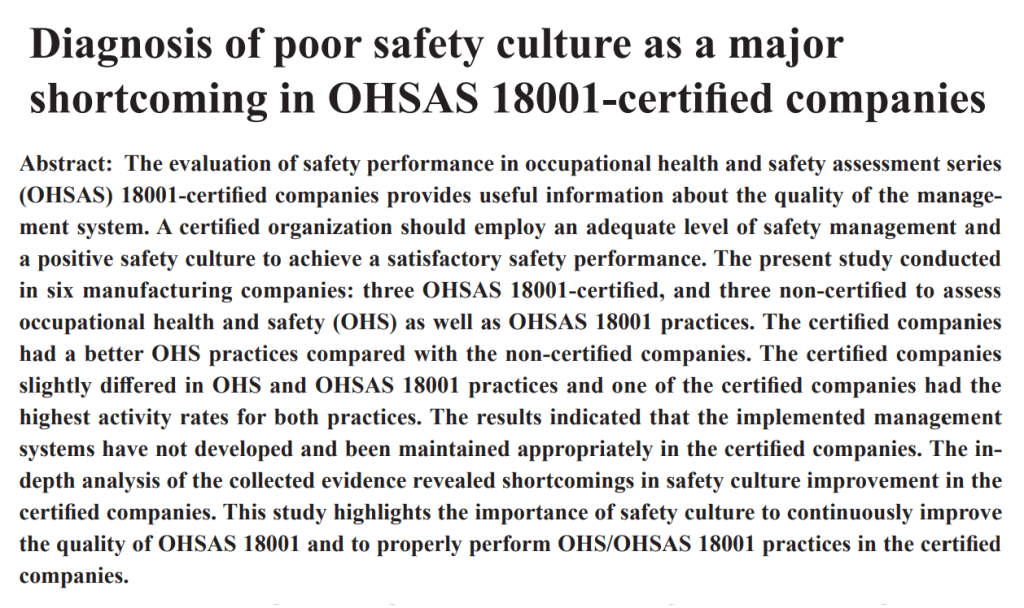
I usually struggle with research focusing on safety culture, given how poorly defined and vacuous it often is. However, if you gloss over the SC stuff then the rest of the findings are pretty interesting.
Six manufacturing companies were included in the study (based in Iran): 3 certified and 3 non-certified. An SMS survey was used in conjunction with a range of interviews with personnel and document reviews.
Results
Expectedly, the certified companies were found to have more robust and extensive OHS practices compared to the non-certified (what the authors called OHS “activity levels”; higher activity = better practices/performance).
What I found interesting, but not surprising, is that while certified companies had far higher activity levels in addressing physical hazards and site conditions than non-certified, non-certified *proportionally* spent more time addressing physical hazards compared to certified companies. Indeed, by far, certified companies directed the most efforts towards document management rather than hazard management.
The authors then focus on certified companies and the gaps in safety practice vs expectations [* although they didn’t mention it – essentially WAI vs WAD].
Noted was that while certified firms did undertake hazard & risk assessments, largely they didn’t identify hazards associated with changes in the company, its activities, design of work areas or processes, machinery or equipment. Notably, gaps existed with physical site conditions & plant like unguarded machinery, exposed penetrations etc.
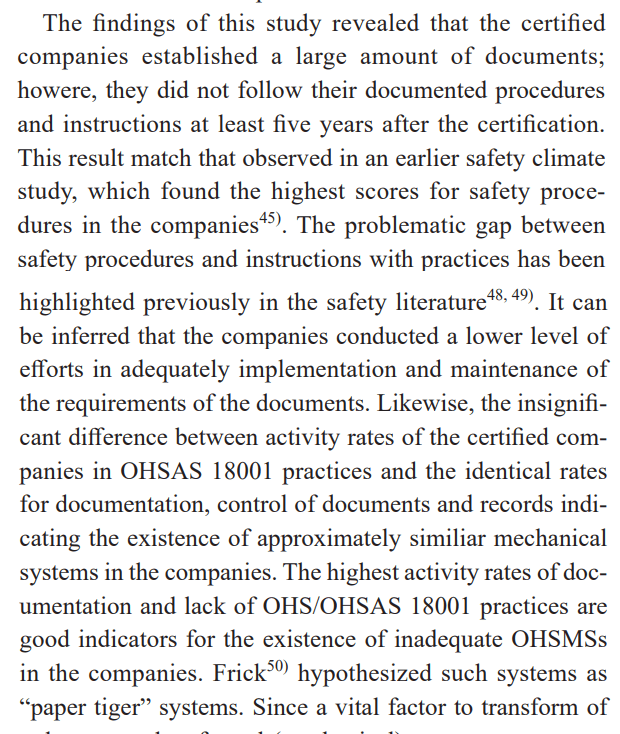
That is, “The companies had documented a large number of procedures and instructions based on the requirements of the OHSAS 18001 standard; however, there were shortcomings in their implementation and maintenance” (p141).
Further gaps were evidenced with certified firms in creating paperwork but not evaluating and monitoring actual work and site conditions, e.g. the actual implementation of the SMS.
Expanding here, the authors found that despite onerous procedures & processes as part of 18001 certification, certified companies in this sample had significant gaps in hazard ID and control, incident reporting & investigation, training and operational control such that certified companies had a large amount of documented procedures that weren’t followed. Authors noted that such an effect results in the management system “degenerat[ing] into a “paper system” (p144).
They further state that “It can be inferred that the companies conducted a lower level of efforts in adequately implementation and maintenance of the requirements of the documents”, in comparison to developing the certified SMS.
[* This supports other research, e.g. Heras-Saizarbitoria, 2019, which found that the implementation of certified systems seemed to be more about perceived legitimacy and symbolism to externally and internally demonstrate commitment to safety rather than appropriately resourcing and managing performance. Click here for a summary of that study.]
Authors suggest that these findings might be the mechanical implementation of certification and SMSs.
Another finding, again expected in my view, was that the lack of knowledge that the interviewed workers had about their certified SMS. Quoting the study, “This finding also suggests that the system is mostly operated by the higher level personnel (i.e., white collar managers) and only slightly by the lower levels of the companies” (p145, emphasis added).
Overall, despite certified companies having significantly higher OHS activity scores compared to non-certified, concluded was that “[certified] companies established a large number of documents that [are] not followed by employees” (p146).
We can further infer from these findings that certified companies also dedicate hefty resources into maintaining administrative elements of the system rather than practical elements.

Authors: Ghahramani, A. (2017). Industrial health, 55(2), 138-148.
Study link: https://www.jstage.jst.go.jp/article/indhealth/55/2/55_2015-0205/_article

 SafetyInsights.org
One thought on “Diagnosis of poor safety culture as a major shortcoming in OHSAS 18001-certified companies”