Part 2/2
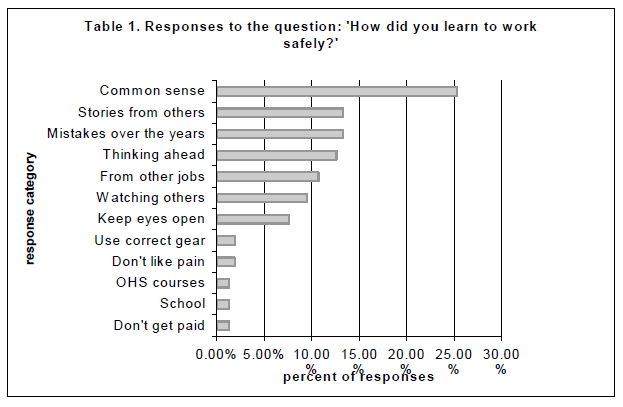
This is the second post relating to the same paper as yesterday. The below image summarises responses from the subbies on how they learned safety in their trade (discussed yesterday). See part 1 here.
Following on from the findings in the first post, the author then went on to deconstruct some of the cultural themes present in the building industry to better understand their meta-narrative and micro concerns. I’ll only highlight some of these factors.
A. Work Method:
Noted is that subbies are specialist trades that perform a limited range of activities; largely physical and repetitive stuff. They rarely use paper save for performing rough sketching and calculations which are dispensed of after work.
In contrast, the regulatory system and modern safety management approach has forced a formalised written system on to them. For instance, safe work method statements are “regarded as an unhelpful burden on their limited resources, as they do not easily allow for constant problem solving in unique situations” (p6).
Safety activities outside of their specific task routines are often seen as an add-on that impinges on their already slim profit margins.
Further, the very nature of building subcontracting, despite the flexibility and cost efficiencies it provides builders also poses a challenge for safety management. The author argues that “At its core are the competitive tendering process and the piecework nature in which subcontractors get paid for how much they produce, which encourages them to take shortcuts” (p6).
[Note: Shortcuts here not just being conscious departures from rules as per conventional safety rhetoric but, from their perspective, necessary financial decisions to pay the bills and feed their families.]
The author highlights some specific implications on the structure of subcontracting on health and safety:
1. Poor communication between trades which “means subcontractors often leave unsuspected hazards for the tradespeople following on from them” (p6).
2. Few structured safety systems for effective consultation – and when people do try to raise issues, they are labelled a whinger.
3. The power imbalance with the builder
It’s argued that subbies are the last in a long chain of circumstances and events of which they have little control of; they don’t feel cared for, so why should they care. The subcontracting structure emphasises making as much money as possible in as little time as possible and moving to the next job.
B. People/construction personnel
Builders are said to be the glue that holds together the fragmented and sometimes chaotic subcontracting process. But builders aren’t always present on site and may lack the soft skills to manage the relationships – they are domain experts at process control but not experts at “communication, consultation, conflict resolution, negotiation, and listening” (p7).
Subbies are said to be seen as an essentially disposable item.
C. Workplace culture and safety culture
Said here is that it’s difficult to separate out safety culture from workplace culture as they are historically integrated. Building construction has said to always have been a “a male dominated masculine culture of toughness, risk taking and ‘can do’ attitude” (p7), where being a good tradie is synonymous with knowing how to use tools safely and effectively. This results in a worldview where if you get hurt then it’s your own fault.
Interestingly, the author further discusses how the trades are structured around ‘doing’ and not paperwork, saying that “It is a practical industry with relatively no history of the written word … it is based on doing and not writing about doing” (p7).
Subbies, being proud craftspeople, are said to often prejudice the delivery of quality work and products over their own health and safety; they pay extra for quality but not for safety (e.g. less hazardous products or tools with more design-related safety).
D. OHS knowledge
It’s said that subbies do want safer workplaces but aren’t happy if they’re the one that have to pay for them from already slim profit margins. Subbies say that “OHS compliance costs them more but they can’t charge more” (p8).
They are also confused around what is actually required under health and safety legislation. It’s noted that confusion is amplified because while the legislation espouses more of a performance-based approach to risk management, regulatory inspectors “often take a prescriptive and random/inconsistent approach that depends on the mood of the inspector” (p8).
The author then goes on to offer 12 recommendations which may help the current state of subcontracting in domestic housing construction. I won’t cover these points.
However, subcontractors believe the most pertinent issues to be resolved are:
· The critically important role that the builder plays in organising the construction process.
· The interdependence of the different trades.
· The accumulative risk of manual handling over a career in the industry.
Author: Wadick, P, 2010, Structural Survey
Study link: https://doi.org/10.1108/02630801011044217
Link to part 1 on LinkedIn: https://www.linkedin.com/pulse/safety-culture-among-subcontractors-domestic-housing-p12-hutchinson
Link to part 2 on LinkedIn: Link to the LinkedIn article: https://www.linkedin.com/pulse/safety-culture-among-subcontractors-domestic-housing-p22-hutchinson

 SafetyInsights.org