This brief discussion paper explores some challenges facing the design and implementation of checklists. Because this paper is open access (you can read the full paper), I’ll only pull out a few points. It has a focus on healthcare but is applicable elsewhere.
First it’s said that checklists have become the “go-to solution for a vast range” of patient safety and quality issues. Some see checklists as quick and obvious solutions to straightforward problems, whereas for others “they illustrate a failure to understand and address the complex challenges” (p545) of modern workplaces.
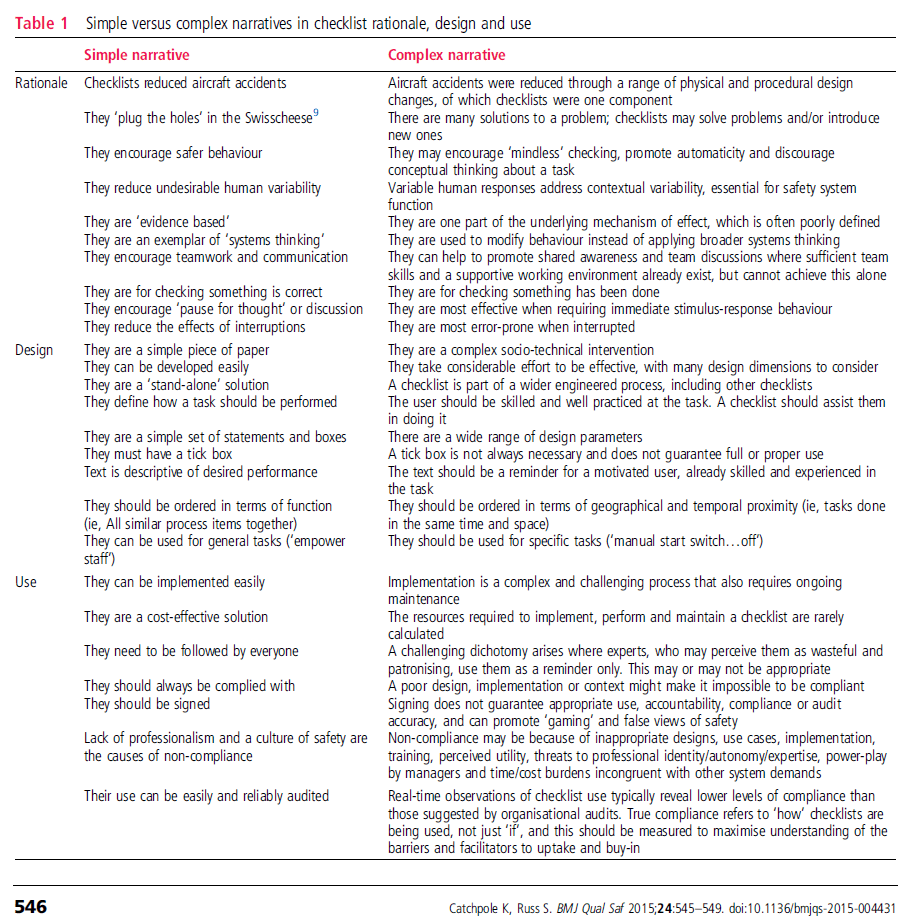
The apparent simplicity of a checklist is said to be tempting for solving intractable and complex problems, whereas this simplicity doesn’t really reflect the problems to be solved, where introducing a checklist is seen to be more “a complex story of gains and losses, procedural interactions and sociocultural balances” (p545). The image below taken from the paper highlights the simple vs complex narrative.
In translating checklists from aviation to healthcare a fundamental underappreciation has occurred, not recognising that aviation was coupled to decades of design and engineering improvements and a sophisticated science around checklist design (e.g. take-off checklist with no more than 3 words per item and no checkboxes to tick compared to a medical blood stream infection checklist with up to 22 words per item).
Another difference in healthcare checklists compared to other industries is more focus on promoting communication and teamwork, but this is seen not to be a strength of checklists and in any case, “authentic checklist completion will rely on good communication and teamwork in the first place” (p546).
Team-related checklists also have other challenges because “there is often no single calm moment where everyone can be involved” and not every user will gain any direct benefit from its completion.
Other issues relate to sociological and cultural challenges (p546), like power distance, hierarchy and perceptions of professionalism. These factors may dominate checklist interactions “regardless of the design and implementation of the checks” (p546).
Furthermore, having a checklist’s success pivoted on teamwork and communication may also be problematic since you can essentially complete check-off all of the boxes but still not actually have undertaken effective team discussion or interaction.
Therefore, it’s said that the “evidence’ for ‘checklists’ can quickly become a semantic or mechanistic misattribution and a correlation/causation fallacy” (p547).
See the free open access paper for more points.
Authors: Ken Catchpole, Stephanie Russ, 2015, BMJ
Study link: http://dx.doi.org/10.1136/bmjqs-2015-004431
Link to the LinkedIn article:
https://www.linkedin.com/pulse/problem-checklists-ben-hutchinson

 SafetyInsights.org