This was a brief conference paper which focused on the “proposition that offshore workers are not sufficiently focused on issues that have the potential to lead to a major incident” and rather, offshore organisations have placed undue focus on issues relating to personal injuries and lost time incidents.
It involved a number of training sessions where the authors surveyed several hundred offshore workers and had them complete a safe job analysis on a scenario that contained elements that could lead to personal injuries but also had the potential to lead to a major accident if the job wasn’t performed as expected.
Before moving onto the results the authors provide a brief overview of the research question “Is there too low a focus on issues that may lead to major accidents?”. They start by explaining that for years, counting lost time incidents and injuries has been, in a sense, marketed “as a type of proof demonstrating how well the company performs on safety issues” (p2). Although reducing personal harm is desirable, understandably it’s insufficient.
Further, as their statistics indicate the issues aren’t necessarily completely separate, being that since 1967 53% of fatalities on the Norwegian continental shelf involved major accidents.
The scenario and results
First and notably, the authors call-out that their methodology was simple and not scientific, but still interesting.
As indicated, they ran training and a scenario with attendees. The example involved the removal of an old fail safe kill/choke line valve on a sub sea BOP and install a new high pressure valve. Attendees developing the safe job analysis identified the normal dangers for personal injuries, including handling a heavy valve hundreds of meters above the floor level, falling tools, pinched body parts and using approved lifting gear.
Interestingly, “Nobody identified issues such as certification of the new valve, torque required to make up the new valve, the correct quality on the ring gasket, correct lubrication of the bolts, quality of bolts etc.” (p3), said to be issues that could lead to a major accident at a later date. The attendees were then asked if they had anything else to add, e.g. factors related to major accidents, yet nothing else was raised.
Of the 250 people that completed the scenario “not a single one identified these significant dangers without being asked again and reminded that we were talking about major accidents” (p3).
As the authors note this is quite telling since, 10 minutes prior, the authors had showed the groups pictures of wells on fire, gas plumes and blow outs and described instances of well kicks etc.
Next, they showed a picture of a well on fire and asked if this could be a result of the kill/choke valve not being properly installed (related to the scenario). This then resulted in a number of different dangers being identified, including seal surfaces being damaged, wrong bolts or torques, pressure testing and more.
The authors conclude that it’s clear to see that initially the attendees only considered factors related to personal injuries and it was only after some level of prompting did people change focus to include major accident factors.
This effect may be pervasive since low consequence or personal injury potential outcomes seem to be the primary focus of day-to-day safety activities on rigs.
In explaining ‘why’ this may be the case that personal injuries and relatively low consequence events capture the most time compared to major accident potential, the authors propose a few reasons. (See the image below for a snapshot from the paper.)
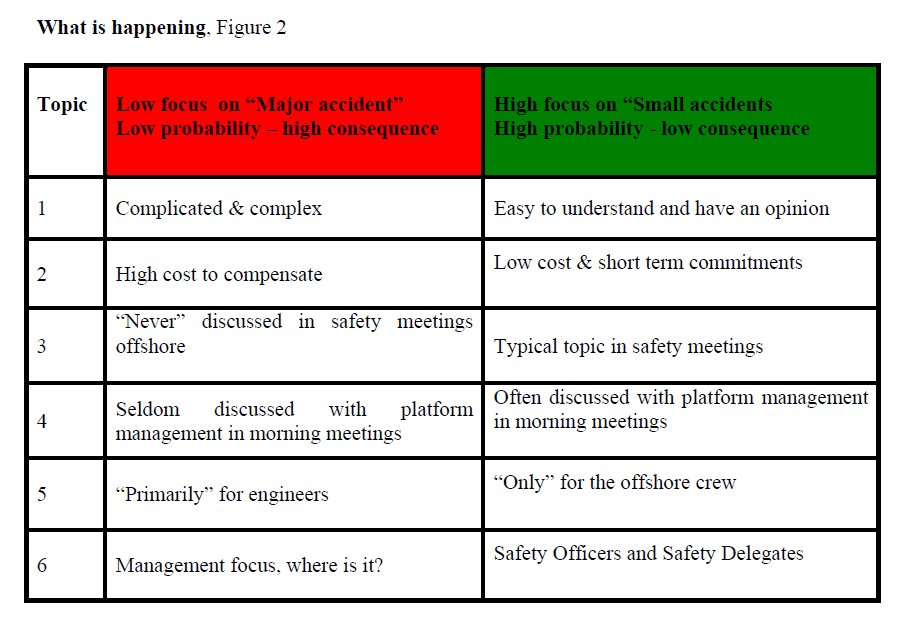
1. Complicated & complex vs easy to understand and have an opinion
Major accidents are said to be typically far more complicated (more likely complex phenomena when considering organisations) and require multiple barrier failures. These failure modes may not be readily understandable or observable. In contrast, it’s easier to have an opinion about low consequence events or personal injuries.
2. High cost to compensate vs low cost & short-term commitments
Controls for major accidents can be very costly, for example adding an extra string casing compared to running safety campaigns and the like. (Note that they don’t say that safety campaigns etc. are effective but are rather easier to understand and run.)
3. “Never” discussed in safety meetings vs typically discussed in meetings
Major accidents or issues with catastrophic potential may be seldom discussed during typical meetings, in contrast to injuries which capture a lot of time.
4. Seldom discussed with platform management in morning meetings vs often discussed
They focus in on morning meetings amongst platform management where smaller and more frequent incidents are commonly discussed but larger incident potentials less so.
5. “Primarily” for engineers vs “only” for the offshore crew
This reflects the potential tendency for major accident issues to be mostly a topic for engineers in ops, planning and work. And although this is said to be what those engineers are “supposed to do and what they are trained to do”, notably the authors highlight that several offshore drilling engineers & supervisors are “disturbed“ in their daily work to plan and supervise a drilling operation. They have been assigned a lot of trivial duties that is not related to the well and the safety of the well” (p5, emphasis added).
6. Focus of management & safety officers/delegates
This point highlighted how management & safety personnel typically focus on small issues that are relatively easy to understand (injuries).
The findings from this paper seem to eerily echo that of Deepwater Horizon and Texas City.
Authors: Gunnar H. Leistad, SPE, and Adam R. Bradley, 2009, SPE Offshore Europe Oil and Gas Conference and Exhibition
Study link: https://doi.org/10.2118/123861-MS
Link to the LinkedIn article: https://www.linkedin.com/pulse/focus-too-low-issues-have-potential-lead-major-ben-hutchinson

 SafetyInsights.org