One of several older but well-known and referenced landmark studies which equated the objectively quantified performance decrement of fatigue against blood alcohol impairment.
40 subjects were included in a counterbalanced methodology, where in one condition the group was kept awake for 28 hours and in the other condition, they were asked to consume 10-15g of alcohol, until their mean blood alcohol concentration reached 0.10%. Cognitive performance was measured using a computer-administered hand-eye coordination test.
Since performance decrements due to alcohol intoxication are well-known and understood by most people, this methodology was used to help equate how sleeploss & fatigue impairs objective cognitive performance
Results
Found was that “moderate levels of fatigue produce higher levels of impairment than the proscribed level of alcohol intoxication” (p235).
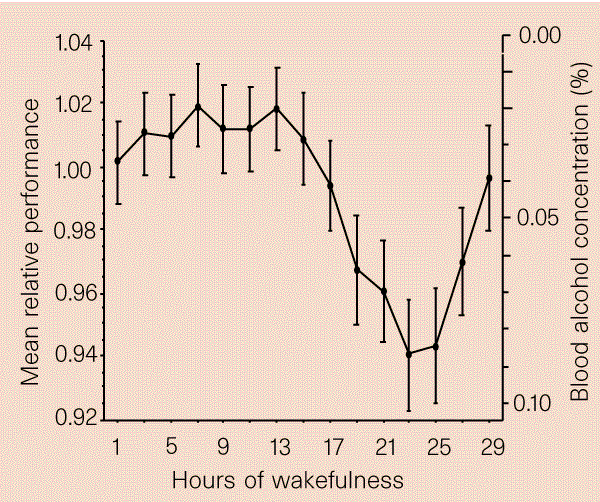
A significant linear correlation was found between the participant’s mean blood alcohol concentration and their mean relative cognitive performance. Each 0.01% increase in blood alcohol corresponded with a cognitive performance decrease by 1.16%.
When equating the two rates of performance decline, it was found that after “17 hours of sustained wakefulness … cognitive psychomotor performance decreased to a level equivalent to the performance impairment observed at a blood alcohol concentration of 0.05%” (p235, emphasised added).
The graph below highlights the relationship. The x axis on the bottom shows the length of sustained wakefulness whereas the right-hand side Y axis shows the equivalent BAC %.
After 24 hours of sustained wakefulness, cognitive performance decreased to a level equivalent to a blood alcohol concentration of ~0.10%.
That is, people who been awake for 17-24 hours have a similar cognitive performance impairment to people with a BAC of between 0.05 – 0.1% BAC in this assessed cognitive task and setting.
[Note: a later study by different authors, eg Paul Maruff et al., suggested that some of these earlier studies overestimated the performance effects at higher BAC. Such that, no degree of sustained wakefulness matched alcohol intoxication of .08 and higher. However, the performance effects at 0.05% BAC were supported. Maybe I’ll post this study at a later point.]
Authors: Dawson, D., Reid, K., 1997, Nature
Study link: https://doi.org/10.1038/40775
Link to the LinkedIn article: https://www.linkedin.com/pulse/fatigue-alcohol-performance-impairment-ben-hutchinson

 SafetyInsights.org