Abstract
In ten years from 2004 to 2013, 359 workers died in the Australian construction industry because of work related causes. This paper investigates crane-related fatalities in order to find the upstream causation of such accidents.
The National Coroners’ Information System (NCIS) database was searched to identify fatal accidents in the construction industry involving the use of a crane. The narrative description of the cases provided in the coroners’ findings and associated documents were content analysed to identify the contributing causal factors within the context of each case.
The findings show that the most frequent crane-related accident types were those that were struck by load, and electrocution. The most prevalent immediate circumstance causes were layout of the site and restricted space. The two most commonly identified shaping factors were physical site constraints and design of construction process. Inadequate risk management system was identified as the main originating influence on the accidents.
This paper demonstrates that a systemic causation model can provide considerable insight into how originating influences, shaping factors, and immediate circumstances combine to produce accidents. This information is extremely useful in informing the development of prevention strategies, particularly in the case of commonly occurring accident types.
****
From the full-text article:
- Regarding fatal incidents involving a crane, struck by load and electrocution were the most frequently involved types. Moreover the “most prevalent immediate causal circumstance was layout of the site and restricted space in the vicinity of the crane” (pg. 11). Site layout/space was common across both of these types of accidents, being involved in 50% of cases where a worker was struck by a load and 100% of cases resulting in electrocution;
- Study findings indicated that upstream “decisions made before construction work commences can contribute to the subsequent occurrence of very serious accidents involving cranes. In particular, the research revealed that design of the permanent structure, selection of construction method and quality of risk management were strongly related to the design of the construction process and site constraints which were, in turn, related to spatial and site layout issues, electrocution and “struck by load” accidents.” (pg. 9);
- The immediate circumstances of site layout or space issues was most commonly preceded by physical site constraints or the design of the construction work processes. Physical site constraints were found to be most commonly related to the quality of the risk management implemented at the project.
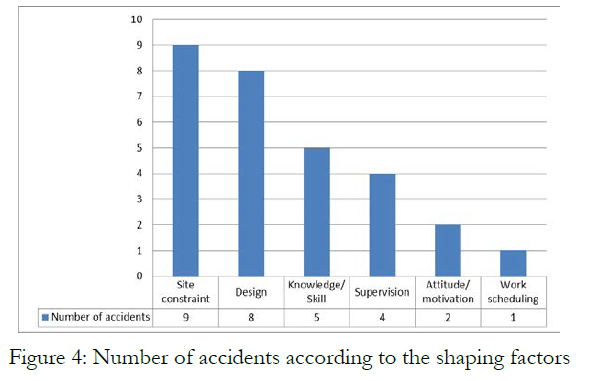
- For shaping factors (see image below), physical site constraints and the design of the process of construction work were the two most commonly identified factors.
- “In the vast majority of accident cases, no single causal factor can be clearly identified and originating influence, shaping factors and immediate circumstances interact in complex ways.” (pg. 10). The point that contributing factors were found at various levels highlights that a full understanding of the sociotechnical system is necessary rather than a focus on the immediate circumstances (e.g. plant, task, personnel).
- It’s said that the findings that many crane incidents can be traced back to decisions made earlier in the project lifecycle is “consistent with the theory developed by Szymberski (1997) positing that the opportunity to influence safety is greatest during the early stages of a construction project and that this opportunity diminishes as the project progresses (pp9-10).
Authors: Gharaie, E., Lingard, H., & Cooke, T. (2015). Construction Economics and Building, 15(2).
Study link: http://dx.doi.org/10.5130/AJCEB.v15i2.4244
Link to the LinkedIn article: https://www.linkedin.com/pulse/causes-fatal-accidents-involving-cranes-australian-ben-hutchinson

 SafetyInsights.org