Another study exploring accident under-reporting, based on survey of 425 workers across five above-average risk of incidents and injury industries.
Some previous research was highlighted, where up to 68% of all workplace accidents and injuries went unreported in the OSHA national reporting system. Other data from the same author found that nearly 78% of experienced accidents went unreported in one study and in another study employees failed to report over half of all experienced accidents to their supervisors. Hence, with several studies the authors note that “the accumulated evidence suggests that under-reporting is a prevalent phenomenon” (p1439).
Some previous research was covered on reporting barriers. Workers who thought managers would be unresponsive or indifferent about safety incidents were less likely to report issues; which leads workers to believe that reporting is useless. Other data found that onerous reporting procedures or unfavourable changes in work due to reporting (e.g. an investigation implements a range of new processes and controls which makes the work harder) are also barriers to reporting.
Results
Similar to previous research, 71% of accidents experienced by workers went unreported. When organisational safety climate is perceived to be positive, few accidents go unreported. But when perceived low, the ratio increases to over 3 unreported to every one reported accident.
Supervisor enforcement (SE) was a significant moderator of reporting. When workers perceive SE, they not only reported more accidents but recalled experiencing fewer of them. The effect of supervisor enforcement was greater than for safety climate, hinting “support for Zohar’s contention that enacted safety policies may carry greater weight than the formal organizational safety climate” (p1441).
When employees perceive their organisational safety climate to be positive then the ratio was observed to drop to 1.46 unreported to every one accident reported. When supervisors enforce and support safety, then workers experienced far fewer accidents but also reported all of the accidents.
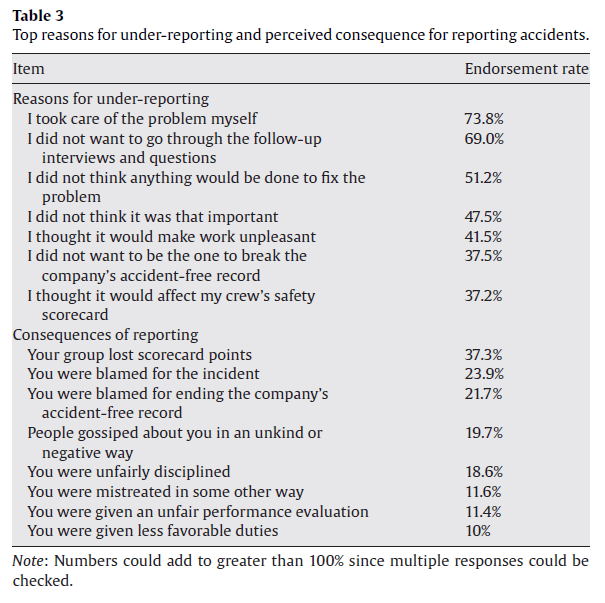
Reasons for not reporting accidents (see below image) included workers fixing the problem themselves or not wanting to go through follow-up interviews/etc & not believing the problem would be fixed.
Workers also noted they didn’t want to break the company’s safety record or affect their crew’s safety scorecard. The authors state that this points to companies that reward safety outcomes rather than the inputs to performance.
64% of workers noted they had experienced at least one negative consequence of reporting an accident within the past year. This included being blamed or gossiped about or adverse job performance outcomes (loss of scorecard points, disciplinary action) or being re-assigned to other tasks.
The authors then discuss some practical implications. One implication for the hidden problem of accident under-reporting relates to the importance of supervisor enforcement and support and safety climate in whether problems receive a noisy fix or quiet fix. For quiet fixes people fix the problems themselves and the organisation does not appropriately learn and improve (these local-level improvements have also been called first-order problem solving) – this is heavily influenced by the abovementioned factors and also psychological safety.
If people do feel safe and empowered to raise concerns and believe management will listen and concerned to fix the problem, then issues are more likely to lead to noisy fixes – which enable the organisation, in theory, to better improve (second order problem solving).
Authors: Tahira M. Probst, Armando X. Estrada, 2010, Accident Analysis and Prevention
Study link: https://doi.org/10.1016/j.aap.2009.06.027
Link to the LinkedIn article: https://www.linkedin.com/pulse/accident-under-reporting-among-employees-testing-ben-hutchinson

 SafetyInsights.org
One thought on “Accident under-reporting among employees: Testing the moderating influence of psychological safety climate and supervisor enforcement of safety practices”