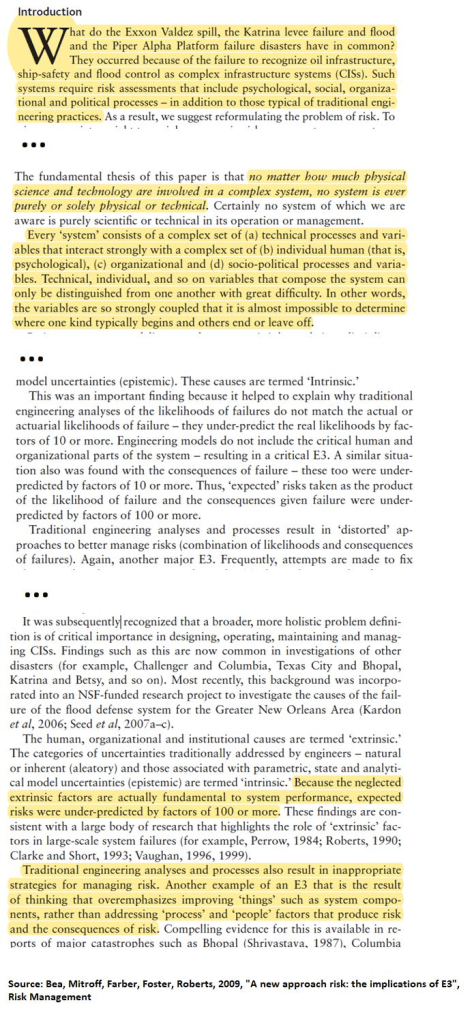
I found these comments pretty interesting from Robert Bea (a professor emeritus in engineering who studied a lot of complex systems and disasters). They argue that traditional risk estimations underestimated the actual consequences of major failures by a factor of 100 or more.
He discusses the area of sociotechnical systems (complex infrastructure systems, CIS, in their terms), as being the interactions of not just technology but individuals, organisations, technology and contextual factors. Nothing new there.
However, what I did find interesting were the risk calculations he offered, as part of previous research that’s been undertaken. Based on the data cited, traditional engineering analyses of likelihoods of major failures under-predicted the actual likelihoods by a factor of 10 or more.
More pointedly is the disparity when traditional risk estimations failed to incorporate the known extrinsic factors that are fundamental to system performance. Here, estimations under-predicted the consequences of failures by a factor of 100+.
I can’t confirm the validity of the estimations, but I found that disparity pretty surprising.
LinkedIn post: https://www.linkedin.com/feed/update/urn:li:activity:6890069115030114304/
Source: Bea, Mitroff, Farber, Foster, Roberts, 2009, “A new approach to risk: the implications of E3”, Risk Management.

 SafetyInsights.org