ABSTRACT
Designers can contribute to enhancing the safety of construction work by considering how their decisions impact on both the physical environment in which construction workers operate and the means and methods they use.
To do so, however, designers require knowledge about safety hazards on site and the opportunity to examine their designs early in projects. Through a set of studies virtual reality tools were used to examine the potential for collaborative dialogue between designers and builders to provide a forum for learning and proactive change of a design to make a project safer to build. In the tests, participants viewed proposed designs using virtual reality to examine various alternative design and construction scenarios.
The study shows that consultation and dialogue with an experienced construction professional are highly beneficial for designers to appreciate the implications of designs on safety, and that designers are more willing to adapt design details than to change aesthetic aspects of their designs.
***************************************
From the full-text paper:
- “The first question posed asked whether a dialogue with construction professionals, conducted while touring a virtual construction site, can improve designers’ awareness of and sensitivity to hazards. The answer is generally positive. Analysis of results obtained from the main set of tests indicated that in 45% of the cases (14 of 31), potential to enhance safety was identified” (p67)
- “The results also show that such consultations can lead to specific design changes that enhance worker safety during construction. Yet designers are more willing to adapt design details than to change aspects that have an impact on the aesthetics of their designs” (pg. 70). Because no control group was used, the authors can’t narrow down the specific effects from the consultation from using the VR, or both.
- “While visualization of rich models provides opportunities to facilitate innovative collaboration between designers and contractors at different moments and through different media, the majority of opportunities for design changes are concentrated in just two specific areas of design: architectural construction details and detailed design of the various building systems. The participating architects were unwilling to contemplate making design changes to facades or aesthetic aspects of building designs.” (pg. 70)
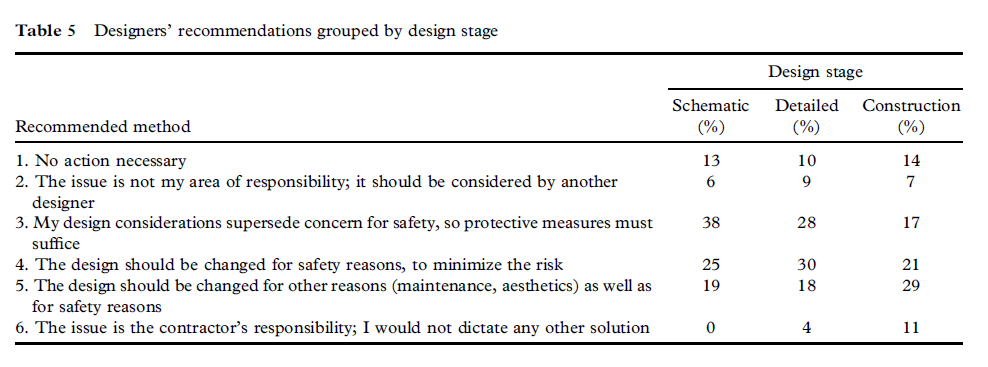
- In many specific situations where changes to aesthetics might have reduced exposure to hazards during construction, designers overall expressed the view that the workers and contractors were themselves responsible for their safety, and that if only they would abide by all the regulations, it would be possible to build any design without accidents. This attitude favours mitigation (by using personal protective equipment, using temporary railings, following standard procedures, etc.) over changing design to eliminate hazards. (pg. 70)
- Designers rejected higher hierarchy of control levels (elimination and/or substitution) far more in the schematic design phase than the detailed design and construction detailing phases, and as noted, this is far stronger for issues relating to the appearance and function of the façade and entrance areas. It’s said these findings may “confirm the assumption … that building designers typically differentiate user safety from construction safety, seeing themselves as responsible for the former absolved of responsibility for the latter” (p69)
- “[D]esigner participants appeared to be insensitive to the aspect of exposure over time of workers to safety hazards. They appear to be familiar with the notion of exposure in space, such as exposure to falling hazards, but they are not sensitive to the notion of exposure in time: none expressed any concept of the length of time during which a worker might be exposed to work at height as a hazard, with or without personal protective equipment, nor to the value that might be obtained by simply reducing the duration over which workers were exposed to hazards. They appear to think of buildings primarily in their final form, as static products, and not as the results of dynamic processes that must themselves be designed.” (pg. 70)
Authors: Sacks, R., Whyte, J., Swissa, D., Raviv, G., Zhou, W. & Shapira, A. (2015). Construction Management and Economics, 33(1), 55-72.
Study link: http://dx.doi.org/10.1080/01446193.2015.1029504
Link to the LinkedIn article: https://www.linkedin.com/pulse/safety-design-dialogues-between-designers-builders-using-hutchinson

 SafetyInsights.org