This meta-analysis evaluated research on the impacts of destructive leadership on organisational, individual, job-related outcomes; highlighting the strength of the correlations. 57 studies (out of 200+ identified) met inclusion requirements.
Way too much to cover, so just a few points.
First, they give a background on destructive leadership. Prevalence of destructive leader behaviours have been identified in 11% of workplaces in one European study, in a third of all surveyed employees in another study, and ~14% in the US.
Second, they differentiate between destructive leader behaviour and destructive leadership. There’s no clear consensus here, but they argue that destructive leader behaviours is a broader concept with more harmful behaviours that aren’t necessarily related to leadership (e.g. drug taking at work), whereas destructive leadership focuses on those aspects which are primarily targeted towards followers.
They define destructive leadership as “a process in which over a longer period of time the activities, experiences and/or relationships of an individual or the members of a group are repeatedly influenced by their supervisor in a way that is perceived as hostile and/or obstructive” (p141). Thus, leaders use destructive leadership practices to achieve certain aims and/or influence the activities and relationships within follower groups.
Finally, destructive leadership is different to negative leadership traits, like laissez-faire, or anti-organisational behaviour.
The table below covers the categories of destructive leadership covered in the analysis.
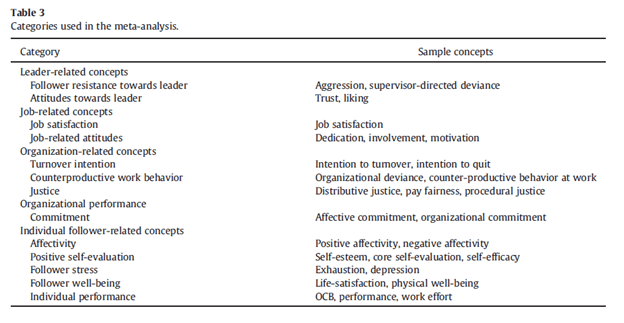
Results
Not surprisingly, destructive leadership is negatively related to positive leader-related concepts and positively related to negative leader-related concepts.
Destructive leadership also had negative associations with positive organisational concepts and positive job-related aspects, and individual facets (as per the table above).
The strongest effect found was towards follower attitudes towards the leader, “indicating that destructive leader behavior is directly related to how followers feel about their leader” (p146). Despite this strong correlation, the relationship between destructive leadership and follower resistance towards the leader, while still having a strong & statistically significant effect, is weaker than some other relationships. This may indicate “that attitudes maybe more strongly affected by destructive leadership than behavior, at least where the leader is directly concerned” (p146).
The second strongest effect was found with counterproductive work behaviour. They suggest that while direct resistance towards the leader via obvious behaviours may be risky regarding punishment and retaliation from the leader (as the above paragraph highlighted that attitudes were more impacted), counterproductive work behaviours may be a more clandestine way for followers to “retaliate upon one’s leader for his destructive leadership” (p147). The use of more clandestine counterproductive work behaviours may be a way to pay back destructive leaders while minimising a further “spiral of abuse” (p149).
Job-related concepts including job satisfaction and organisational concepts like turnover and experience of justice had medium-sized correlations.
Some of the correlations of the higher categories are shown below (the full list of correlations are in the paper). The correlations between constructive leadership and outcomes were generally stronger than the effects of destructive leadership [which is probably worth a separate study/post in itself].
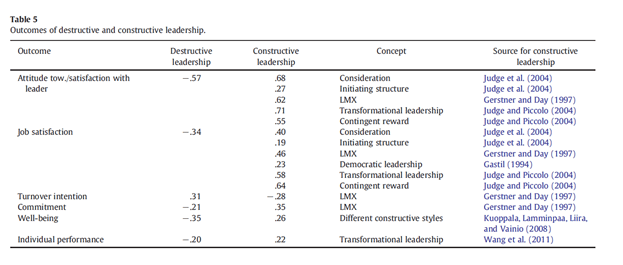
The impacts of destructive leadership spill over outside of work-related facets, worsening perceptions of well-being, negative affectivity and stress. The relationship with stress was weaker than the other two factors, hinting that destructive leadership may more strongly impact a persons’ well-being and negative emotions more than their perceived stress; with stress, people may be able to adopt other coping mechanisms, such as sharing load with co-workers and the like.
They note that destructive leadership also impacted organisational commitment, follower positive self-evaluation & individual performance, which are all influenced by a wide range of factors outside the control of the leader. Nevertheless, “it is still striking that destructive leadership has an effect even on those aspects of their followers’ lives” (p148).
In discussing the findings, it’s said that at least initially, destructive leadership might work for achieving goals and that some research found that goal setting “can contribute to the emergence of destructive leader behaviors”. In that sense, some leaders may be using those techniques to achieve goals.
Followers of destructive followers not just have worsened attitudes to the leader or their work, but also another spillover effect towards the organisation as a whole. It’s argued that peoples’ experience of organisations may in a sense mirror their experience of their destructive leader and also because of a “perception that the organization does not intervene to protect their employees” (p149).
Expectedly, this spiral impacts staff turnover and likely a drop in performance.
The very strong relationship between destructive leadership and counterproductive work behaviours is said to be particularly worrisome. They discuss three reasons for the high correlation.
- The relation effect from followers towards the leader, which provides followers with a safer course of action against them (called ‘displaced deviance’).
- The role modelling influence of leaders may convey the message that this type of behaviour is acceptable within the organisation.
- Potentially indicative of more general organisational cultures which tolerate these types of negative behaviours.
Authors: Schyns, B., & Schilling, J. (2013). The Leadership Quarterly, 24(1), 138–158.
Study link: https://doi.org/10.1016/j.leaqua.2012.09.001
Link to the LinkedIn article: https://www.linkedin.com/pulse/how-bad-effects-leaders-meta-analysis-destructive-its-hutchinson

 SafetyInsights.org