In 1987, a fire ripped through The King’s Cross St Pancras tube station and killing 31 people. The fire started under a wooden escalator, probably ignited by a discarded burning match and fuelled initially by a build-up of grease and fibrous materials.
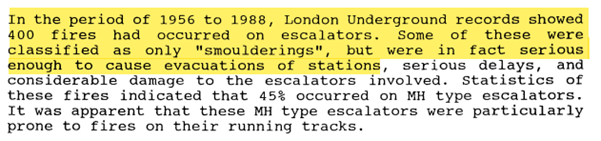
One thing I found interesting is the observation from the investigation (see image below). It noted that a history of fires was evident, yet some of them were classified as “smoulderings” rather than as fire. Saying fire is more alarming than smoulder. (#5 of DisasterCast nicely discusses this accident.)
The NASA Challenger space shuttle disaster provided similar examples. First, the well-known case of how danger of erosion in the o-rings were normalised over time to be seen as acceptable. Also, the definition of the shuttle’s high pressure fuel turbopump blade system was reinterpreted over time. Initially, a turbopump blade with no cracks was considered safe but, over time, the definition of safe was socially negotiated to be defined as a blade that had not **totally fractured** (Feynman talks about this in his book).
Normalisation of deviance has been covered extensively, but I think there’s another interesting message. It’s that incident reporting systems aren’t accurate representations of your organisation. They highlight a limited & biased subset of what gets observed and reported – and even when reported, how things get reported are strongly influenced by a range of sociopolitical, psychological and structural factors.
There’s probably hundreds of examples of negotiated terminology in safety: slip/trip or loss of balance rather than fall from height, bump instead of collide, variations of leak/spill/splash/discharge + lots more.
Further, a range of studies has shown that near misses are readily reinterpreted as “near successes” and can, in fact, lead to greater organisational risk-taking activities rather than sensitising them to failure.
I guess my thoughts are that we invest too much time into incident reporting systems rather than learning about and improving the things we know to be important which are there, every day.
Link to the LinkedIn post: https://www.linkedin.com/feed/update/urn:li:activity:6895132094037680128/
Link to the DisasterCast episode: https://podcasts.apple.com/au/podcast/episode-5-fire/id1261258234?i=1000390053133

 SafetyInsights.org