How rational is an incident investigation process? It’s easy to believe it’s rational: you have an incident, investigate the contributing factors and then implement corrective actions to address those factors.
There’s a concept called “what you look for is what you find”, highlighting that if you go looking for something (e.g. error or violations, cultural issues etc), then you’ll likely find (or construct) those things.
But what we find isn’t necessarily what we fix and the fixes aren’t necessarily connected to the risks or issues.
One of my favourite studies countered the rational view of investigations.
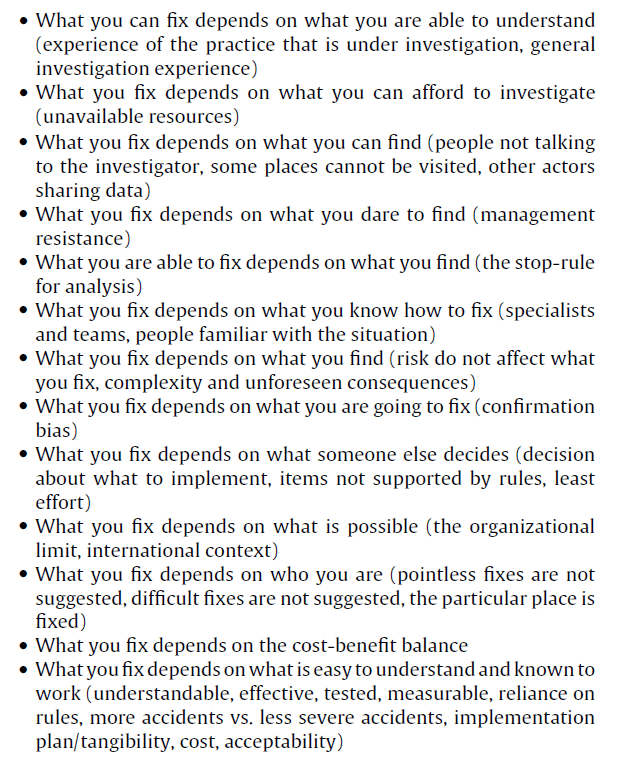
They found that many of the same cognitive & sociopolitical factors (“constraints”) that influence incidents also, expectedly, influence the investigation itself. The attached image highlights these constraints.
For instance:
- Involving experts into investigations for diversity of views is constrained by power, structures & other factors (e.g. if somebody’s competency isn’t considered to be relevant then it may be excluded. As Dekker & Nyce note, “there’s safety in power & power in safety”)
- Focusing on issues that you know how to fix may seem logical – since you have knowledge fixing that issue, but it may also drive a focus towards fixing easy issues at the expense of more difficult issues with higher utility
- Finding issues is subject to scrutiny from management, who may be uncomfortable with the findings and other issues involving clients etc (e.g. what you fix is what you “Dare to find”)
- Risks relating to the issues aren’t necessarily connected to the remedial actions, where in some industries these issues are not systematically addressed despite the investigation findings
- Corrective actions may largely focus on things that were going to be fixed anyway
- No investigator in their study identified poor investigation methods as a constraint
- + more findings.
In concluding, they argue that perhaps it is actually rational, in a pragmatic way, to consider the possibilities & constraints of the situation during investigations and then selecting reasonable fixes based on the constraints.
(Source: Lundberg, Rollenhagen, Hollnagel, 2010, Accident Analysis & Prevention; link in comments)
My summary of this paper: https://safety177496371.wordpress.com/2021/02/16/what-you-find-is-not-always-what-you-fix-how-other-aspects-than-causes-of-accidents-decide-recommendations-for-remedial-actions/
Link to the LinkedIn post: https://www.linkedin.com/posts/benhutchinson2_how-rational-is-an-incident-investigation-activity-6897666715694575616-Iibz?utm_source=share&utm_medium=member_desktop

 SafetyInsights.org