ABSTRACT
The impact of stress on mental health in high-risk occupations may be mitigated by organizational factors such as leadership. Studies have documented the impact of general leadership skills on employee performance and mental health. Other researchers have begun examining specific leadership domains that address relevant organizational outcomes, such as safety climate leadership.
One emerging approach focuses on domain-specific leadership behaviors that may moderate the impact of combat deployment on mental health. In a recent study, US soldiers deployed to Afghanistan rated leaders on behaviors promoting management of combat operational stress. When soldiers rated their leaders high on these behaviors, soldiers also reported better mental health and feeling more comfortable with the idea of seeking mental health treatment. These associations held even after controlling for overall leadership ratings. Operational stress leader behaviors also moderated the relationship between combat exposure and soldier health.
Domain-specific leadership offers an important step in identifying measures to moderate the impact of high-risk occupations on employee health.
*********************************************************************************************************
My comments based on the full-text paper:
This paper may be of interest. Although it is focussed on military applications, it is clear that these findings are relevant more broadly.
It’s argued that while general leadership skills and behaviours are important, a line of research has highlighted the value of domain-specific leadership skills, which target specific organisational outcomes.
They describe a previous study which looked at sleep-specific leadership, e.g. leadership behaviours which promote good sleep patterns, were “associated with greater sleep quantity over and above transformational leadership behaviors” (p5). And further, “This finding is important because it confirms that while general leadership skills are important, focusing on specific leader skills addressing discrete organizational targets can expand the way in which leaders can influence the health [of their team members]” (p3).
The authors then applied these types of findings to leaders focusing on elements of mental health, eg mental health-specific leadership skills, such as leader behaviours promoting stress management among their team. These behaviours were measured via a specific survey (survey + findings in images below).
First, the survey:
- Had a high internal reliability, hinting that the survey questions combine to create a single construct
- The relationship between the health-specific leadership behaviours and general leadership behaviours only had a moderate correlation, suggesting they don’t represent the same construct (but are related)
- When controlled for general leadership behaviour and other covariates, mental health-specific behaviours still explained variance in mental health symptoms of team members
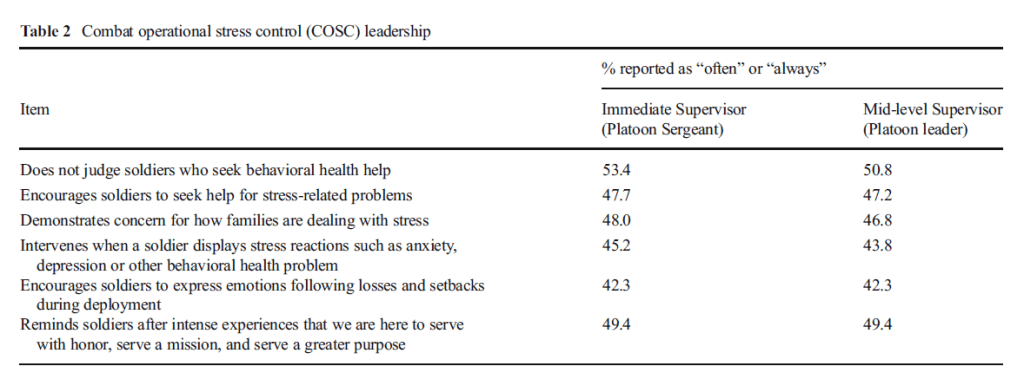
The authors argue that “These findings are important because they suggest that while engaging in good general leadership behaviors is important, other domain specific leader behaviors are also key to supporting subordinate adjustment and well-being” (p4).
Given the role leaders play in shaping particular organisational trends and outcomes, it’s said there is considerable potential “for leaders engaging in behaviors explicitly promoted by the organization and considered part of the leader’s area of responsibility” (p5).
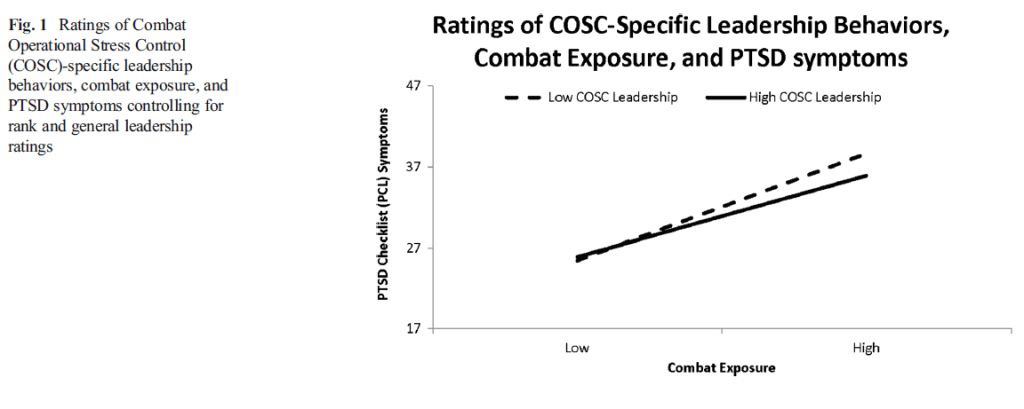
Further, domain-specific leadership “should be a basis for training, and this training should be examined in terms of its impact on health, and other variables of interest to the occupational context such as unit climate and performance” (p5). For instance, health-care seeking behaviours of team members may be positively influenced by domain-specific leadership behaviours.
A range of other domain-specific leadership skills are also being explored, such as for emotional regulation leadership, post-traumatic growth leadership and others.
As an aside, but another study (linked below) looked at the role of general leadership and health-specific leadership and found that both were significantly related to better employee psychological climate for health. General leadership was related to lower employee strain (through lower levels of role ambiguity) and higher job satisfaction. Interestingly, however, health-specific leadership, whilst being associated with higher levels of psychological climate for health, also increased role ambiguity.
Nevertheless, health-specific leadership appears to be an exciting and novel approach to employee health.
Authors: Amy B. Adler, Kristin N. Saboe, James Anderson, Maurice L. Sipos, Jeffrey L. Thomas, 2014, Curr Psychiatry Rep
Study link: https://doi.org/10.1007/s11920-014-0484-6
Secondary study mentioned: https://doi.org/10.1080/02678373.2011.595947
Link to the LinkedIn article: https://www.linkedin.com/feed/update/urn:li:ugcPost:6901297872940216320?updateEntityUrn=urn%3Ali%3Afs_updateV2%3A%28urn%3Ali%3AugcPost%3A6901297872940216320%2CFEED_DETAIL%2CEMPTY%2CDEFAULT%2Cfalse%29

 SafetyInsights.org