Happy to share the first published study in my PhD, with co-authors Drew Rae and Sidney Dekker. (Huge thanks to Drew for his guidance and patience.)
This theoretical paper outlines the key concepts and ideas that were used for studies 2 (which looked at major accident reports) and 3 (which explored internal audit reports); both being finalised for publication.
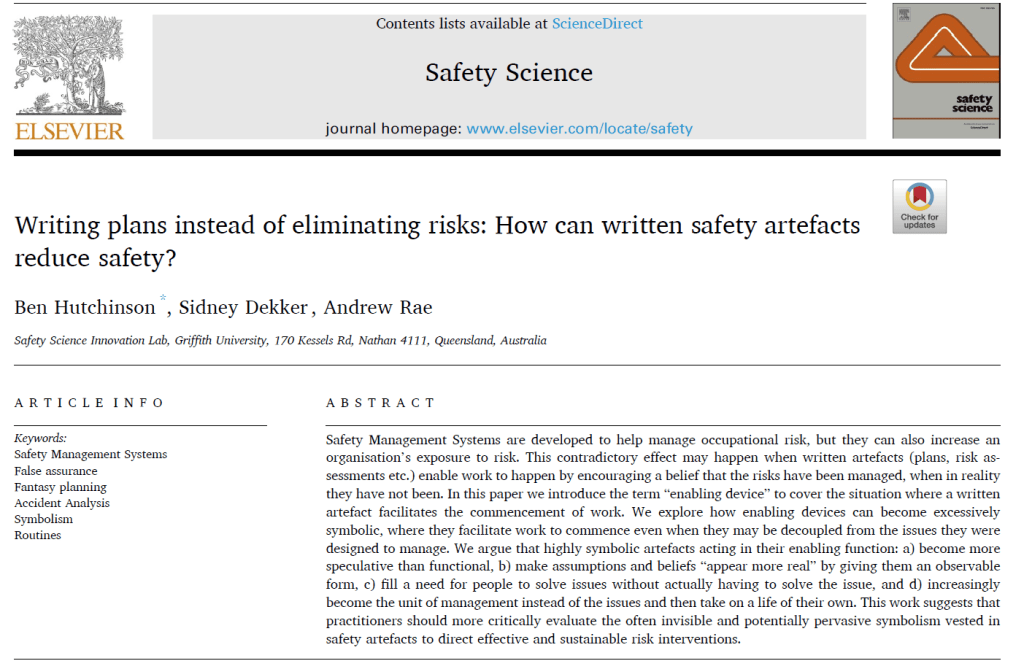
We explore how safety management systems, and in particular safety artefacts (risk assessments, emergency plans, risk registers etc.) can increase our exposure to harm.
An idea we propose is that artefacts act as “enabling devices”. They enable work to progress from design through to execution by allowing groups to pass through organisational barriers (such as contractual requirements to have a site safety plan).
While the artefact may address the organisational barrier (writing an emergency plan addresses the contractual or procedural need for a plan), it may not actually improve the management of emergencies.
That is, artefacts can get ever more detailed (“specifications”; the actual things written into the artefact that describe what to do”), but not necessarily get any closer to addressing the overarching goal of the artefact (“requirements”; what the artefact is supposed to address).
We refer to this disparity between intentions and actual effect as “decoupling”. Higher degrees of decoupling increase exposure to failure since we believe we are safer than we really are and have few reasons to question our exposure.
Pentland & Feldman refer to the folly of creating artefacts when what people intended was to change a routine. Drawing on this idea, we then propose that safety artefacts are often created when what was intended was to solve a tangible issue (i.e. we want to change confined space entry but instead of actually changing the routines of confined space entry we change a written procedure. These aren’t the same thing.)
We conclude that “The symbolic influence of written artefacts should not be underestimated – some plans can be symbolically powerful yet functionally weak. Indeed, the road to hell may be specified with well-intended procedures”.
The paper is free to download for 50 days.
Study link: https://authors.elsevier.com/a/1ekpK3IVV9r1EL
Link to the LinkedIn post: https://www.linkedin.com/posts/benhutchinson2_writing-plans-instead-of-eliminating-risks-activity-6923776846278930432-do2H?utm_source=share&utm_medium=member_desktop

 SafetyInsights.org