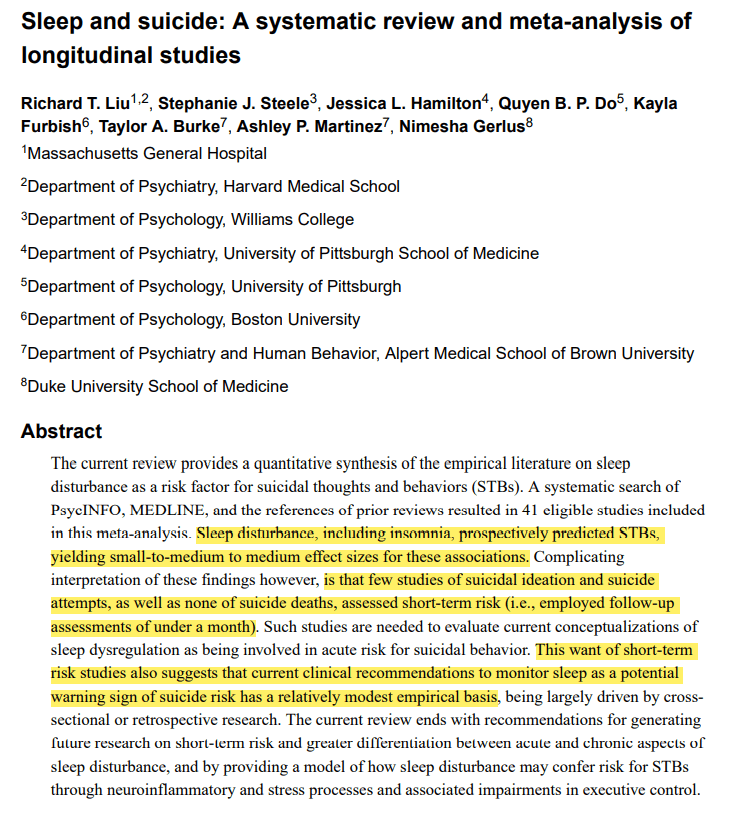
An interesting meta-analysis of the evidence around sleep disturbances and insomnia on the risk of suicidal thoughts and behaviours (STBs). 44 studies met inclusion criteria out of about 1k studies.
They found that “sleep disturbance, including insomnia, appears to be prospectively predictive of STBs, with small-to-medium to medium effect sizes for these associations” (p13). Further, sleep disturbances resulted in generally “significant but not necessarily potent longitudinal predictors of STBs” (p9).
Moreover, they noted the observation that sleep disturbances and insomnia were able to have the predictive power to result in effect sizes of >.39 over such lengthy time periods “time speaks to their value in understanding suicide risk“ (p9).
They discuss the relationship between suicide and sleep disturbances. Although further research is needed, some studies found that the relationship was unidirectional. I.e. “not only does sleep temporally predict STBs, at least in the case of suicidal ideation, but suicidal ideation, in turn, does not predict subsequent sleep behavior” (p12, emphasis added).
That is, based on limited evidence sleep disturbances appear to influence suicide risk rather than the reverse relationship.
For mechanisms ‘how’: it’s not really clear. One mechanism includes acute sleep disruptions resulting in inflammation, which subsequently impairs executive function. There’s probably a host of other social and physiological factors correlated.
Study link: https://doi.org/10.1016/j.cpr.2020.101895
Link to the LinkedIn post: https://www.linkedin.com/feed/update/urn:li:activity:6912173286407770113/?lipi=urn%3Ali%3Apage%3Ad_flagship3_profile_view_base_recent_activity_details_all%3Bi3BNnidyRd6zFibcvaewlA%3D%3D

 SafetyInsights.org