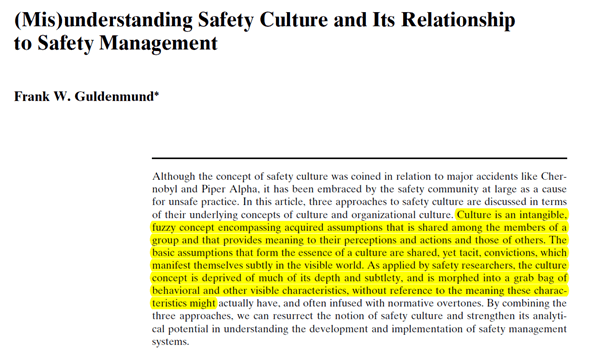
Has the concept of safety culture become a “grab bag of behavioral and other visible characteristics” that has lost much of its depth and subtlety?
This is a fantastic paper by Frank Guldenmund scheduled for a summary in the near future.
Some points I liked:
· Facets of culture and how they relate to performance largely need to be “deciphered”. That is, a process of interpretation is needed to understand the shared underlying assumptions of cultural patterns.
· Cultures are “immensely patterned and therefore related to everything we think, perceive, and do” (p1474).
· Trying to change the underlying beliefs and assumptions that form cultures requires “changes to our belief networks” (p1474). This is problematic since these deep-seated assumptions are so “taken for granted that, within the boundaries of a culture, they are never challenged and, consequently, never have to be verbalized” (p1474).
· Thus, due to the fundamental nature of culture, “a culture can be blinded by itself to itself” (p1474).
The last point ties into views from Diane Vaughan who said that anthropological approaches by “outsiders” to that culture/subculture may really be needed to understand cultures, since people who are part of that culture may be blinded to its nuances.
Some points for considering the assessment of “safety culture” include:
· Culture is a value-free concept, whereas safety is not. Safety culture assessments take on a normative tone – identifying things to improve (evaluation) rather than forming descriptions, which may make this a significant challenge.
· Whereas safety may be about behaviour (individuals and systems), understanding culture “is about the meaning of behavior” (p1475).
· The assessment of culture is not straightforward. Behaviour may become the key focus of cultural change approaches with “some allusions to its meaning and an underlying culture but in the end, the actual meaning of the observed behavior seems to be much less important than the behavior itself” (p1476).
· Also the temporal frames between safety and cultures may come at odds – cultural change may span years whereas many safety issues need to be resolved immediately.
Guldenmund also argues that focusing more directly on the SMS may be a promising venue for continued improvements in safety culture/culture of safety since SMSs can “provide a framework for people to give meaning and direction to their safety actions” (p1478).
I’m not sure if this is contentious or not, but he concludes that “The notion of safety culture development or maturity can gradually be replaced by SMS development” (p1478).
Interestingly, Reiman & Rollenhagen (2014) had this view around what safety culture may have become in some organisations:
“To blame an organisation for having a weak safety culture has become almost the equivalent easy response to system problems as was blaming individuals for human errors a few decades ago” (pp. 8-9).
Study link: https://doi.org/10.1111/j.1539-6924.2010.01452.x
Link to the LinkedIn article: https://www.linkedin.com/posts/benhutchinson2_has-the-concept-of-safety-culture-become-activity-6917949260789424128-vwWL?utm_source=linkedin_share&utm_medium=member_desktop_web
Link to the Reiman & Rollenhagen summary: https://safety177496371.wordpress.com/2022/03/07/does-the-concept-of-safety-culture-help-or-hinder-systems-thinking-in-safety/

 SafetyInsights.org