An interesting diagram from Saurin et al. of how the elements of complex sociotechnical systems (CSTSs) interact with guidelines for managing CSTSs.
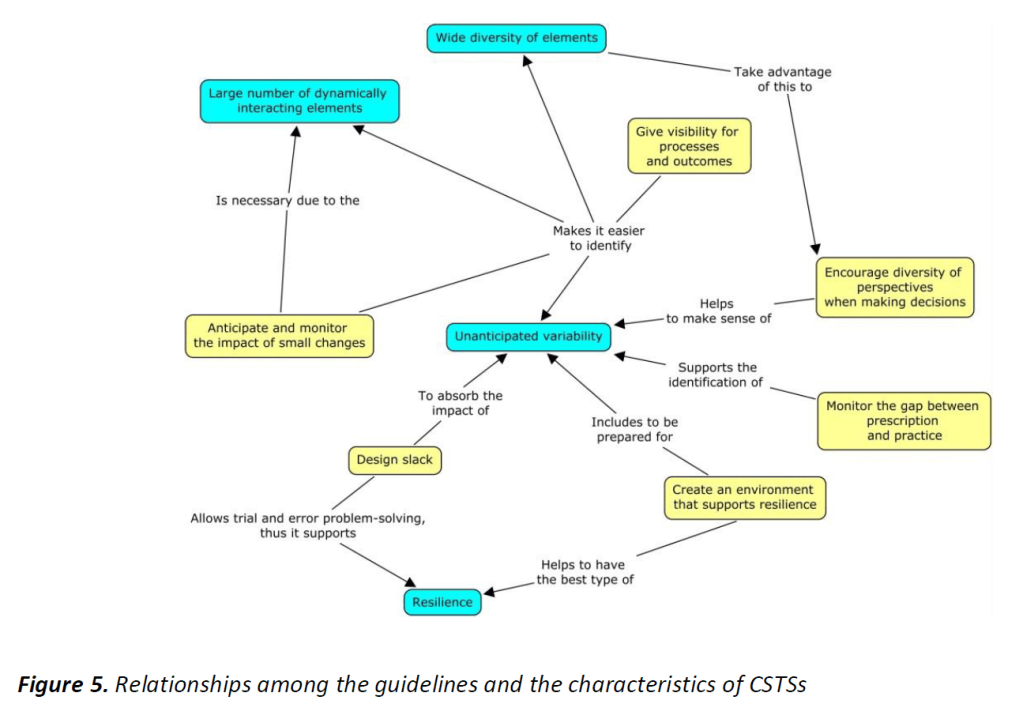
CSTSs are said to have:
- Large number of dynamically interacting elements – the system changes over time.
- Wide diversity of elements – different hierarchical levels, division of tasks, specialisations, inputs/outputs, information and their relationships influence performance
- Unanticipated variability – complex systems are open, meaning they interact with their environment and emergence is a key manifestation where system behaviour results from the interaction of elements rather than the sum of individual elements.
- Resilience – the ability of a system to adjust functioning to suit performance. Performance adjustments means filling in procedural gaps, under-specifications, resource constraints and more. Systems will self-organise, meaning complex systems develop or change structure to adaptively cope with the environment.
It’s remarked that “large number of dynamically interacting elements is an asset for resilience as it tends to provide more alternatives for the adjustment of performance” (p12), where diversity of complimentary skills being an asset for performance. Resilience is discussed in the context of proactive resilience and reactive.
It’s further said that “resilience compensates for unanticipated variability, in order to maintain operations when procedures are no longer sufficient” (p13). Resilience can “contribute to reduce the incidence of unanticipated variability” (p13) and providing that performance adjustments also seek to reduce unnecessary interactions, elements and diversity, like waste, then resilience potentials are likely to also decrease unanticipated variability.
For slack – too much can reduce safety by adding unnecessary complexity and creating new pathways for failure, and detrimental to productivity by creating waste. Too little or no slack is also harmful for safety and productivity.
Interestingly, they note that CSTSs seem to be self-reinforcing, where the intensification of one characteristic intensifies other characteristics. That is, “complexity generates more complexity, and therefore, more resilient performance” (p13).
Importantly, “some complexity and resilience is unnecessary, as it only exists because of waste in the system” (p13).
The second image highlights their recommendations for guiding adaptations in CSTSs.
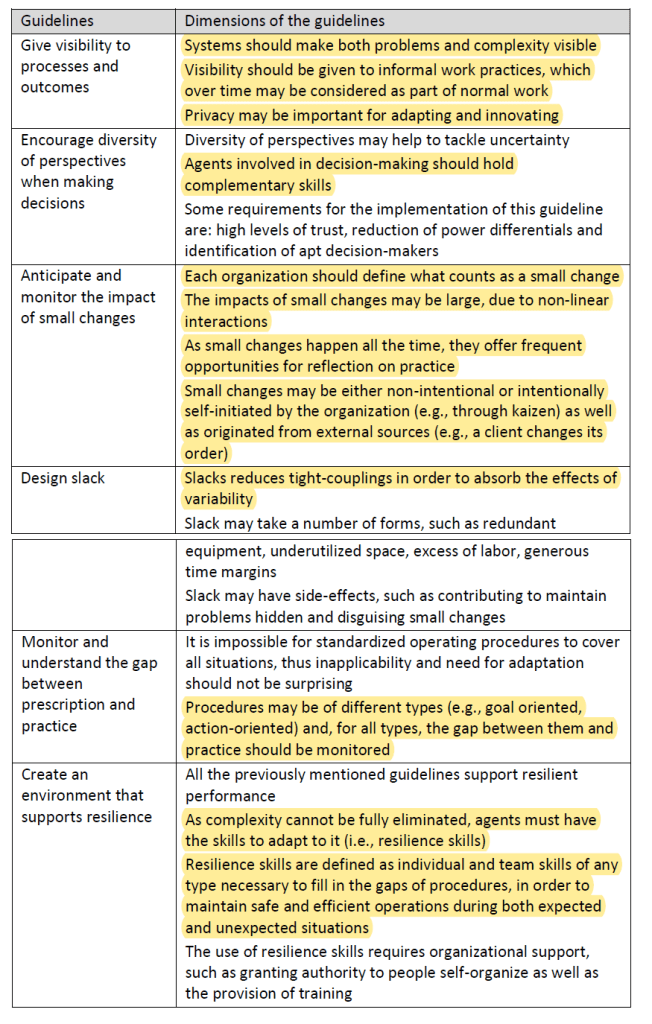
The paper notes some trade-offs that may be created by the guidelines. E.g. visibility of processes may conflict with the need for privacy, anticipation and monitoring may generate info overload, and increasing slack may disguise and absorb problems – increasing the need for more monitoring.
Link to the LinkedIn article:

 SafetyInsights.org