ABSTRACT
Purpose
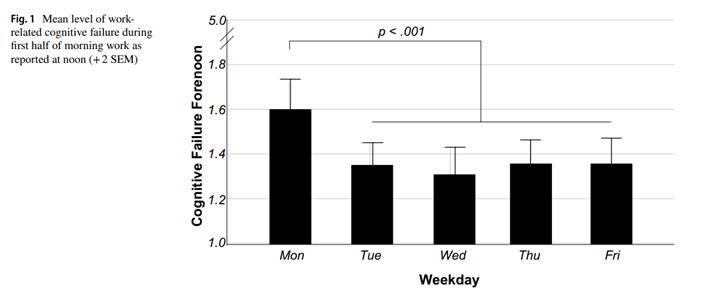
Accidents are more likely to occur during the morning hours of Mondays (Monday effect). This might be due to a higher level of cognitive failure on Monday morning at work.
Methods
In a pilot actigraphy study across one working week, we explored this Monday effect and regressed daily self-reported workplace cognitive failure on weekdays (Monday versus other days), background social stressors at work, delayed sleep onset and sleep duration. Diary data were gathered from 40 full-time employees.
Results
Confirming our assumptions, results revealed work-related cognitive failure and sleep-onset latency on the previous night to be higher on Mondays compared to other workdays. Work-related cognitive failure correlated positively with delayed sleep-onset latency and background social stressors. In multilevel regression analysis, Monday significantly explained variations in workplace cognitive failure. The addition of background social stressors at work and sleep-onset latency to the regression model showed unique contributions to the prediction of workplace cognitive failure. No significant two-way or three-way interactions between working days, sleep-onset latency or sleep duration, and background social stressors were found.
Conclusion
Peak levels of cognitive failure on Monday morning and the association of cognitive failure with social stressors at work contribute to understanding the mechanisms involved in the increased prevalence of occupational accidents on Monday morning. Occupational safety interventions should address both social stressors at work and individual sleep hygiene.
************************************************************
From the full-text paper:
This interesting pilot study evaluated the effects of sleep characteristics (worn actigraphs/sleep monitors) and background social stressors on self-reported workplace cognitive failures.
First they provide some background on the potential links:
- Previous work has indicated Mondays often show peaks in work accident rates, such as via 750k Australian occupational injuries workers compensation claims (which was called the “Monday peak effect”) where accident rates peaked on Monday and decreased through to Friday (Friday being a third of the rate of Monday).
- Similar data from Swiss claims with peaks on Monday versus Friday – with these types of analyses being useful for emergency department surge planning.
- The Monday effect is “characterized, first, by the fact that the increased risk is limited to the morning hours” (p167).
- The effect seems to be stable over many decades of data despite many changes in work tasks, working hours and organisational contexts (which they note was stable in Switzerland for instance between 1977 and 2015).
- The effect “seems to be independent of the overall risk of occupational accidents, which has largely decreased over the last 40 years due to efforts to prevent accidents and technological change” (p168).
- Monday effect doesn’t appear to be specifically limited to only working time – but also related to non-work accidents. Hence, “it is unlikely that higher work demands on Monday morning (e.g. extra procedures to start production after the weekend) cause the Monday effect” (p168).
They hypothesised that the Monday effect would at least partially manifest in altered cognitive performance. Other data has found that there’s a higher risk of cell abnormalities being missed by diagnostic raters on Mondays, as with railway controllers making more mistakes.
Mood on Mondays also seems lower than other workdays (blue Monday). This difference was said to be “rather universal”. Lower mood is also linked with higher fatigue, and levels of fatigue have observed to be highest on Mondays and Tuesdays and decreased over the week.
Blue Monday has also been observed to be linked with work-related stressors, perhaps increasing stress and shifting attention from immediate goals.
For specific findings:
- More frequent workplace cognitive failures corresponded to longer sleep onset delay on the preceding night.
- Delay in sleep onset was greater at night before Monday than on other working weekday nights.
- Mean levels of workplace cognitive failures were highest on Monday compared to other weekdays.
- Longest mean sleep latencies were found on Sunday evening and Thursday evening.
- Sleep onset latency was a significant predictor of self-reported workplace cognitive failures during the next morning.
- Curiously, sleep duration wasn’t significantly linked to workplace cognitive failure [which other work regularly observes].
- Higher background social stressors predict more frequent workplace cognitive failures; however an interaction of social stressors and Monday wasn’t observed.
- On the above lack of interaction finding – Mondays, sleep quantity, and background social stressors were unique contributing factors, and the expected interaction effects were not confirmed.
For some limitations – they note a small sample size, lack of daily social stressor assessment to check whether higher work demands on Mondays accounts for effects, lack of lifestyle assessment over the weekend (e.g. alcohol etc), and also a lack of consideration for decision-making.
Authors: Elfering, A., Gerhardt, C., Pereira, D. et al. Sleep Vigilance 4, 167–176 (2020).
Study link: https://doi.org/10.1007/s41782-020-00105-5
Link to the LinkedIn article: https://www.linkedin.com/feed/update/urn:li:ugcPost:6927382201982468096?updateEntityUrn=urn%3Ali%3Afs_updateV2%3A%28urn%3Ali%3AugcPost%3A6927382201982468096%2CFEED_DETAIL%2CEMPTY%2CDEFAULT%2Cfalse%29

 SafetyInsights.org