This evaluated the effectiveness of workplace interventions in improving workplace safety culture (SC) survey performance; 23 studies were included. They also describe the types of interventions used and their influence on the outcomes.
[Biases on the table: I’m pretty critical of the concept of “safety culture”, but I’ll do my best to stick to the source material.]
They highlight the multitude of definitions for SC and confusion around what SC entails. In this review, safety climate and safety culture were treated similarly (which in my view is problematic) – and curiously included studies on safety climate for outcome measures.
Moreover, the majority of studies used a survey to measure the impact of the safety interventions – and from what I can tell, most included studies used a climate survey; further confounding the interpretation of the findings. [Although as argued by Diane Vaughan, cultures may not really be something you can adequately measure with surveys and may require deep immersion into the cultures by an outsider to observe and describe].
Findings were grouped into categories based on the below:
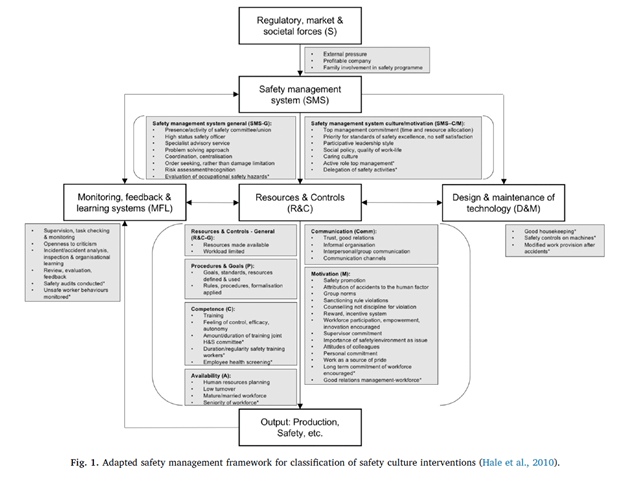
I had a fair challenge summarising this paper. It may be more useful as a reference on the state of evidence rather than as a practical aid to assist practitioners.
Results:
Not surprisingly, the included studies were, overall, methodologically weak.
However, in 16 of the 23 studies there was a statistically significant increase in post-test SC culture scores in the intervention groups.
Further:
- Of the remaining 7 studies, no statistically significant change in SC scores post intervention was found in 3 studies
- 2 studies found minor “partial statistically significant” improvements [Which I think means that some of the SC subscale scores had statistically significant improvements but not other subscales]
- 2 studies found a partial statistically significant decrease in sub SC subscales [as above re: “partial”]
As a breakdown of the relationship between outcomes and study quality, it was found that:
- 3 studies (60%) of the 5 studies which were rated as good methodological quality found statistically significant improvements in SC score performance
- 12 (80%) of the 15 studies rated as “fair” found statistical improvements or partial score improvements
- The remaining 3 rated as “poor” found statistical improvements
The study then covered the types of interventions used. They assessed the effectiveness of the interventions based on the number of studies that found statistically significant improvements in SC score performance. In order of effectiveness: [effectiveness based on the above caveat and not on pooled effect sizes]
- Leadership style [fair quality methodologies]
- Importance of safety [fair]
- External pressure [fair]
- Incident/accident analysis [fair]
- Behavioural monitoring [poor]
Other sub-categories that were found to be often effective were:
- Top management commitment [fair]
- Training [fair]
- Supervisor commitment [fair]
- Workforce participation [fair]
- Safety committee [poor]
It’s noted that of 2 studies using health and safety promotion interventions, only 1 found a statistically significant improvement in SC score. A single study using an ergonomics intervention “had a minor effect on safety culture” (p387).
The study then looked at the effect of interventions on different hierarchical levels. They found:
- 6 of 8 studies looking at the organisational-level found statistically significant improvements [fair]
- 7 of 11 group-level interventions found significant improvements [fair]
- 3 of 4 aimed at the individual-level found significant improvements [fair]
It’s said that based on these findings, the effect of interventions at different hierarchical levels is inconclusive but may be more effective at the organisational and group levels (consistent with cultural and climate theories). Most interventions were aimed at the work group-level, followed by organisational and then individual (which was least targeted).
In discussing the findings, it’s stated ”the majority of the interventions included in our review were found to be effective and resulted in a positive impact on safety culture post-intervention … However, this finding should be tempered considering the majority of the studies included in the review were assessed as having susceptible methodological quality” (p387).
Most interventions were of a motivational nature and safety training was the most often utilised type of intervention.
Based on their definition of effectiveness, interventions aimed at management’s emphasis on the importance of safety, management’s leadership style and the implementation of behavioural monitoring programmes were more frequently employed and returned statistically significant findings.
A whole host of limitations are discussed – including largely weak methodologies and that a meta-analysis couldn’t be undertaken due to the spread of methodologies, outcome measures and statistical measures.
Also, positive outcomes were more prevalent in the studies with weaker methodologies, suggesting statistical power was a concern. Moreover, study follow-up duration was wide (varying between 1 to 42 months post-intervention), with 6 studies < 6 months.
The authors conclude with “From a theoretical perspective, the findings of this study confirm that the conceptual foundations of safety culture remain unclear, partly due to the focus of safety culture intervention studies on multi-faceted interventions that target distinct and varying aspects of behavioural change (e.g. attitudes, norms, perceptions). This makes it challenging to isolate the element(s) of safety culture that have the strongest and most direct relationship to behavioural change” (p389).
Authors: Mohammed Aburumman, Sharon Newnam, Brian Fildes, 2019, Safety Science
Study link: https://doi.org/10.1016/j.ssci.2019.02.027
Link to the LinkedIn article: https://www.linkedin.com/feed/update/urn:li:ugcPost:6929551048495828992?updateEntityUrn=urn%3Ali%3Afs_updateV2%3A%28urn%3Ali%3AugcPost%3A6929551048495828992%2CFEED_DETAIL%2CEMPTY%2CDEFAULT%2Cfalse%29
Other summaries of safety culture research:
https://www.linkedin.com/pulse/safety-culture-reasons-risk-taking-large-company-ben-hutchinson
https://www.linkedin.com/pulse/safety-culture-misbehaving-time-change-ben-hutchinson
https://www.linkedin.com/pulse/safety-culture-moral-disengagement-accident-ben-hutchinson
https://www.linkedin.com/pulse/safety-culture-assessment-mission-impossible-ben-hutchinson
https://www.linkedin.com/pulse/can-we-examine-safety-culture-accident-investigations-ben-hutchinson
https://www.linkedin.com/pulse/safety-culture-assessment-mission-impossible-ben-hutchinson
https://www.linkedin.com/pulse/safety-culture-among-subcontractors-domestic-housing-p12-hutchinson

 SafetyInsights.org
One thought on “Evaluating the effectiveness of workplace interventions in improving safety culture: A systematic review”