ABSTRACT
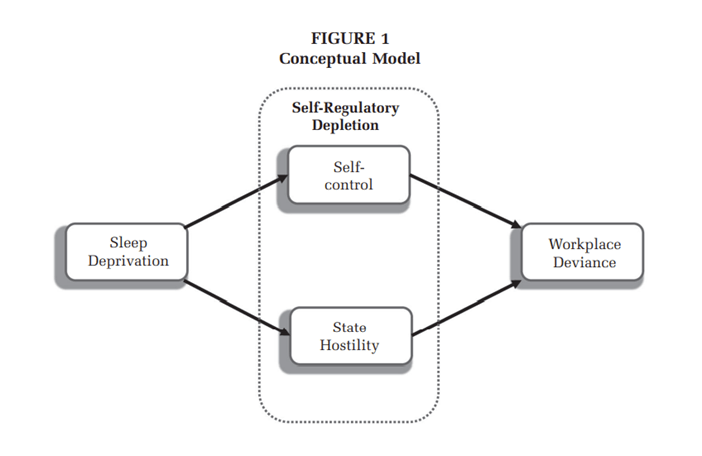
The causes of workplace deviance are of increasing interest to organizations. We integrate psychological and neurocognitive perspectives to examine the effects of sleep deprivation on workplace deviance. Utilizing self-regulatory resource theories, we argue that sleep deprivation decreases individuals’ self-control while increasing hostility, resulting in increased workplace deviance. We test our hypotheses using two samples: one comprised of nurses from a large medical center and another comprised of undergraduate students participating in a lab study. Results from both samples largely converge in supporting our hypotheses
******************************
From the full-text study:
This looked at the role of sleep deprivation on workplace deviance, like hostility and antisocial behaviour in a sample of nurses (study 1) and a lab study with students (study 2).
Workplace deviance is defined as: “voluntary behavior that violates significant organizational norms, and in so doing, threatens the well-being of the organization and/or its members” (p913). This includes theft, violence, vandalism, drug use, interpersonal rudeness, withholding of effort, leaving early or arriving late to work.
Deviance can be organisational or interpersonal focused. This paper reasoned that sleep deprivation may be related to workplace deviance as a factor of self-regulatory mechanisms.
They note that sleep deprivation may not reliably impact logical reasoning or rule-based cognition, it may effect divergent thinking, innovative thinking, risk analysis and strategic planning. Sleep deprivation, among other impacts, can affect functioning in the prefrontal cortex, which involve executive or supervisory control of emotions and inhibiting behaviours.
Sleep deprivation may result in heightened impulsivity, interpersonally inappropriate behaviour and less adherence to social norms. Moreover, impairment of the prefrontal cortex is related to increased antisocial behaviour, deceit, aggression and violence.
Results
- Sleep deprivation was statistically related to heightened workplace deviance
- Sleep deprivation significantly affected self-control and hostility
- From the lab study with students: sleep deprivation was related to both theft, interpersonal deviance, and during scenario activities – sleep deprived students took more money than the control and were more interpersonally deviant
- Further, the sleep deprived students spent less time on maths problems and had higher levels of hostility compared to controls
The authors state that the findings “largely converged to show that the effects of sleep deprivation can lead to decreased self-control and increased hostility, which increase the likelihood that individuals will engage in work-place deviance” (p925).
They note that these findings have implications for most workplaces but in particular:
- Workplaces that require higher emotional control, e.g. call centres, retail etc. where workers face customers and may be subjected to higher customer hostility
- Safety-critical industries and particularly those involving shiftwork and sleep disruption, e.g. mining, oil & gas, construction. Sleep may impair motor coordination, alertness, attention and other mechanisms of self-regulation, which may result in workers being “less able to restrain impulses to engage in dangerous behaviors that lead to accidents, injuries, and even death” (p926).
Authors: Christian, M. S., & Ellis, A. P. (2011). Academy of Management Journal, 54(5), 913-934.
Study link: https://doi.org/10.5465/amj.2010.0179
Link to the LinkedIn article: https://www.linkedin.com/feed/update/urn:li:ugcPost:6929919003540738048?updateEntityUrn=urn%3Ali%3Afs_updateV2%3A%28urn%3Ali%3AugcPost%3A6929919003540738048%2CFEED_DETAIL%2CEMPTY%2CDEFAULT%2Cfalse%29

 SafetyInsights.org
One thought on “Examining the effects of sleep deprivation on workplace deviance: A self-regulatory perspective”