This paper covered a resilience engineering-based framework for assessing Safety Performance Measurement Systems (SPMS).
They used the TOE (Technical, Organisational, Environment) framework, four RE resilience abilities (monitor, anticipate, respond, learn) and the Resilience Assessment Grid as applied to construction projects via observations, document analysis and interviews.
SPMSs are sub-systems of safety management systems and detail the performance monitoring component via indicators and the like.
SPMSs are said to be “underpinned, implicitly or explicitly, by a model of what safety is and how it is created and maintained” (p1). E.g. if human error is believed to be the critical “cause” of many accidents then that model will be reflected in the what’s monitored in the SPMS. For Resilience Engineering (RE), the perspective of anticipating, monitoring, responding and learning was adopted to understand how an SPMS can contribute to these resilient abilities.
This was a tough paper to summarise, so consider this summary incomplete.
Results
Based on the four resilience abilities, the “respond” ability had a low general score. Use of indicators in safety and production meetings had the lowest average score of all in this area “indicating that the quantitative results of safety indicators rarely supported decision-making in collaborative planning meetings” (p8). In saying this, they note however that collaboration between front-line workers, supervisors, managers and others scored highly – meaning that these teams do engage well.
For “monitor”, both the site manager and safety coordinator mentioned the importance of Gemba walks for helping to collect opportunities for understanding the actual development of construction work. Although operational levels of workers (rather than management) actively contributed in data collection for some of the indicators they were largely in the dark about why those metrics were selected.
For “learn”, the frequency of learning was, predictably, stacked towards learning from failures. However, a database of previous best practices was compiled in a corporate database.
For “anticipate”, participants had a positive perception of using direct info from other departments to improve safety and for gauging feedback and suggestions from workers. The project manager valued the “close-up” meetings and the site manager and safety coordinator valued the look-ahead meeting. However, front-line workers were not aware of the benefits of these practices for recognising the threats that may develop in the future [** This sounds like metrics and initiatives developed by managers without the workers really understanding why, nor the value.]
Below the authors provide guidance on the design of SPMS from the RE perspective:
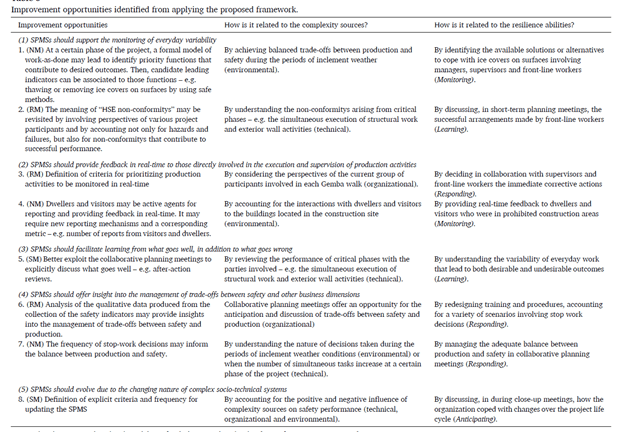
1. Support the monitoring of everyday variability
This indicator should provide insights to both undesirable performance variability as with expected and ideal.
2. Provide feedback in real-time to those directly involved in the execution and supervision of production activities
Here the SPMS should provide feedback as close as possible in real-time to those directly involved in executing and supervising production activities. One mechanism used in this sample was via Gemba walks for site conditions and worker feedback and observation.
Although the site was using a safety app for reporting, a HSE non-conformance database and a short-term planning meeting – these three practices involved some lag in feedback.
3. Facilitate learning from what goes well in addition to what goes wrong
As above, weekly meetings and Gemba walks supported discussions about what went well to some degree. However, these discussions were stacked largely towards non-conformances rather than normal work. Further, lessons learned from existing injury and accident metrics were disseminated via the corporate database only to management levels and not to the coal face.
4. Offer insights into the management of trade-offs between safety and other business dimensions
Indicators should help in managing trade-offs. Indicators in use on this project did permit some insights at certain phases of the construction project. However, no formal analysis of the correlation between these indicators was undertaken by the project staff.
Moreover, they observed “production was prevailing in the trade-off with safety and environmental dimensions” (p11).
5. Evolve due to the changing nature of complex socio-technical systems
No evidence was found of formal mechanisms for updating the SPMS based on the current states of the system. However, at certain periods of the construction project different indicators were given different priorities. In any case, strong and regular communication between parties played a significant role for monitoring and understanding the changing nature of everyday construction work.
Next they covered some of the findings of the role of project complexity on safety performance. Key factors identified were:
- A large number of simultaneous tasks at a certain phase of the project.
- Positive: it encourages communication between project teams
- Negative: It creates difficulties for housekeeping and waste sorting
- Both positive and negative: Workers had to adapt for missing components of scaffolds
- Interactions with dwellers and visitors to the buildings located in the construction site
- Negative: inaccurate delamination of public roads and sidewalks around the site
- Inclement weather conditions
- Negative: increased slip and trip hazards etc
- Active collaboration and communication among project participants
- Positive: diversity of perspectives for making decisions
- Positive: decentralised mechanisms for reporting
Next the paper discusses the key findings.
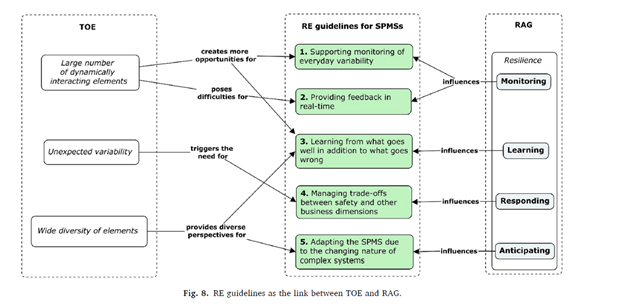
Supporting monitoring of everyday variability is most strongly connected to complexity attribute for a large number of dynamic interactions on site and the resilience ability of monitoring. The fact of a large number of simultaneous tasks required close monitoring of variability.
Providing feedback in real-time is most closely associated with monitoring ability and the large number of simultaneous and dynamically interacting elements. However, this complexity attribute impacts the ability to provide real-time feedback.
For instance, the reliance on workers to report HSE non-conformities was a slow process.
Learning from what goes well in addition to what goes wrong was related to the learning ability as well as two complexity attributes (i.e. large number of elements in dynamic interactions, and wide diversity of elements).
Gemba walks were valued by varied project participants for “creating opportunities to understand what went well” (p12). It was noted that “Gemba walk seems to be an adequate practice to learn from what goes well, as it takes place “when” and “where” the work occurs involving people who are part of the work” (p12).
Managing trade-offs between safety and other business dimensions is related to the ability to respond and mostly connected with the complexity attribute of variability of everyday work.
Having teams interacting in close physical proximity and simultaneous tasks created efficiency pressures that were detrimental to safety.
Collaborative planning meetings played a role in creating efficiency pressures but also helping to manage them.
Adapting the SPMS due to changing nature of complex systems was said to be clearly related to the ability to anticipate.
However, this potential wasn’t fully utilised for the purpose of updating the SPMS across different construction stages. They note “During the eight months of the empirical study, no indicators were added to the SPMS and no existing indicator was removed from it” (p13).
Below they highlight how the different concepts interact.
Authors: Peñaloza, G. A., Formoso, C. T., & Saurin, T. A. (2021). Safety science, 142, 105364.
Study link: https://doi.org/10.1016/j.ssci.2021.105364
Link to the LinkedIn article: https://www.linkedin.com/feed/update/urn:li:ugcPost:6930272212952190976?updateEntityUrn=urn%3Ali%3Afs_updateV2%3A%28urn%3Ali%3AugcPost%3A6930272212952190976%2CFEED_DETAIL%2CEMPTY%2CDEFAULT%2Cfalse%29

 SafetyInsights.org
One thought on “A resilience engineering-based framework for assessing safety performance measurement systems: A study in the construction industry”