Just culture vs blame culture / restorative culture vs retributive culture / learning culture, informed culture / restorative justice, blame logics, retributive logics and more.
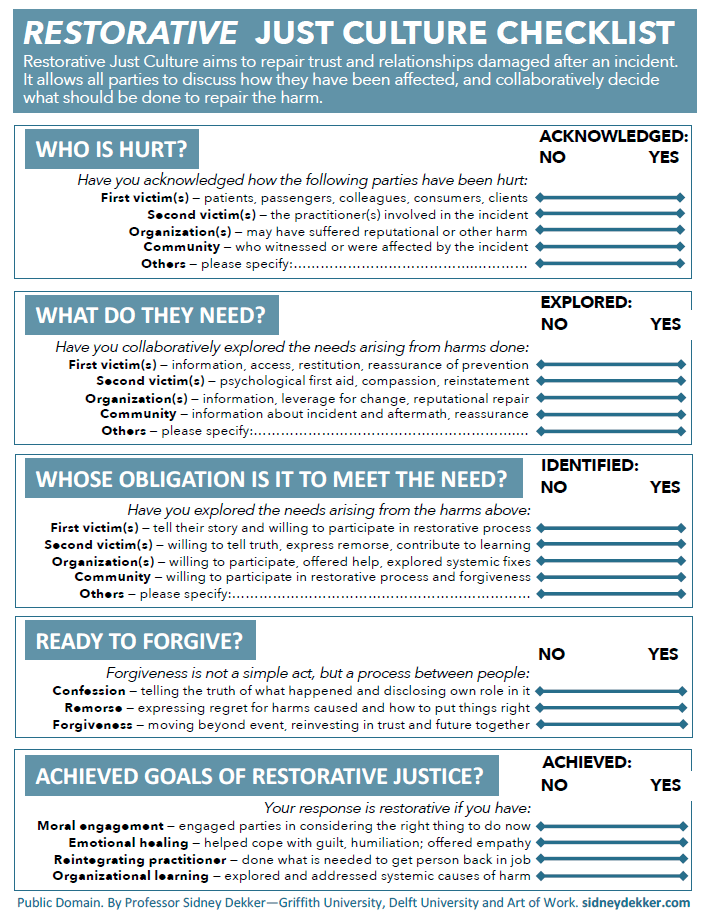
There’s been a bit of talk lately about restorative and retributive logics and associated topics. I think it’s an opportune time to re-post Sid Dekker’s restorative just culture checklist (image 1 below + link in comments) since it may be a useful aid in navigating this space.
(And yes, Sid was self-aware enough to highlight the apparent contradiction of advocating for removing clutter while at the same time as proposing another checklist or as he said “a checklistable, to-do algorithm or procedure”).
When you look at many iterations of the just culture flowchart, isn’t it striking how so often there appears to be an onus of proof on the employee to prove their “innocence” by how each steps flows through the process? That is, in some (many?) iterations of the process, it appears we start with the assumption of wrongdoing and then move along to clear their intentions.
As noted by Diane Chadwick-Jones et al.’s 2018 paper (link in comments), there’s a perception by some that rather than the Just Culture flowchart process permitting a just process, some operators referred to it as “to be just cultured”, implying a punitive element to the process” (p6).
Diane’s paper further highlighted some other perceptions of a JC process:
- Seen by some frontline operators that the process holds downstream workers accountable but not upstream managers
- It served more as a tool for justifying disciplinary action for workers but no decision points for management involvement
- The disciplinary aspect had a scoring slide focused mostly on disciplinary action – that is, focused more determining the type of disciplinary action rather than with disciplinary action being one option among other responses
- In some iterations using words like violation or negligent which “may have been given a common-language interpretation as implying people’s conscious disregard of the rules and akin to sabotage” (p12).
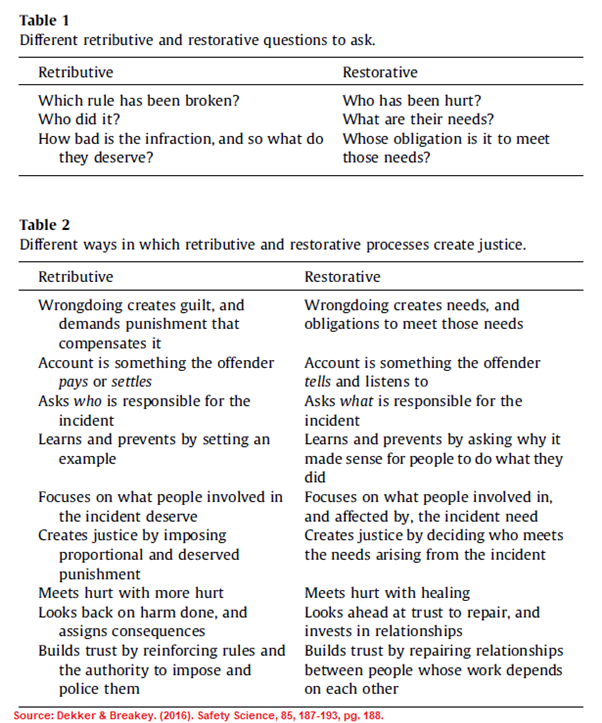
Another study from Dekker and Breakey (2016) provided some other useful questions to navigate this space – see the second image.

Links:
Restorative Just culture checklist: https://safetydifferently.com/restorative-just-culture-checklist/
Diane’s 2018 JC paper: https://www.sciencedirect.com/science/article/abs/pii/S0950423018300081
Dekker & Breakey 2016 paper: https://doi.org/10.1016/j.ssci.2016.01.018
Link to the LinkedIn post: https://www.linkedin.com/feed/update/urn:li:activity:6930654373064716288?commentUrn=urn%3Ali%3Acomment%3A%28activity%3A6930654373064716288%2C6930654662408761344%29

 SafetyInsights.org
One thought on “Restorative Just Culture Checklist”