This explored psychological & neurophysiological mechanisms with hazard recognition among novice and experienced construction workers.
77 construction workers took part in a designed hazard recognition task where participants viewed a series of construction photos and judged whether a hazard was present. EEG (electroencephalography) and signal detection theory were used.
In providing context, it’s said that inaccurate hazard recognition has been implicated in over half of on-site accidents. Whereas most previous research has shown that experienced workers have a higher hazard accuracy performance compared to novices, some research has shown no real difference between cohorts. For instance, one study found that experienced construction superintendents couldn’t correctly identify more hazards than civil engineering students. Better cognitive capacity of younger workers versus older may be one factor. Another study found novices evaluated hazards with a greater degree of danger compared to older/experienced workers, who demonstrated lower perceived risk levels.
Novices have also been found to have a greater gamma band brain activity compared to experienced workers; gamma band activity in the brain is said to be “responsible for the processing of threat-related stimuli” (p2).
Results
Based on this series of images hazard recognition task, novices had higher hazard recognition rates compared to experienced workers (higher accuracy).
Novices were also found to have higher gamma band activity in their brains (left frontal and right posterior parietal areas) compared to experienced workers during hazard recognition processes.
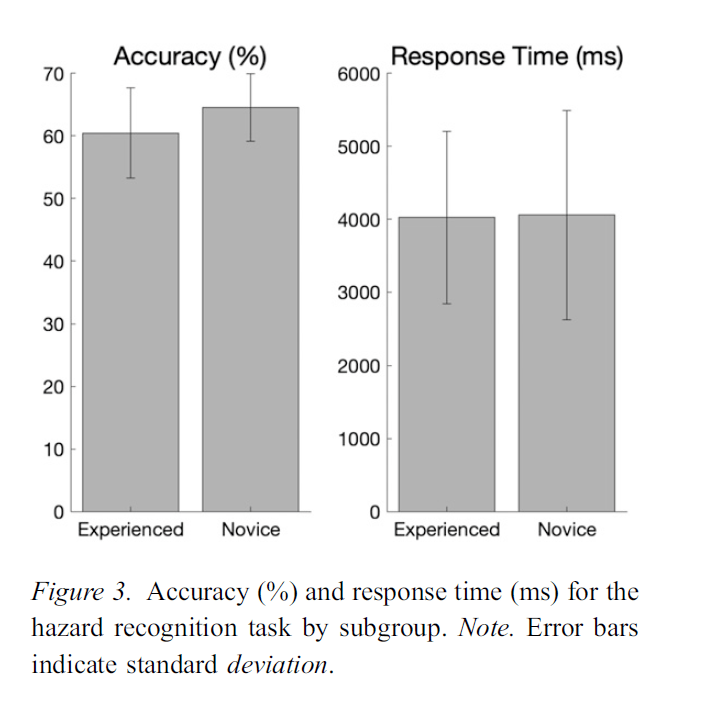
No statistically significant difference was found between cohorts with response time or other performance indices. Hazardous stimuli “induced significantly higher gamma-band activation than safe stimuli in all electrodes (p7)”, consistent with other research.
The findings are then discussed. It’s said that “novices were better at discriminating between potentially hazardous scenes, while experienced workers were more likely to confuse sensory cues, leading them to misclassify hazards” (p7). No differences in response bias (defined as “the threshold of perceived hazardousness”), indicating neither group had differing recognition & judgements on what counted as a hazard.
The authors say this finding is important since it seems to go against some common wisdom that as workers get older, they may “tend to underestimate risks due to complacency and decreased motivation“ (p7) and that they are just as capable, if not more capable, of identifying hazards compared to younger workers.
Rather, based on these findings, more experienced workers had lower gamma band activity compared to less experienced workers in the left frontal & right posterior parietal areas. Frontal area activation is said to be prominent during visuospatial working memory and correlated with “object vision for remembering “what” an object is” (p9). Therefore, novice workers with higher gamma activation in these areas may provide them a higher capacity for visuospatial working memory, resulting in greater performance in complex cognitive functions like decision making and reasoning during hazard recognition processes.
It’s said that experienced workers (<10 years’ experience) showed poorer hazard recognition performance compared to more novice workers (<10 years’ experience). The higher gamma band in novices “constitutes a neural basis for increased hazard recognition … in construction workers, suggesting better working memory and attentional control” (p10).
It’s concluded that it’s important to provide continuous refreshment of hazard recognition skills for experienced workers as it is for novice workers.
[Note. Something I’m uncertain about in this is the relationship between novice / experience and age. Novice and experienced groups had a statistically significant difference in experience (by design), but no statistically significant difference was found in age (avg in novice = 39.8 years ± 11.2 years and 44 years ± 8.2 years). However, the authors state that age-related changes result in lower gamma band activity and this was found between the novice vs experienced groups, but there wasn’t a statistical difference in mean age. It could be something REALLY obvious that I’ve misinterpreted or overlooked in the paper (maybe more a difference in experience than age-related changes), so caveat emptor.)
Authors: Xiaoshan Zhou, Pin-Chao Liao and Qingwen Xu. (2022). Human Factors, Vol. 0, No. 0
Study link: https://doi.org/10.1177%2F00187208211066666
Link to the LinkedIn article: https://www.linkedin.com/feed/update/urn:li:ugcPost:6932813874039529472?updateEntityUrn=urn%3Ali%3Afs_updateV2%3A%28urn%3Ali%3AugcPost%3A6932813874039529472%2CFEED_DETAIL%2CEMPTY%2CDEFAULT%2Cfalse%29

 SafetyInsights.org