Two of many studies exploring Root Cause Analysis methodologies in healthcare and whether these investigations prevent repeat occurrences (sources in comments).
Study 1 evaluated 21 studies and found:
- Despite RCAs and investigations being promoted under the guise of preventing reoccurrences, the authors state that “more recent studies do not confirm these findings” (p12),
- Based on this data and other research, the use of RCA investigations “does not seem to produce enough benefits to address the problem … and thus, avoid possible AAEs” (p11)
- Only in 2 studies was it established that RCA contributed to improvement of patient care
- In 50% of cases, recommendations in RCAs were weak and didn’t lead to a reduction in serious events
- One gap limiting the effectiveness of investigations was that the recommended actions were not always coupled with verifications to ensure that the actions/improvements were carried out and effective
- As expected, “active errors” of operators were prioritised over latent conditions and systems factors
- 47% of the studies found that the main weakness of RCA is its recommendations
- They concluded that “It is not clear if root cause analysis is effective in preventing recurrence adverse events”
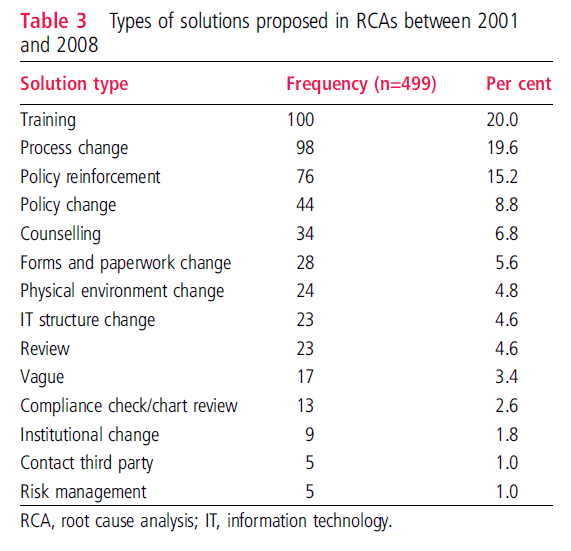
Study 2, drawing on 302 RCAs over an 8-year period found that: (image 1)
- The most common solutions were training, process change and policy reinforcements
- That is, the “most commonly proposed solutions were weaker actions, which were less likely to decrease event recurrence” (p381).
- For training, the most common method was via didactic teacher – where focus is on the instructor providing info and instructees are passive listening
- For policy reinforcement, reminding people of procedures and other means are said to be demonstrable of “work-as-imagined”. Reminding people as a common response “violates the basic premise of safety engineering involving sociotechnical systems, which recognises that human errors will always be repeated [without redesigning the conditions that people work under]” (p385).
- Few of the investigation recommendations included deeper design changes and further, the authors note that despite the RCAs, repeat occurrences of events were found to keep happening
RCAs were observed to not identify “meaningful aspects of the event but simply observes that humans are imperfect” (p385), such as reports highlighting people forgetting things taught to them (which, according to the authors, simply highlights that human memory is imperfect).
As others have argued (Hibbert et al., 2018, Int J for Quality in Health Care):
“Time spent in repeatedly investigating similar incidents may be better spent aggregating and thematically analysing the full range of existing sources of information about patient safety (p130).
Sources:
Study 1: https://wordpress.com/post/safety177496371.wordpress.com/189
Study 2: https://www.linkedin.com/pulse/our-current-approach-root-cause-analysis-contributing-ben-hutchinson
Hibbert et al. quote: https://www.linkedin.com/pulse/root-cause-analyses-recommendations-effective-study-ben-hutchinson
Link to the LinkedIn post: https://www.linkedin.com/feed/update/urn:li:activity:6938268537983504384?commentUrn=urn%3Ali%3Acomment%3A%28activity%3A6938268537983504384%2C6938268831110836226%29

 SafetyInsights.org
One thought on “Are Root Cause Analyses (RCA) effective for preventing incident reoccurrences?”