This studied the effects of work intensification (WI) on safety performance and mediating factors by surveying 122 people from high-accident companies.
WI is different to time pressure. Whereas time pressure reflects high quantitative workload at a specific point in time, WI “refers to increasing levels of quantitative workload over time. In other words, work intensification is characterized by an increased need to complete more tasks within one working day, work at a heightened speed, perform different tasks simultaneously, and/or reduce idle time” (p2).
WI has been linked to reduced safety performance, a rise in musculoskeletal disorders and psychosocial risks, greater production-focused trade-offs, more workarounds and also poorer communication at work leading to higher anti-social behaviours and adverse effects on safety climate (SC).
Results
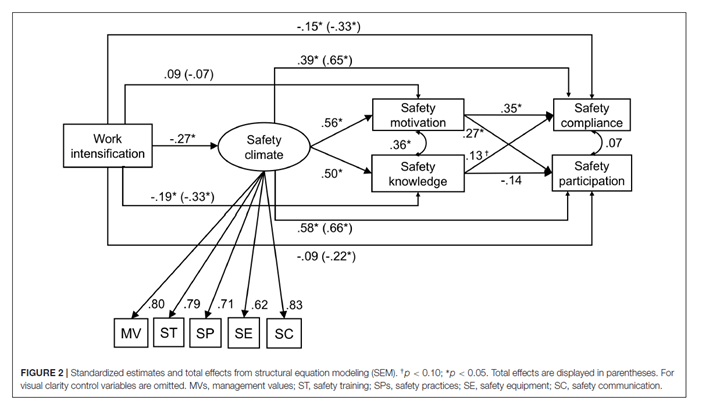
WI was negatively related to safety compliance and participation. It compromises not just individual safety but also the work environment.
WI was also found to negatively impact performance and indirectly worsens SC. That is, “work intensification not only directly negatively affects safety performance but also indirectly affects it through worsening the organizations’ safety climate. Safety climate, in turn, directly and indirectly affects safety performance” (p9).
Further, the resulting changes in organisational and structural changes may also affect other forms of organisational climates.
WI was not found to directly affect Safety Motivation (SM), suggesting that employees aren’t less motivated to minimise their exposure to danger or think less of safety. However, changes in SC due to WI can influence their SM. Changes in organisational safety climate strongly affects safety motivation and then safety motivation had a direct relationship with both safety compliance and safety participation.
WI had a strong negative association with Safety Knowledge (SK) and this wasn’t explained by SC. The authors speculate that the increase in WI decreases safety communication, training & information among employees; reducing SK.
The detrimental effects of WI is said to often remain unnoticed because it “stems from structural and organizational changes of work”, including reductions of headcount and more flexible organization structures.
Downsizing and restructuring and tightened production may increasingly lead to a loss of institutional SK. Moreover, reduced headcount with increasing workloads may exacerbate inadequate training and instruction for workers to carry out their new duties.
Authors: Bunner, J., Prem, R., & Korunka, C. (2018). Frontiers in psychology, 9, 2575.
Study link: https://doi.org/10.3389/fpsyg.2018.02575
Link to the LinkedIn article: https://www.linkedin.com/feed/update/urn:li:ugcPost:6944415779714916352?updateEntityUrn=urn%3Ali%3Afs_updateV2%3A%28urn%3Ali%3AugcPost%3A6944415779714916352%2CFEED_DETAIL%2CEMPTY%2CDEFAULT%2Cfalse%29

 SafetyInsights.org