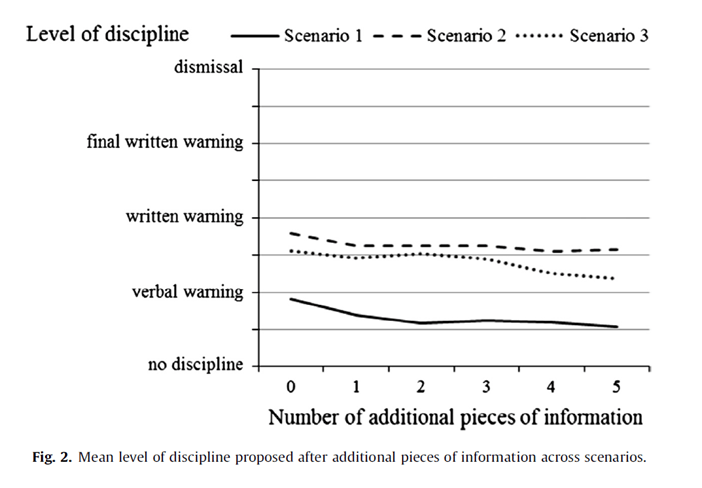
This surveyed 3136 aviation maintenance personnel from one company to judge the appropriate level of discipline in 3 incident scenarios. Five pieces of ‘‘mitigating” contextual information were presented per scenario and the participants given an opportunity to re-assess their judgement of culpability/discipline.
First, the issues with Just Culture (JC) processes were highlighted. Including the fallacy of JC appearing to be objective rather than a judgement of social construction. Or how acceptable or unacceptable behaviour are not stable categories with fixed features independent of context.
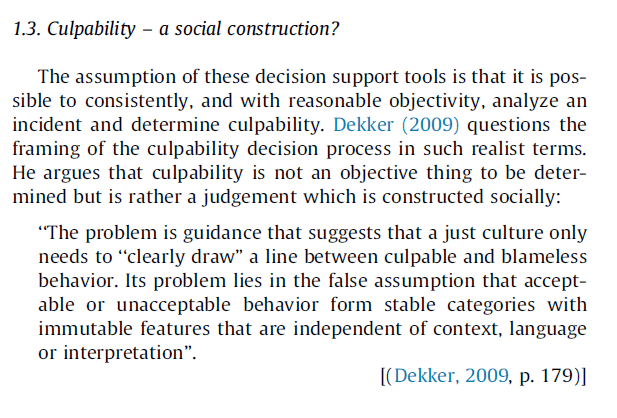
Also, the evidence was discussed that shows the order of info, how it’s presented, and other characteristics influence culpability judgements (including things like outcome bias). This includes:
- Assigning less blame when actors provided external explanations for their performance
- Witness statements presenting step-by-step information led to a recency effect, where evidence presented later affected culpability judgements more than info presented earlier; when all statements were presented at the one time then no recency effect was found
- Posteriori information also affected judgements (information that wasn’t known to the actor before the event but which the culpability assessors now know after the fact). Actors were perceived as less blameworthy when posteriori information confirmed that a shot home intruder was a burglar rather than a “good citizen”
- Significantly higher levels of blame were assigned to upper-level positions, because people at these levels were seen to hold greater accountability for actions. In these situations, the difference between lower and higher role culpability were greater in taller organisational hierarchies compared to flatter ones
- Cultural influences are also present. Some research found that the “general public” held individual managers in organisations more culpable for errors of their personnel in Japanese compared to US companies
Results
Although there were differences b.t. responses in each scenario, and some individuals were markedly different, mostly people responded similarly per scenario in alignment to JC culpability principle; suggesting a sense of shared thinking around culpability and discipline.
The authors conclude that the JC process is not an objective system that can simply be implemented; it is social and organisational of negotiating meaning. Further, based on their findings they question whether JC tools can be reliably used or if they serve a useful purpose in managing safety.
Judgements on culpability became more lenient as additional info was provided. However, in each scenario there was one piece of info that consistently led to more severe ratings of discipline – so called “anti-mitigating” factors.
There appeared to be no consistency to the type of info that led to this, except for the fact that this one factor was an external factor outside the direct control of the implicated employee. Authors speculate that perhaps participants draw a line between what they see as genuine circumstances or excuses.
European sites were significantly more lenient than North American sites.
Engineers and managers were more lenient than operational staff, and more experienced personnel more lenient than juniors. Engineers were the most lenient; whereas management were more severe on other senior managers.
Interestingly, quality and safety personnel appeared to be the most severe in judgement – but this was not statistically significant (which the authors believe was due to the small sample size).
Unexpectedly, the consequence of the incident to the company doesn’t appear to have influenced the participants. Participants were more sympathetic to issues that they perhaps had exposure to (poor IT systems, lack of supervisor, family pressures). Moreover, the seniority and level of responsibility of the target individual was important in participants’ assessments of discipline – where they were harshest on managers and the most lenient on new hires.
Authors: Cromie, S., & Bott, F. (2016). Safety science, 86, 258-272.

Study link: https://doi.org/10.1016/j.ssci.2016.03.012
Link to the LinkedIn article: https://www.linkedin.com/pulse/just-cultures-line-sand-shifting-one-empirical-ben-hutchinson

 SafetyInsights.org
One thought on “Just culture’s ‘‘line in the sand” is a shifting one; an empirical investigation of culpability determination”