ABSTRACT
This study tested the contribution of trust between leaders and subordinates to safety. It is suggested that leaders who create a relationship of trust with their subordinates are more likely to create a safe working environment, and to achieve higher and stronger safety-climate perceptions among their subordinates. Hence, trust should be negatively related to injuries and positively related to safety climate.
Questionnaires distributed among 2524 soldiers in three army brigades tested for trust and safety-climate variables and were then crossed with injury rate according to medical records at the platoon level of analysis (N = 105).
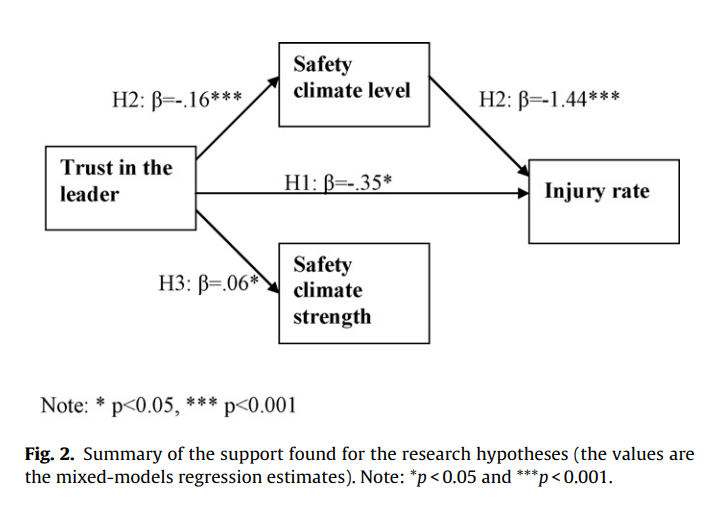
Trust was found to be negatively related to injuries and positively related both to level and strength of safety climate. Furthermore, safety-climate level was found to mediate the relationship between trust and injury rates. Theoretical and practical implications are discussed.
*****
From the full-text paper –
Many of the key findings are highlighted in the abstract above, but notably:
- Trust was positively correlated with climate level and strength (both move in the same direction)
- Injury rate was negatively correlated with climate strength (as one goes up, the other goes down)
- Thus, the results support James Reason’s premise that “trust is an essential condition in safety management” (p1292).
- Safety climate fully mediated the relationship with trust on injury rate. That is, in this sample trust acted fully in the context of safety climate. The authors explained “It is evident that trust in the leader is related to high climate level, which in turn is related to better safety performance” (p1292). They argue that this finding, that trust didn’t have its own direct relationship, may be because of the military setting.
- Further, there may be a reverse causal relationship in the findings. That is, “accident occurrence is an antecedent of distrust in the leader rather than the outcome of trust or distrust in her/him. Trust and safety climate were measured at the same point in time and from the same source (soldiers), thus it is possible that safety climate is an antecedent of trust” (p1293).
- Interestingly, “trust may not only be functional but also dysfunctional for safety”. The authors give the example where ” trust may reduce personal responsibility, lead to undetected mistakes, and to less monitoring for safety behaviors … It is possible that the functional effects of trust are stronger than the negative effects on safety, which is why, in this study, only evidence for trust as a functional variable was found” (p1293).
- Of further interest, the authors explain that leadership styles like transformational leadership acts via trust. In this study, the effects of transformational leadership was non-significant when controlled for trust.
- In explaining the findings, it’s said that people “cognitively evaluate the information communicated to them. If they trust their leader, they believe the information they are given, and are more likely to reach similar conclusions about the importance of safety, i.e. strong safety climate. Trust is thus shown to be related to both strong and high climates, both of which are mandatory for safety” (p1293).
- Finally, while there were significant relationships between trust and injury, “these relationships explain only a small percentage of the variance in injury rate” (1293); so, of course, this is one piece of a larger puzzle.
[Note: While the relationship between trust and climate is interesting and important, I think we need to be more cautious in interpreting the links with accidents/injuries, given their statistically random nature.]
Author: Luria, G. (2010). Accident Analysis & Prevention, 42(4), 1288-1295.

Study link: https://doi.org/10.1016/j.aap.2010.02.006
Link to the LinkedIn article: https://www.linkedin.com/pulse/social-aspects-safety-management-trust-climate-ben-hutchinson

 SafetyInsights.org