One of many studies from Tahira Probst and colleagues on injury underreporting. This study explored underreporting in the context of US construction and the relationship to organisational safety climate.
Data from 1,390 employees across 38 companies were included.
Results
As confirmed by this study and previous work – the rate of injuries experienced by workers far surpass the injury rate that organisations report to OSHA.
Key findings include:
- A more positive safety climate was related to a lower experienced injury rate and a lower rate of underreporting (47% of eligible injuries unreported); companies with a poorer safety climate had a significantly higher rate of unreported injuries (81% of eligible injuries unreported)
- For every injury that was appropriately reported to OSHA, there were an additional 3.5 injuries resulting in medical care beyond first aid that were not reported (but should have been)
- Despite the difference in unreported injuries to OSHA between companies with better vs poorer safety climate performance, “there was no significant difference in the injury rates reported to OSHA” (1152)
- That is, both better and poorer performing have similar and non-statistically different) OSHA rates (3.98 vs 3.18 – see graph below)
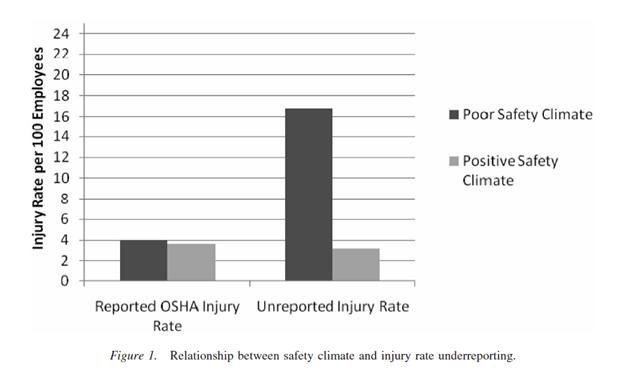
The fact that poorer performing have similar “on the book” performance compared to better performing is problematic for a few reasons. One, as the authors explain, is the fact that these metrics are used to “to tout an organization’s “commitment to safety” and can therefore be used to recruit new employees and/or present a favorable image to the public” (p1152).
While the officially reported statistics in the graph above indicate little difference between companies, “the unreported injury rate data tell a far different story” (p1152), with the poorer performing not reporting up to 81% of eligible injuries. [ **** Although conversely – the better performing still failed to report 47% of injuries].
It’s argued that in organisations “there is a disconnect between what organizations measure (OSHA recordables) and the results that really matter” and organisations have become “overly focused on poor measures (OSHA recordables) for a number of good reasons” (p1153), including:
- Regulator requirements to report certain injuries
- Tracking of these metrics by other stakeholders, safety professionals, auditors etc.
- Competitive tendering being predicated, at least partially, on injury performance
- Use of these data by rating bureaus
- Executives believing the data
- Managers being rewarded based on the data
- Administrators being able to manipulate the data
They then argue that “To paraphrase Kerr (1975), it is folly to reward for A while hoping for B. Executives, owners, regulators, managers and others provide rewards (and/or are granted rewards) based on a company’s OSHA recordable rate” (p1153).
Thus, we can’t be surprised that systemic underreporting exists and with few incentives to address the issues.
Authors: Probst, T. M., Brubaker, T. L., & Barsotti, A. (2008). Journal of Applied Psychology, 93(5), 1147.
Study link: https://psycnet.apa.org/doi/10.1037/0021-9010.93.5.1147
Link to the LinkedIn article: https://www.linkedin.com/pulse/organizational-injury-rate-underreporting-moderating-ben-hutchinson

 SafetyInsights.org
One thought on “Organizational Injury Rate Underreporting: The Moderating Effect of Organizational Safety Climate”