This study systematically reviewed the evidence of Psychological Safety (PS) up to 2015. 83 studies were included.
Most studies evaluated PS at the team-level, rather than individual or org., where PS is likely “more potent and meaningful at the team level” (p.4).
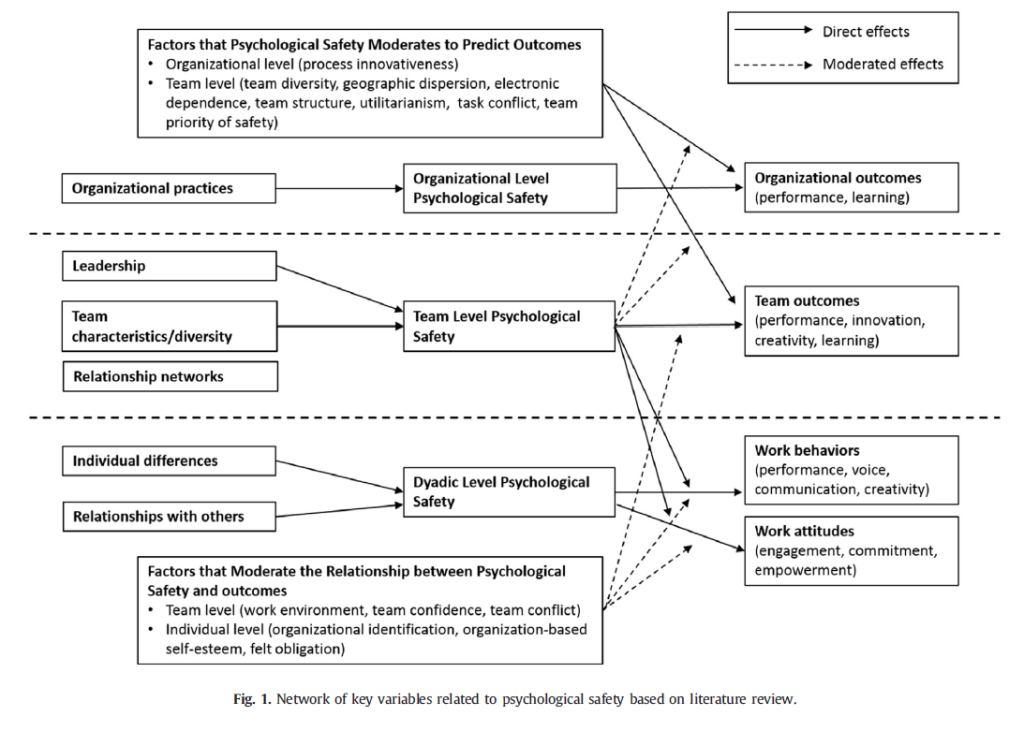
Most antecedents of PS can be grouped under the umbrella of supportive environments: supportive leadership, relationships, practices etc. It was found that in most studies, PS was the “mechanism through which the effects of these supportive environments were transmitted to desirable outcomes”.
Main outcomes included improved knowledge sharing, engagement, creativity, innovation and performance. PS was also found to be important in hazardous work environments where safety voice and speaking up is critical. Higher PS (HPS), such as through supported social networks, was positively related to teams better learning from failure.
HPS within teams is more likely to lead to workarounds where people deal with barriers to workflow but also lead to better reflection on work. HPS also enabled greater courage for people to admit “bad investment decisions” and less likely to salvage a poor project.
HPS had higher associations with team performance in environments with higher creativity, sense making, and complexity + more likely to adapt new technology.
At the team level, PS has been associated with more feedback giving and seeking behaviour, and also associated with the use of “of internally focused learning activities that provide employees with the knowledge required to adapt and implement new practices in their unit” (p7). PS also “positively influenced the successful implementation of new technology” (p7).
PS appeared to moderate some antecedent-outcome relationships, like with high levels of PS intensifying the positive relationship between team expertise diversity and team performance.
PS was found to mitigate negative effects of geographical dispersion, electronic dependence and national diversity on team innovation.
Leaders that value engagement through dyadic discovery (having one-on-on conversations with individuals) rather than group-based discovery were able to foster HPS.
Interestingly, the authors highlight that little research exists on negative effects of PS. One study found that higher PS actually led utilitarian teams to engage in more unethical behaviours. Authors also hypothesise that HPS may have negative effects on team learning/performance in teams with high autonomy.
[*** Note, there’s now at least one or two more studies highlighting some boundary conditions of PS and potentially unintended outcomes from higher PS.]
Authors: Newman, A., Donohue, R., & Eva, N. (2017). Human resource management review, 27(3), 521-535.
Study link: https://doi.org/10.1016/j.hrmr.2017.01.001
Link to the LinkedIn article: https://www.linkedin.com/pulse/psychological-safety-systematic-review-literature-ben-hutchinson

 SafetyInsights.org
2 thoughts on “Psychological safety – A systematic review of the literature”