This studied the effects of psychological safety (PS) on unethical behaviour (EB) on team performance. 136 three-people teams at university were assessed both on attitudes to cheating (hypothetical) & on actual cheating (via a real assignment that students self-graded as a team, with fake elements added by the lecturer to capture cheating).
EB was divided between team orientation: utilitarian (UTIL; where people choose options that are seen as harmless but get best benefits for the group) or formalistic (FOR; where people strictly follow rules, irrespective of gain).
The authors hypothesise a link between psychological safety and higher unethical team behaviour – in particular, teams higher in utilitarian characteristics. Teams with higher utilitarian orientations weigh up the costs of an action versus the benefits to the individual or their team as a whole rather than against social norms or right or wrong. Teams higher in formalistic orientations are more likely to abide by rules, customs and social norms.
For a team to endorse an unethical action, it must first be voiced and agreed upon by other members of the group. It’s said that “The fact that team members can monitor each other’s behaviors provides a social barrier to unethical behavior … and there are often strong social norms against unethical behavior such as cheating in groups …However, if team members feel safeguarded, they may be more likely to overcome such social constraints” (p403).
Because psychological safety provides an environment safer for people to voice tough issues, it may actually be conducive to unethical behaviour in certain types of teams and situations.
Thus, “When facing a decision, teams that are composed of members high in utilitarianism are able to use the safety of their environment to suggest choosing the most beneficial option, even if it is socially considered to be unethical … Psychological safety, therefore, provides a mechanism through which intent may be transformed into collective, unethical action for highly utilitarian team members” (p403).
Results
High UTIL in teams was related to higher intentions for cheating (compared to FOR) and significantly related to actual cheating (x4 higher than low UTIL). UTIL had a significantly stronger positive effect on cheating in teams with high PS.
However, simply knowing ethical orientation is not enough for predicting EB, as PS appears to be the mechanism which allows people the interpersonal risk taking to suggest unethical decisions in the first place.
Authors state “For teams high in [UTIL], [PS] helped to unlock the team’s propensity to engage in unethical behavior” (p407, emphasis added).
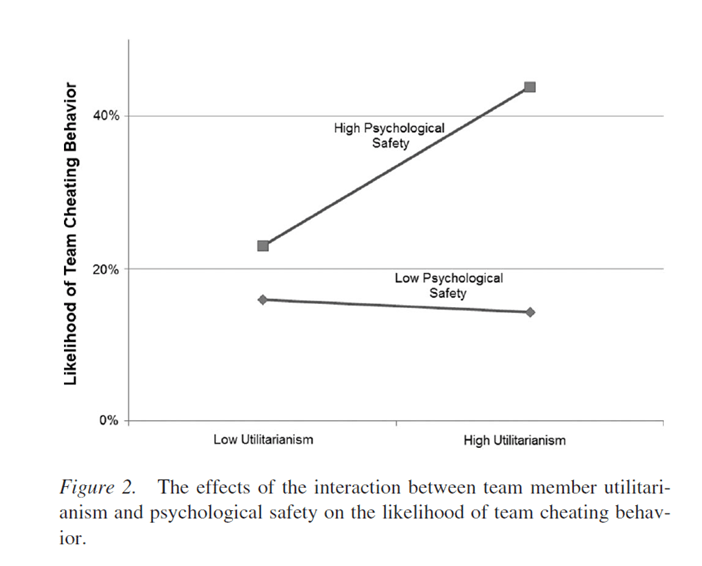
Importantly, the authors note that PS doesn’t need a warning label – and benefits clearly outweigh negatives. However, in some circumstances, when the team have the right (wrong?) orientation, higher PS can lead to the unintended consequence of contributing to behaviours that are non-conducive to long-term success of the company. As they said, these results “uncover a potentially important boundary condition … of [PS]” (p407).
Interestingly, although formalism was more likely to lead to EB in the hypothetical situation, direct effects were not found on actual decisions; indicating that when people within groups actually have something to lose – benefits of formalism may quickly fade.
Authors note that trying to build teams higher in formalism may not be a robust strategy, since in actual scenarios (rather than hypothetical), advantages of formalism seemed to fade. Also, utilitarians may provide benefits around team performance and creativity – where they tend to be more innovative.
Finally, it’s said that if leaders can serve as social models for ethical behaviour, then negative effects of PS might be reduced.
Authors: Pearsall, M. J., & Ellis, A. P. (2011). Journal of Applied Psychology, 96(2), 401.
Study link: https://doi.org/10.1037/a0021503
Link to the LinkedIn article: https://www.linkedin.com/pulse/thick-thieves-effects-ethical-orientation-safety-team-ben-hutchinson

 SafetyInsights.org
2 thoughts on “Thick as Thieves: The Effects of Ethical Orientation and Psychological Safety on Unethical Team Behavior”