ABSTRACT
Objective
Mechanical injury has been postulated as a risk factor for widespread pain, although to date, the evidence is weak. The aim of this study was to determine whether repeated exposure to mechanical trauma in the work place predicts the onset of widespread pain and to determine the relative contribution of mechanical trauma compared with psychosocial factors.
Methods
In this prospective cohort study of 1,081 newly employed subjects in 12 diverse occupational settings, we collected detailed information on mechanical exposure, posture, physical environment, and psychosocial risk factors in the work place. Study questionnaires were completed at baseline and at 12 and 24 months. Individuals free of widespread pain at baseline and 12 months were eligible for followup. Generalized estimating equations were used to determine which factors predicted the new onset of widespread pain.
Results
Of the 1,081 baseline respondents, 896 were free of widespread pain and were eligible for further study. Of these 896 subjects, 708 and 520 responded at 12 months and 24 months, respectively. The rates of new-onset widespread pain were 15% at 12 months and 12% at 24 months. Several work place mechanical and posture exposures predicted the new onset of widespread pain: lifting >15 lbs with 1 hand, lifting >24 lbs with 2 hands, pulling >56 lbs, prolonged squatting, and prolonged working with hands at or above shoulder level. Of the psychosocial exposures, those who reported low job satisfaction, low social support, and monotonous work had an increased risk of new-onset widespread pain. In multivariate analysis, monotonous work and low social support were found to be the strongest independent predictors of symptom onset.
Conclusion
Our findings demonstrate that the prevalence of new-onset widespread pain was high, but among this young, newly employed work force, both physical and psychosocial factors played an important role.
*********************************************
From the full-text paper:
This prospective 2-year study tracked new starter employees at baseline and at 12 and 24 months on new-onset widespread pain and the relationship with a range of physical and psychosocial risk factors.
Several mechanical, posture and psychosocial factors predicted new-onset widespread pain for new employees including:
Physical
- Lifting >15 lbs (~7kg) with 1 hand
- Lifting >24 lbs (~11 kg) with 2 hands
- Pulling >56 lbs (~25kg)
- Prolonged squatting
- Prolonged working with hands at or above shoulder level
- Prolonged kneeling
- Squatting
- Repetitive arm movements
Psychosocial
- Those reporting low job satisfaction
- Low social support
- Monotonous work
In multivariate models, they found that new-onset pain in any 12-month period increased 11% where people were not exposed to the studied mechanical or psychosocial factors, whereas people who were exposed to 3 factors (pulling >56 lbs, squatting >15 mins, monotonous, low support from colleague) had new-onset up to 60% higher.
The table below highlights some of the adjusted factors, odds ratios and confidence intervals (you will need to refer to the full paper to see the entire list of mechanical and psychosocial factors and their associations).
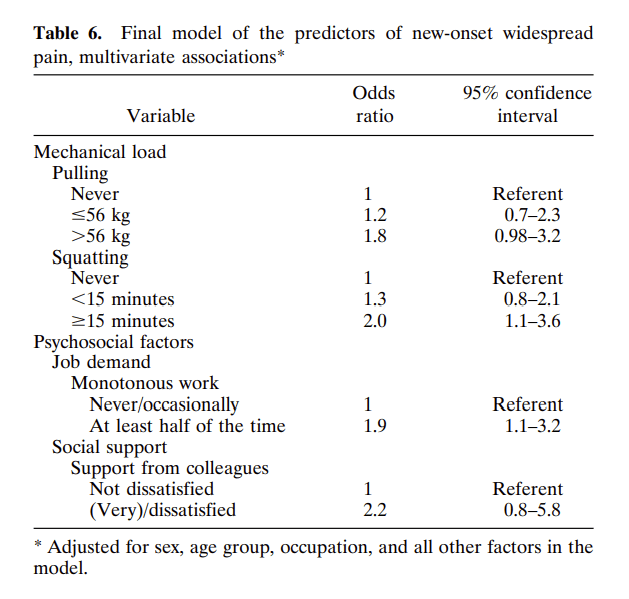
Multivariate analysis also found monotonous work and low social support to be the strongest independent predictors of new on-set pain.
They further note that this sample was young, presumably healthy new workers without existing widespread pain. 27% reported that the new-onset pain restricted activities at home at 12 months and 31% by 24 months.
Monotonous work was found to consistently predict new-onset musculoskeletal pain. They state that “Although monotonous work could be a marker of repetitive tasks, such as movements of the arms or wrists, it was found to be independently predictive” (p1662).
New-onset pain was largely multifactorial, “with the strongest associations for repetitive movements of the wrists, other regional pain symptoms, and individual psychosocial factors, in particular, illness behavior” (p1663).
In concluding they state that “new onset of widespread pain is common and the risk is multifactorial” and while mechanical factors are important, the “strongest independent predictors of symptom onset were, however, work-related psychosocial factors, and these associations have implications for the development of possible interventions” (p1663, emphasis added).
Authors: Harkness, E. F., Macfarlane, G. J., Nahit, E., Silman, A. J., & McBeth, J. (2004). Arthritis & Rheumatism, 50(5), 1655-1664.
Study link: https://doi.org/10.1002/art.20258
Link to the LinkedIn article: https://www.linkedin.com/pulse/mechanical-injury-psychosocial-factors-work-place-onset-hutchinson

 SafetyInsights.org
2 thoughts on “Mechanical Injury and Psychosocial Factors in the Work Place Predict the Onset of Widespread Body Pain”