I think it’s safe to say there’s differing opinions on the relationships between hazards & minor/major precursors & events.
In one stream, a delineation is drawn for process vs personal indicators & hazards; nicely articulated by Andrew Hopkins discussing the BP Texas City disaster – where BP was largely relying on injury metrics over process safety.
In another related & overlapping stream, there’s the delineation between minor / major events & precursors.
Yet are minor events predictive of major ones? Will reducing minor potential events, precursors & hazards assist major events?
Without trudging into this debate (there’s been whole special journal issues dedicated to this topic) – one study from Linda Bellamy (2014) explored the question using 23k Dutch serious reportable events from 1998-2009.
This study found that “there is a link between occupational and process safety and between fatal and nonfatal occupational accidents, and that link is the hazard” (p10).
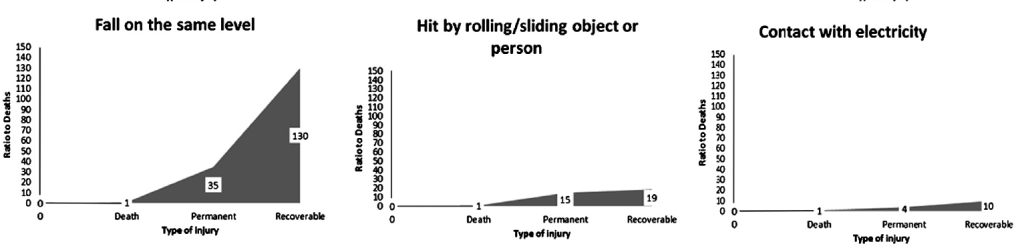
Linda found that “fatal and non-fatal accidents share the same causes but not in the same proportions” and that “907 fatal accidents in 35 bow-ties all have non-fatal accident equivalents in terms of safety barrier failures”, with only 2 exceptions.
The attached images provide some of the data – image 1 highlights different accident ratio “hills” for a small number of events. Image 2 flags the different barrier failures & their consequences.
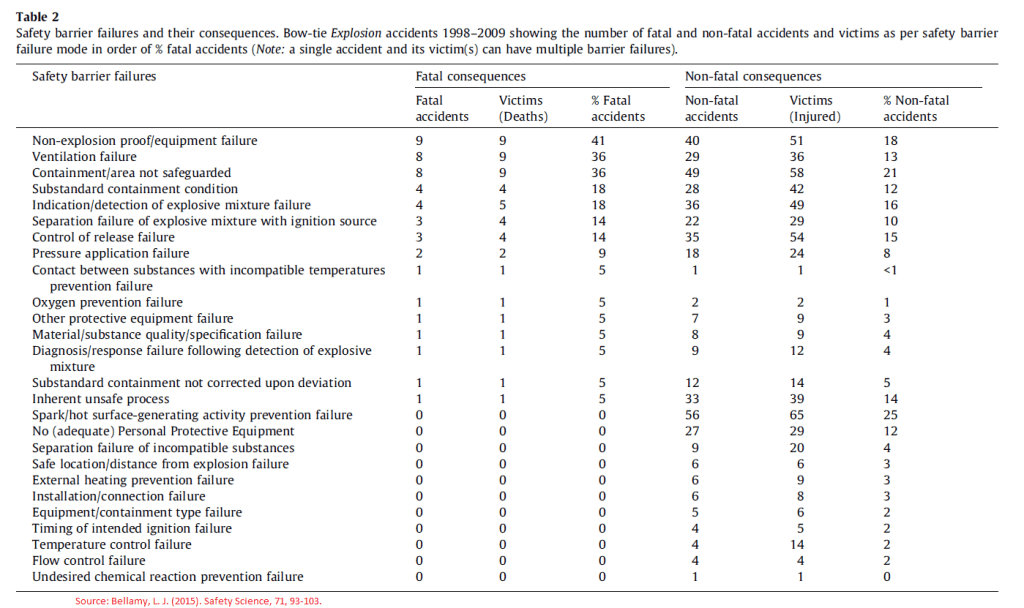
One example of “different proportions” of contributing factors was for fatal vs non-fatal falls. While for fatal falls there was a failure of fall arrest equipment in 42% of cases, in non-fatal it was 29%.
Thus, the “numbers of fatal and non-fatal accidents do not significantly correlate within the same barrier type failure but there are no fatal accidents with different types of barrier failures to the non-fatal accidents” (p6).
An example would be minor slips & trips versus fatal falls. A minor slip & trip at ground level may not be fatal but it could well be 3m above ground level.
A conclusion is “provided accidents from different hazard bow-ties are not mixed together, small severity more frequent accidents can be used to consider the causation and hence prevention of the bigger severity rarer accidents” (p1).
Although this paper focused on reported incidents – I don’t think it only applies there. It also applies across the sociotechnical spectrum of work & proactive understanding of variability.
Finally, I think we need to be quite directed and clear on what we focus on and how it’s connected to achieving our goals. A favourite quote of mine from Andrew Hale (2002) poetically supports this:
“We are not going to get very far in preventing [major disasters] by encouraging people to hold the handrail when walking down stairs” (p36).
[NB. Some may argue that the data is influenced by a type of common method bias, given that the data is processed via the inspectorate into common causal categories. Thus, WYLFIWYF.]
Author: Bellamy, L. J. (2015). Exploring the relationship between major hazard, fatal and non-fatal accidents through outcomes and causes. Safety Science, 71, 93-103.
Study link: https://doi.org/10.1016/j.ssci.2014.02.009
Link to the LinkedIn post: https://www.linkedin.com/posts/benhutchinson2_i-think-its-safe-to-safe-theres-differing-activity-6956025467392983041-IjB8?utm_source=linkedin_share&utm_medium=member_desktop_web

 SafetyInsights.org
One thought on “Relationship between minor and major accidents”