This study explored how workplace monitoring of employees (e.g. via surveillance systems in email, screens, vehicle IVMS, cameras etc.) impacts employee behaviour and how, when and why it may result in greater unethical (“deviant”) behaviour.
Two separate studies were ran.
Nicely, the paper begins with a quote from one worker reflecting on his experience with an online monitoring system. The employee noted that monitoring started to affect his behaviour, such that knowing that his actions could be reviewed resulted in him, initially, spending less time reading sports articles and other apps and more time on his core work. However after some time, he found he spent more time trying to cheat the monitoring system.
Providing context they say that:
- 50-60% of the world’s largest companies use some form of employee monitoring
- It may be implicitly assumed that workplace monitoring reduces deviant behaviour. Some research supports this by finding some monitoring can reduce theft and facilitates other types of performance and feedback)
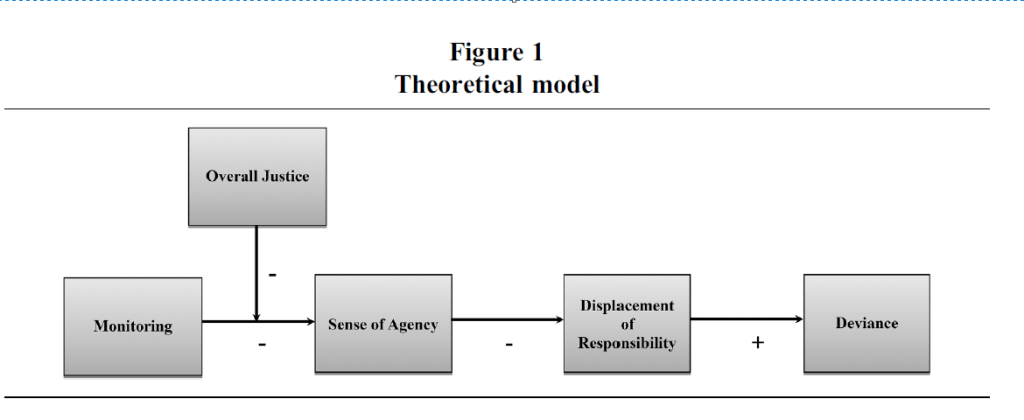
- However monitoring may result in a reduced sense of agency in employees. Quoting Bandura it’s said that “moral standards do not function as fixed internal regulators of conduct” and that “there are many processes by which self-sanctions can be disengaged.” (p5). That is, external factors of the environment & management practices can reduce internal agency of people and result in a displacement of responsibility
- Some factors & management practices like goal setting can erode employee self-regulatory capacity for moral conduct, which then may result in cheating or lying via “deactivation of the self-regulatory process” (p6)
- That is, monitoring can reduce agency and thus, override people’s moral regulatory processes – leading to displacement of responsibility. Nevertheless, people don’t always react negatively to monitoring but when this occurs is unclear. Notably, though, intrusive, secretive and coercive aspects of monitoring may lead employees to conclude that the technology is being used against them
- One factor that may alleviate negative perceptions of monitoring is overall justice. If employees perceive a high level of justice and fairness, then they may not perceive monitoring as coercive or intrusive.
They argue that “as monitoring replaces employees’ sense of agency with external surveillance … this facilitates displacement of responsibility and paradoxically contributes to deviant behavior” (p3).
Results
Key findings included:
- Monitoring was negatively related to sense of agency (i.e., as monitoring goes up, sense of agency goes down and vice versa)
- Monitoring was positively related to displacement of responsibility through sense of agency (positive as in, both go up in the same direction)
- Monitoring was positively related to employee deviance through sense of agency and displacement of responsibility
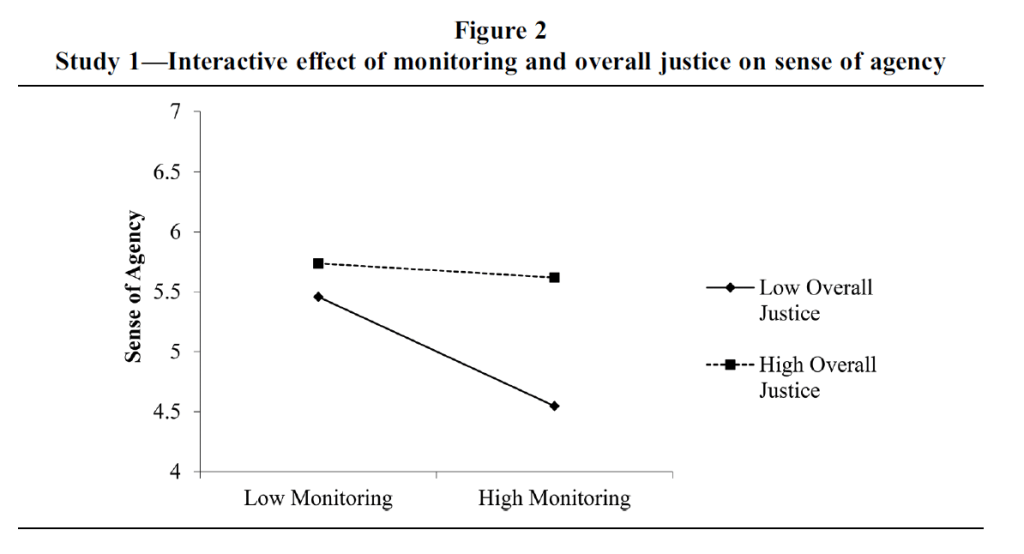
- Further, “this effect of monitoring on deviance was also mitigated by employee perceptions of overall justice, highlighting that monitoring does not necessarily have to produce undesired outcomes” (p13)
- The findings from study 2 largely supported those from study 1
The findings are next discussed. People are sensitive to being watched and at times will avoid norm-breaking behaviour while being monitored. However, monitoring also “creates conditions for disengagement from moral standards because it erodes employees’ sense of agency. Thus, monitored employees are prone to act out in deviant ways as their self-regulatory control is diminished” (p21).
These findings support the opening quote from the paper, highlighting that he took fewer unauthorised breaks at first after being monitored. However, this led to him finding ways to “game the system”, e.g. leaving a document open on his screen which then appeared on the monitoring system as working and he then started taking longer breaks.
It’s said that by “robbing people of a sense of agency over their choices, monitoring creates conditions wherein employees likely only respond to very salient external controls” (p21); this effect goes beyond just distrust.
Monitored employees are better able to “rationalize away their low sense of control because they perceive that they lack the agency to control their actions and assume responsibility for their choices” (p21).
Higher perceived justice has an overall buffering effect to monitoring – such that even if monitoring is perceived as coercive, it can be shaped by how fairly the organisation is seen to treat its employees. Thus, “monitoring that could be perceived as coercive may instead be viewed as acceptable by employees experiencing high levels of justice” (p21).
A view that monitoring deters deviant behaviour is said to be rooted more in economics rather than psychological perspectives. Sanctioning systems, including monitoring, change how people use their agency to make ethical decisions.
These results, and other work from the authors, also highlight how managers can enhance the benefits of monitoring and/or reduce some negative effects.
If monitoring must be used, then methods include:
- Establishing a “strong heuristic of fair treatment” via high levels of justice is necessary
- Managers should ensure employees have a favourable perception of justice prior to introducing controversial practices like monitoring
The results also have implications for employees, which I’ve skipped.
Authors: Thiel, C. E., Bonner, J., Bush, J. T., Welsh, D. T., & Garud, N. (2021). Journal of Management, 01492063211053224.
Study link: https://doi.org/10.1177/01492063211053224
Link to the LinkedIn article: https://www.linkedin.com/pulse/stripped-agency-paradoxical-effect-employee-deviance-ben-hutchinson

 SafetyInsights.org
One thought on “Stripped of Agency: The Paradoxical Effect of Employee Monitoring on Deviance”