This explored the role employee electronic monitoring (EM) plays in undermining ethical leadership by eroding trust. Data was via survey from a diverse field sample of supervisors and their employees.
Providing background on ethical leadership and employees, it’s said:
- Employees of ethical leaders perform their expected duties more effectively and ethically but also speak up when they observe workplace issues
- Employees of ethical leaders (EL) also undertake more organisational citizenship behaviours
- These effects result, in part, because ethical leaders typically form strong relationships with their employees and “thereby inspire ethical behaviours through social exchange processes” (p1).
Relating to EL and EM:
- Some prior research shows that monitored individuals “perform assigned tasks more efficiently … commit less deviance … and engage in more OCB … despite employee objections” (p2)
- Nevertheless, organisation’s on one hand emphasise ethicality in the hiring process and appraisal of supervisors and on the other hand “[subject] their employees to electronic surveillance … such as desktop software-based monitoring” (p2). EM also includes GPS-tracking, biometrics, video and more.
- EM is an “organizational control system involving the use of technology to observe, track, and evaluate employee behaviour” (p5) and some data indicates that >80% of large global companies electronically monitor employee performance
- Employees have reported a dislike, frustration, feelings of injustice and dissatisfaction towards EM and “decrying the choice-limiting, privacy-robbing, and coercive nature of the HR practice” (p5)
- It’s reasoned that because of how EM is perceived by employees, it will seek to undermine and erode the relationships between supervisors/leaders and their teams. Thus, challenging the very underlying principles of ethical leadership.
Results
Core findings included:
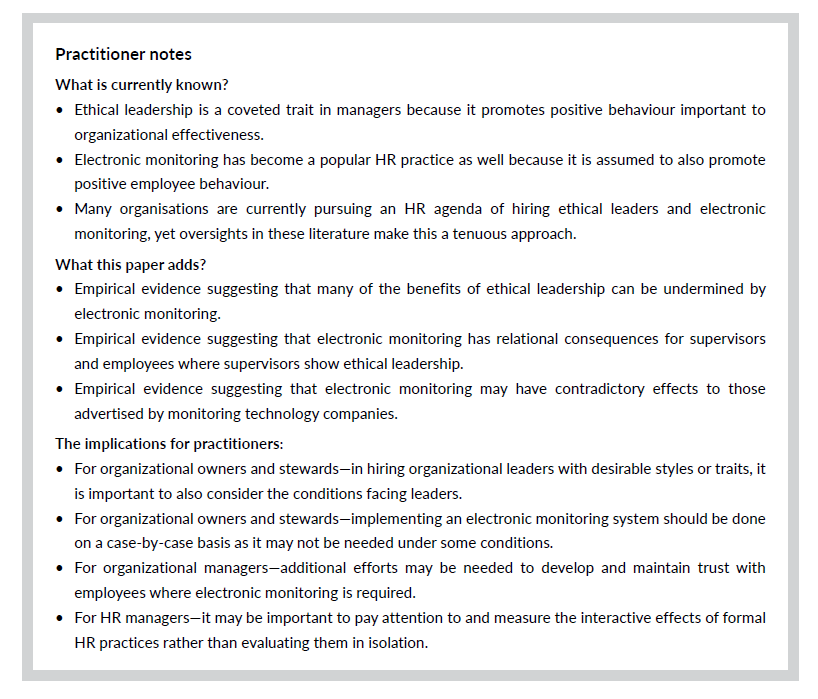
- “an ethical supervisor’s ability to positively shape employees is weakened by EM because monitoring erodes the trust their employees experience” (p11)
- Organisational conditions created through HR policy, like monitoring, can “undermine good relationships fostered by positive leadership” (p11)
- As expected, when EM was low, the relationship between EL and trust was positive and significantly related. When EM was high, the relationship between EL and trust was still positive but significantly smaller (shown in the graph below)
- The indirect relationship between EL and employee voice through trust was significantly larger when the EM was low compared to when EM was high
- Likewise, employee citizenship behaviour was larger when EM was low compared to high
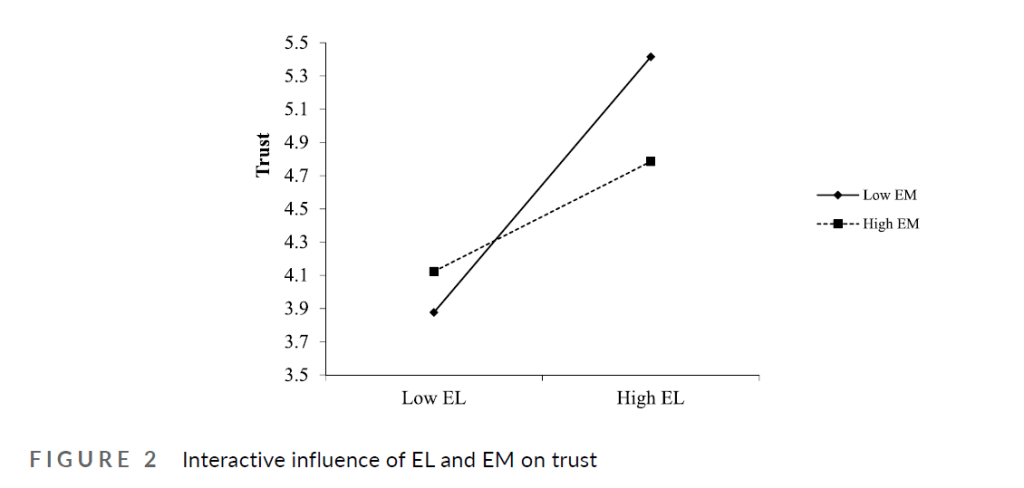
They also found that monitoring had no direct effect on employee trust in their supervisor, since trust only emerges if the leaders offer social benefits to followers.
Notably, while monitoring may be implemented to decrease deviance and try to enhance ethical behaviour, it “may paradoxically undermine the very behaviours it is designed to promote when employees are already supervised by an ethical leader” (p11).
Indeed, they argue that for organisations who are pursuing the hiring and development of ethical leaders, EM may do more harm than good. This is said to make sense because ethical leaders bring about positive outcomes through fair treatment humane employee conditions and thus introducing controversial practices like EM “would likely seem contradictory to employees” (p12).
If organisations want to keep using EM, the authors suggest it should be used on a case-by-case basis, since it may make sense in some conditions but not others (like when ethical leaders are already in place).
Further, the authors suggest that companies should either commit to “the hiring of ethical leaders and the fostering of an ethical culture … or EM, but not both” (p12, emphasis added) and further these approaches “are not complementary, as some may think” (p12).
Ethical managers who have no choice in EM should take proactive steps to mitigate the negative effects.
Authors: Thiel, C. E., Prince, N., & Sahatjian, Z. (2022). Human Resource Management Journal. 022;1–16.
Study link: https://doi.org/10.1111/1748-8583.12462
Link to the LinkedIn article: https://www.linkedin.com/pulse/electronic-walls-between-us-how-employee-monitoring-ben-hutchinson

 SafetyInsights.org
One thought on “The (electronic) walls between us: How employee monitoring undermines ethical leadership”