This explored how safety management factors (SMF), contextual factors (e.g. project & org. complexity) & combinations of factors are linked to Safety Performance (SP). 12 construction companies were compared using SP data, interviews & audit results. Small sample, so caution is advised.
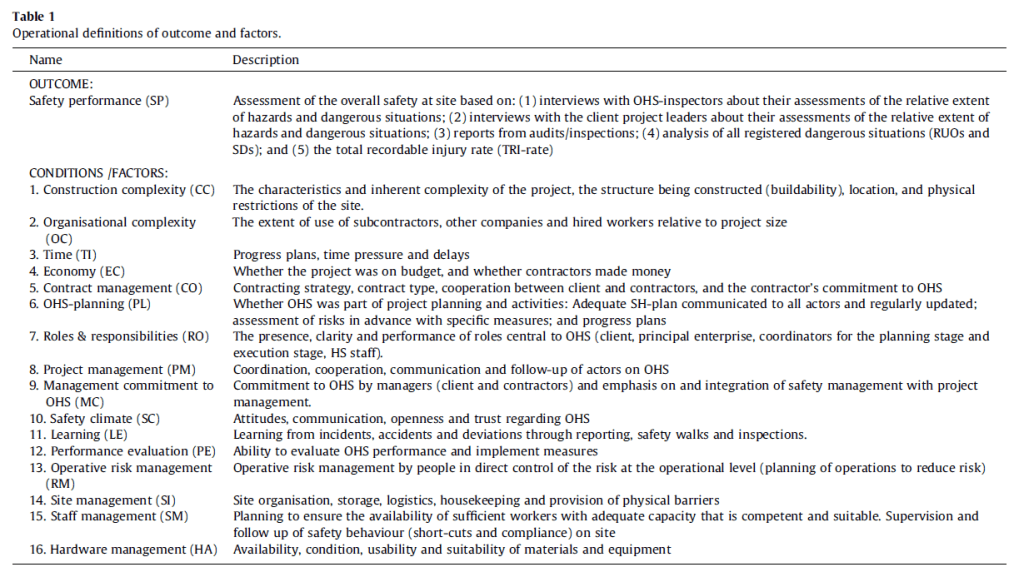
Included factors and definitions below.
Results
Expectedly, a higher average score on 12 SMF was found among projects with higher SP compared to projects with lower SP.
However, it’s possible to “achieve high [SP] despite many relatively poor safety management factors, and … possible to produce low [SP] despite many relatively good safety management factors” (p15, emphasis added).
8 of the 12 SMF were “necessary” for high SP. These are:
1. roles & responsibilities
2. project management
3. management commitment
4. safety climate
5. learning
6. operative risk management
7. site management
8. staff management
Operative risk management (management of risks at higher hierarchical levels) was good in all high SP companies and poorer in lower SP.
Interestingly, the combination of factors linked to high SP aren’t necessarily the same as those linked to lower SP, implying causal asymmetry. This may support the idea that we should study the range of performance (normal work, success, failure etc) rather than just mostly focused on failure.
Poorer performing projects were more similar to each other than the similarities between higher performing projects.
Although project/org complexity may increase the challenge of managing projects, “less” complexly interactive projects aren’t necessary for higher SP. More important is how it’s tackled, i.e. by the SMS and management practices. ORP was linked to tackling challenges related to complexity.
OHS-planning wasn’t found to be “necessary” for high SP, with most projects highlighting relatively “inadequate” provisions around planning. Considerable residual risks were left for workers to manage. However, the two projects with the highest SP also had the better planning in place.
Inadequate OHS planning may generally explain why operative risk management, staff & site management were so important for high SP, in that they cover how project & frontline workers deal with inadequate upstream planning and support.
Expectedly, management commitment and responsibilities around safety (including OHS project management) were found to be “necessary” factors linked to higher SP.
For contractor management, the formal contract management system wasn’t strongly linked. However, more important appeared to be how well the client/subs were able to “cooperate, communicate, and avoid conflicts” and the ability of people to work in tandem (p148).
Time & economy factors were connected to performance but not independently sufficient to explain performance, suggesting that how its addressed (via project/org planning, resources etc.) is of more importance. Like many factors in this study, context is most relevant.
Performance evaluation (indicators etc.) weren’t found to be necessary for high SP. More important than measurement itself appears to be how projects identified problems early in the project life & developed relevant indicators. Complexity impacted the ability to successfully measure things of interest.
Authors: Winge, S., Albrechtsen, E., & Arnesen, J. (2019). Journal of safety research, 71, 139-152.
Study link: https://doi.org/10.1016/j.jsr.2019.09.015
Link to the LinkedIn article: https://www.linkedin.com/pulse/comparative-analysis-safety-management-performance-ben-hutchinson

 SafetyInsights.org
One thought on “A comparative analysis of safety management and safety performance in twelve construction projects”