This study investigated biases in the context of risk assessment workshop facilitation and then mapped these against Rasmussen’s socio-technical systems model.
Interviews with 23 facilitators and technical experts was undertaken. Three research questions drove the investigation: (p5)
- Which biases are difficult for facilitators to manage in a risk assessment workshop, with the potential to falsely understate risk estimates?
- What levels of a socio-technical system model correspond with the sources of bias in a risk assessment workshop?
- What levels of a socio-technical system model, if any, are sufficiently independent of the bias source that they might counteract the bias?
Providing background, it’s said:
- Skew in risk estimations may overstate or understate risk; this is analogous to Type I and II hypothesis testing errors. Type I is when workshop teams incorrectly judge the likelihood/impact to be high (resulting in unwarranted risk reduction measures). Type II errors are more potentially dangerous, where estimates are understated, resulting in sufficient risk treatment
- Some have divided applicable biases into two types that affect risk judgements. One are cognitive biases, occurring from “cognitive operations which ‘default to contextually-appropriate, high-frequency responses” (p3)
- The other type are motivational biases. These “may be conscious or subconscious, and is characterized by changes in opinion based on external incentives such as social pressures, organisational environment, culture, and self-interest Motivational biases can permeate a workshop from the broader environment to not only affect individuals but potentially whole workshop sub-groups” (p3)
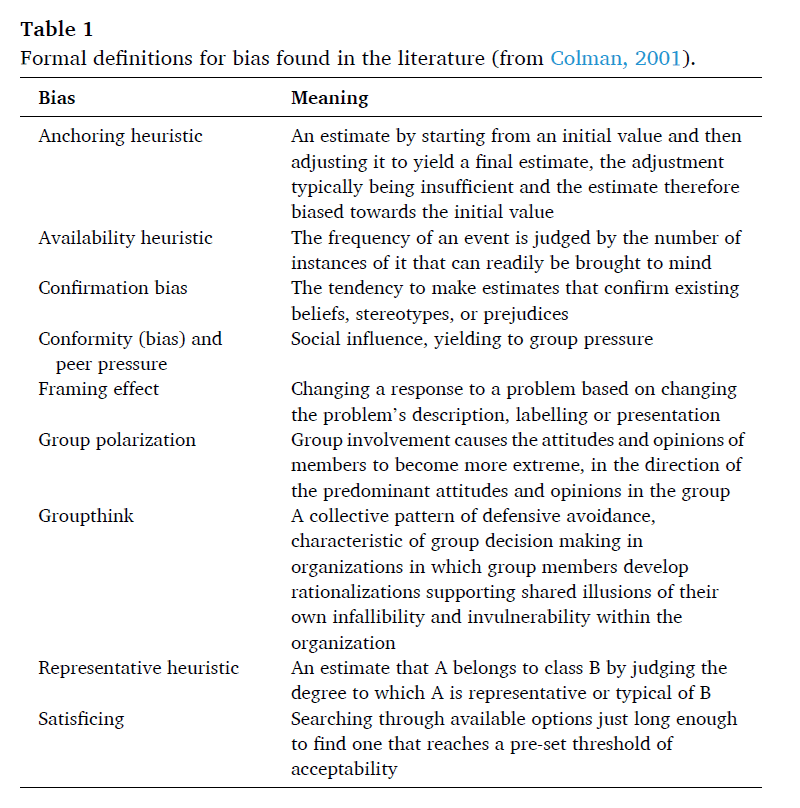
Some common types of biases are presented below.
Results
Six biases emerged from the results that may work to understate risk in workshops. Five were coded at a group level (39%), one was coded at an individual level. A single bias, authority figure, was observed in individuals but it influenced a workshop towards false understatement via peer pressure.
Each bias will now be briefly discussed.
Group biases
Organisational Confirmation bias
- This factor was characterised by a tendency of employees to “seek out or create data supporting previous actions that had been taken by an organisation” (p8)
- It was observed via the influence of project managers, who were seen to resist challenging design decisions which may have impacted project cost or schedule
- Authority figures were seen to frequently contribute to confirmation bias, like with design teams not wanting to rework their design or project managers not wanting to spend more money
- The prospect of design changes created a conflict of interest in design teams during risk workshops
- Also observed was a view that a lack of hazardous events indicated that a design was performing against its specs
- There was a tendency to under-report maintenance issues in one area of operations
- Safety targets/KPIs were also seen to exert pressure on personnel. Therefore “By not reporting near misses, facilities or plants were perceived to be safer than they actually were. Such beliefs were felt to permeate risk assessment workshops” (p8)
- Participants described how risk assessment exercises could become “routine confirmations of what was already there” (p9). Further, some noted a pressure to identify new stuff or things that aren’t meaningful, or routine hazards since they feel they have to write something down
- Others perceived some participants who didn’t want to be there or were generally uncooperative
Occupational roles
- This area had some overlap with organisational confirmation bias but was also distinct in that it stemmed from the professional role of the workshop participant and not the wider organisational factors
- Some risk workshop attendees may have roles that motivate them to protect a budget or design for instance, e.g. a project manager protecting costs versus an engineer protecting a design
- Instances of designs not adequately treating risks were given. A facilitator may have little ability to mitigate these potential impacts once the workshop is underway
- Also the facilitator was a source of bias, where they may direct or enforce what they think is right. For instance having a designer as facilitator could influence the entire workshop
- It’s noted that “influence on the workshop group may arise from facilitator’s own authority as a designer and their ability to speak to the design aspects. However, criticism for a design may also be interpreted as undermining their credibility as a designer and this may contribute to bias” (p9)
Cultural/Corporate Appetite for risk
- Risk appetite is the tolerability of risk and over time the tolerability may creep or normalise
- For risk workshops, “normalisation manifests as a reduced sensitivity to hazards that are constantly present but have not yet resulted in an incident” (p9)
- This was observed by participants by statements like how experiencing things every day leads to a normalisation where it isn’t seen as hazardous any more
- Another example related to a participant who dealt with risk assessment every day, and thus perceived low levels of risk. Any outstanding actions were eventually seen as noise
- The local culture or government jurisdiction was also seen to influence bias and risk appetite in workshops
Corporate Direction
- Another source related to risk workshop bias were actions during or after workshops that protected corporate interests
- For example, use of an authority figure (senior manager) to sign-off risks when they rank at a particular level
- This was seen to result in behavioural changes where people would “make sure that all risks were less than high, because getting senior managers to sign anything off was somehow embarrassing, awkward, or difficult” (p10)
- One participant observed how risk contours on a plant layout where manipulated in order to avoid new costs
- One participant was directed by an organisation to not find any new risks during a workshop that would require expensive risk treatments
Availability heuristic
- Availability heuristic is the higher priority given to things that can be more readily recalled
- For workshops, this was seen in how scenarios that reflected incidents that could not be recalled as having had occurred recently resulted in an understatement of the risk; this resulted in the group falsely believing the incident occurred with less frequency
- For things which had either not happened before (in the context of the group’s experience), these events lost credibility
- One participant relayed an example of a fatality that led to certain changes. After some time without a repeat incident the event itself was forgotten, and precautions went back to the original
Individual biases skewing to understated risk
Authority Figure
- In most cases of workshop bias, participants believed risk was overstated rather than understated
- In most cases these instances were seen to be manageable, however individuals in positions of power made this difficult
- People conveyed the power of groupthink and/or a desire for conformity in the presence of a powerful figure
- Some believed that specialist manufacturers could introduce some bias, like with generally overstating assurances of the safety of their plant
- Facilitators were, as mentioned earlier, also seen to introduce bias as some could “dispense with their impartiality and use the authority of their workshop role to impose their own judgement of risk” (p10)
The authors then discuss the biases as mapped against Rasmussen’s model; I’ve largely skipped this section but an extract is below:
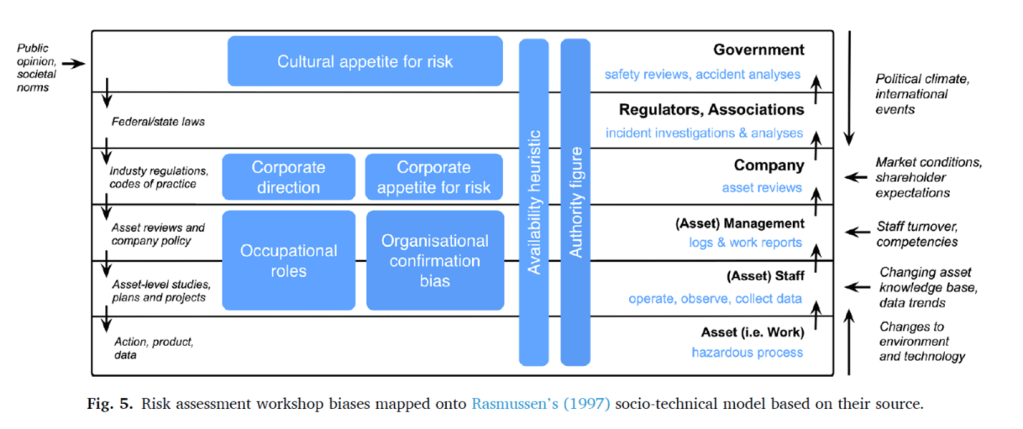
However, some points were: (* noting I’ve skipped large parts of the paper to summarise the below)
· Measures to control biases deriving from occupational roles and organisational biases would likely need to come from higher hierarchical levels (e.g. company level)
· Company-level biases, like corporate direction or corporate appetite from risk may be assisted via regulations and codes of practice from industry
· Companies with a global footprint may need to leverage corporate standards and consistent application of maximum levels of tolerable risk
· Group biases may be assisted via the de-identification of evidence of accidents and incidents
· Individual biases were seen to largely act via authority or cognitive heuristics. Availability heuristic was seen to influence attendees. Authority figures “was found to be an endemic problem of the
workshop methodology and ubiquitous across participants “ (p12). This may be tackled via coordinated facilitator training and other means
The authors then discuss some practical implications but I’ve skipped that section.
Authors: Hunt, D., & Naweed, A. (2023). Safety Science, 157, 105918.
Study link: https://doi.org/10.1016/j.ssci.2022.105918
Link to the LinkedIn article:

 SafetyInsights.org