This study explored the effects on team performance where not all members of a team necessarily agreed on the level of psychological safety within the team (e.g. dispersed perceptions of team psychological safety [PS]).
>1k members of 160 management teams were studied.
Providing background, it’s said:
- Team psychological safety (TSS) refers to “a climate where team members are not afraid to ask questions, do not fear being humiliated, are comfortable sharing ideas, can ask for help, and can safely admit mistakes” (p3)
- TSS is a cognitive group-level construct “originating in team members’ assessment of interpersonal risk in their team” (p3)
- The majority of existing PS research is said to focus on an assumption that PS is somewhat equally distributed throughout the team, but this isn’t necessarily the case
- Individual perceptions of PS collected 6 weeks apart were only moderately correlated, highlighting that PS can fluctuate over time
- Others, like Edmondson, maintain that group-level (team) PS is a more appropriate level of analysis than individual PS – however as above, the “sharedness” of PS (the degree of variance/dispersion, which they call “climate strength”) is a less studied area
- Existing research has mostly focused on average levels and within-group agreement, rather than as per the standard deviation
Results
Key findings included:
- Significant and positive relationships between TSS, climate strength and team performance
- TSS had a strong and positive contribution to team performance; explaining 31.5% of the variance
- Adding climate strength didn’t explain more variance in team performance over and above TSS
- However, the interaction of TSS and climate strength explained a small but significant part of the variance in team performance
- The perceived level of team performance is higher in polarised teams than in teams that conform or in unsafe outliers teams – quoting the paper “Since polarized teams also have safe outliers—as well as unsafe outliers— it indicates that having someone on the team perceiving a higher level of psychological safety than the rest is beneficial for teams low on team psychological safety” (p19)
- Interestingly, both safe outliers teams and polarised teams perceive a higher level of team performance than the overall mean of the whole dataset, even though their TSS is below the overall median of the whole dataset
Discussion
Summarising the findings, the authors note:
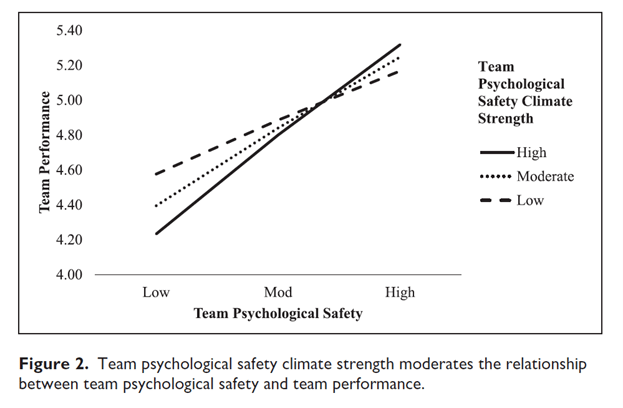
- TSS is positively related to team performance and the relationship is moderated by team PS climate strength. As they say, “the stronger the climate, the stronger the relationship between team psychological safety and team performance” (p20)
- Climate strength moderates both the relationship between high levels of TSS and team performance, and the relationship between low levels of TSS and team performance
- That is, “the positive effect of high levels of team psychological safety on team performance is strengthened when climate strength is high, and the negative effect of low levels of team psychological safety on team performance” (p20)
- Further, “the positive effect of high levels of team psychological safety on team performance will be greatest when management team members agree that there is a high level of team psychological safety, while the negative effect of low levels of team psychological safety on team performance will be greatest when management team members agree that there is a low level of team psychological safety” (p20)
- Interestingly, for teams with low levels of TSS, “teams are better off (in terms of team performance) when team members do not agree on the level of safety. One possible explanation is that some team members may perceive a considerably higher level of safety than the rest of the team, hence reducing the negative effect of low team psychological safety” (p21)
- Further on the above, the results indicate that for teams low on TSS, it’s beneficial to have a safe outlier (one or more team members who rate the level of TSS more than 1.5 standard deviation above the team’s TSS mean, e.g. higher dispersion/less agreement)
- They note “as long as there is at least one person on the team that perceives enough safety to share their views, questions, and concerns, the team can perform relatively well” (p22)
- And further, this indicates that good ideas or areas of concern may “may remain unspoken on the unsafe outliers and conform types of team because members feel it is unsafe to stand out, which is detrimental to team performance” (p22)
The authors discuss practical implications, summarised as:
- Teams will particularly benefit from a high level of TSS when all team members share perceptions that the team is actually psychologically safe. Thus, facilitating teams to focus on potentially divergent perceptions when building safe teams may be prudent (perhaps through a team charter and other alignment activities)
- Team leaders also need to be acutely aware on whether all team members contribute evenly or if some team members have too much power or sway
- Highest performing teams are those in which both the level and sharedness (climate strength) of PS is high. Thus, to build safe teams, “the focus should be on team psychological safety for the team as a whole and on lifting all team members to that level so the safety is shared” (p23)
- In contrast, for unsafe teams, “it is beneficial for team performance that safety (or lack thereof) is not shared (i.e., to have low climate strength). Thus, instead of increasing every team member’s perceived safety because it may take some effort, it may be worthwhile to ensure that at least some team members experience safety in teams that are low on team psychological safety and need to perform in the short run” (p23)
Authors: Fyhn, B., Bang, H., Sverdrup, T. E., & Schei, V. (2022). Safe Among the Unsafe: Psychological Safety Climate Strength Matters for Team Performance. Small Group Research
Study link: https://doi.org/10.1177/10464964221121273
Link to the LinkedIn article: https://www.linkedin.com/pulse/safe-among-unsafe-psychological-safety-climate-team-ben-hutchinson

 SafetyInsights.org
One thought on “Safe Among the Unsafe: Psychological Safety Climate Strength Matters for Team Performance”