A classic from David Woods & the late, great Richard Cook.
Here they critique the label of “human error”, as if “it were an explanation for what happened”; rather being a label that organisations can readily get stuck on.
They provide nine generalised steps to help organisations move on from these labels and enhance learning – I’ll be posting a summary of this paper soon but for now, the image provides the nine steps.
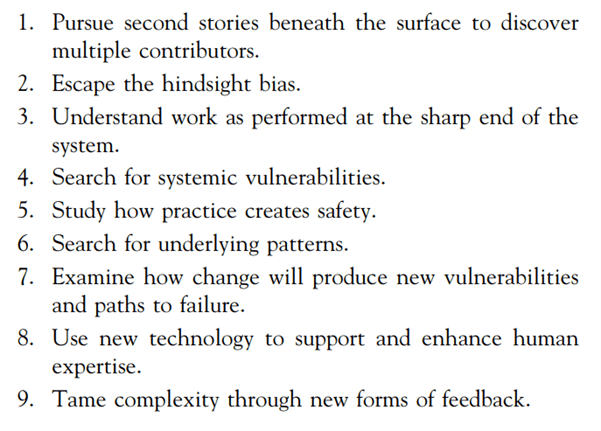
In short, organisations are driven to collect first stories – overly simplified accounts of apparent causes which are biased by knowledge of the outcome.
First stories “appear to be attractive explanations for failure, but they lead to sterile responses that limit learning and improvement”.
Instead, organisations should seek second stories.
Second stories direct attention to people at the sharp end with the most knowledge of how normal work occurs; navigating difficulties, complexities, dilemmas and trade-offs.
Learning from second stories via normal work pushes us towards practice-centred observation, which is technical work in context. It helps to uncover systemic vulnerabilities normally hidden from sight.
Understanding practice-centred observation is critical because “doing technical work expertly is not the same thing as expert understanding of the basis for technical work”; one doesn’t necessarily flow from the other.
Finally, complexity can be navigated, in part, by opening up new forms of feedback. In one way, feedback can help situate an organisation in its trajectory towards failure.
Source: Woods, D. D., & Cook, R. I. (2002). Nine steps to move forward from error. Cognition, Technology & Work, 4(2), 137-144.
Link to the LinkedIn post: https://www.linkedin.com/posts/benhutchinson2_a-classic-from-david-woods-the-late-great-activity-6986434060017422336-z3cN?utm_source=share&utm_medium=member_desktop

 SafetyInsights.org