This study explored the relationship between lack of sleep on the development of leader-follower relationships from initial commencement to over time.
40 leads and 120 followers were included in the study.
Providing background they note:
- Sleep-deprived people tend to be more emotionally reactive, and particularly with negative emotions (e.g. hostility)
- Sleep deprived leaders (or followers) then expose the other parties to hostility, thereby diminishing relationship quality (and perhaps more so earlier in the relationship timeline)
- Sleep-deprived people are often unaware or unwilling to acknowledge how their sleep impairment can/has negatively influenced their behaviour
- Therefore, they may signal hostility cues to the other party without even realising it
- Expressed emotions have been found to be important in relationship evaluations. One study found that leaders who suppressed their negative emotions (through deep acting) were perceived as more charismatic by followers
- Followers’ sleep was also linked indirectly on evaluations of leadership charisma via positive affect
- A study on marital couples found that a partner’s sleep problems were associated with self-ratings of marital unhappiness (even accounting for their own sleep problems)
Results
Key findings included:
- “leader and follower lack of sleep influenced the other party’s perceptions of relationship quality via hostility” (p68)
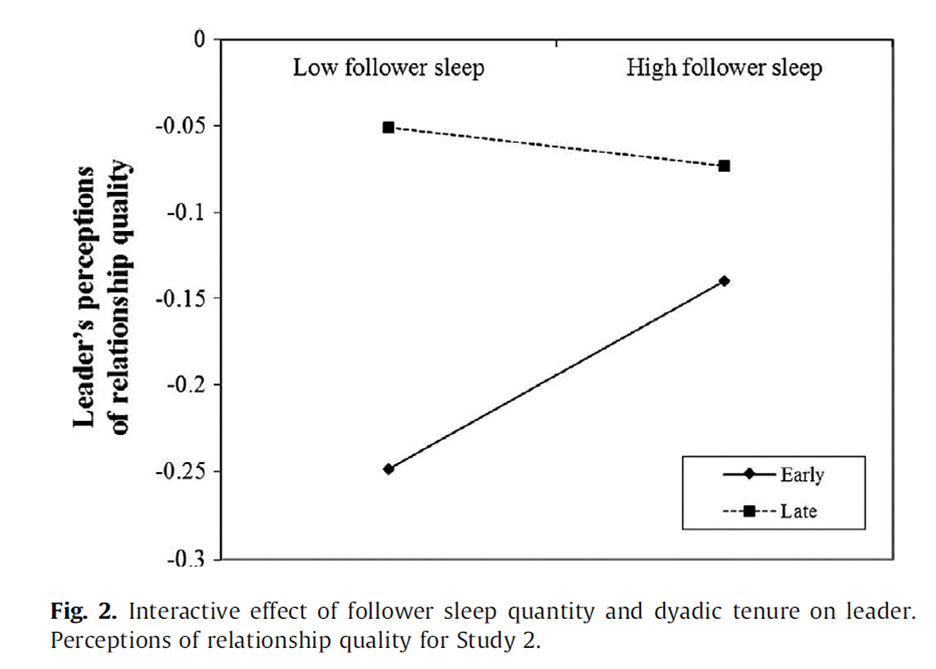
- Leader sleep was linked to follower perceptions of relationship quality irrespective of the relationship tenure, while in contrast follower sleep quantity was linked positively to leader perceptions of the relationship only at the beginning of the relationship tenure
- Lack of sleep influenced relationship awareness. Leader sleep quantity had a stronger effect on follower ratings of relationship quality than self-ratings of relationship quality, and vice versa for followers
It’s argued that these findings challenge and extend LMX (leader-member exchange theory), which have largely focused on stable individual characteristics for relationship quality, by showing a dynamism related to sleep.
Further, this dynamism can influence an individual’s perceptions of relationship quality over and above things like extraversion and agreeableness.
Sleep deprived leaders and followers experience hostility, which then influences the other party’s perception of their relationship quality.
There is an asymmetrical effect of sleep deprivation on relational awareness, such that sleepy people underestimate the effects of lack of sleep on the perception of relationship quality by the other party – and are not completely aware of the affective and behavioural signals.
The “presence of relational asymmetry in dyads is consistent with recent work on emotional inaccuracy reported by sleep-deprived couples” (p69).
These findings also “imply that LMX is influenced by emotional cues that are triggered by factors potentially unrelated to the organizational context” (p69).
They further note that their findings “advance the LMX field by incorporating a distal antecedent (sleep) and a discrete emotion (hostility) as antecedents influencing the development of leader-follower relationship quality” (p69).
They argue these findings suggest organisations should make efforts to minimise sleep loss within their workforce in order to better nurture higher quality relationships; e.g. via a range of fatigue risk management principles and better design and management of schedules, working hours, sleep opportunity, staffing levels etc.
Authors: Guarana, C. L., & Barnes, C. M. (2017). Organizational Behavior and Human Decision Processes, 141, 57-73.
Study link: https://doi.org/10.1016/j.obhdp.2017.04.003
Link to the LinkedIn article: https://www.linkedin.com/pulse/lack-sleep-development-leader-follower-relationships-over-hutchinson

 SafetyInsights.org
One thought on “Lack of sleep and the development of leader-follower relationships over time”