Safety failures, so it goes, are caused by unreliable or erratic performance of individuals working at the sharp end.
This is a first story. First stories focus on agency of individuals and how they undermine systems that are inherently safe.
First stories are noted to appear as attractive explanations for failure, but ultimately lead to “sterile responses” that limit learning and improvement.
Importantly, first stories act as forms of social control within organisations – limiting and distancing the organisation’s responsibility for designing safer systems, and act as convenient stop-points in investigations when the first person with sufficient agency is identified.
As Woods et al. note, if “erratic people are the cause, then the response is to remove these people from practice” or quite commonly, “provide remedial training to other practitioners, to urge other practitioners to try harder, and to regiment practice through policies, procedures, and automation”.
In contrast, second stories look more closely at the system in which people and technology are embedded and hence “reveal the deeper story – a story of multiple contributors that create the conditions that [shape operator [performance]” (p6).
They argue that since human performance, at least in part, is shaped by systematic factors, “the scientific study of failure is concerned with understanding how these factors lawfully shape the cognition, collaboration, and ultimately the behaviour of people in various work domains” (7).
Although, this isn’t of course just for failure but equally all work.
Indeed, they highlight how “systemic regularities” generate conditions “ripe with the potential for failure” and while our ability to predict the timing and number of erroneous/unexpected actions is weak, our ability to “foresee vulnerabilities that eventually contribute to [performance variability] is often good or very good” (p7).
Fixing systemic issues hinges on our ability to dig deeper and move beyond simplified and alluring first stories. Hence, second stories are about levers for organisational learning.
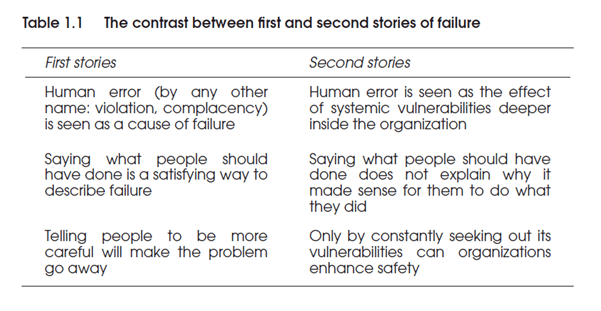
Source: Behind Human Error. (2010). Woods, D, Dekker, S, Cook, R, Johannesen, L, & Sarter, N. Ashgate Publishing.
Link to the LinkedIn article: https://www.linkedin.com/posts/benhutchinson2_safety-failures-so-it-goes-often-result-activity-6991512241091080192-oRGW?utm_source=share&utm_medium=member_desktop

 SafetyInsights.org
One thought on “The allure of first stories, the tragedy of second stories and the levers for learning”