This study, including Sidney Dekker as co-author, evaluates the impact of a new response framework following critical incidents – called the Gold Coast Clinical Incident Response Framework (GC-CIRF).
GC-CIRF utilises a Restorative Just Culture (RJC) framework and Safety-II principles. A number of initiatives were involved in the framework, including tools for carers to use post event, training and several other initiatives (see the paper for the full list).
GC-CIRF draws on RJC and S-II principles “structured around building culture, healing and “learning anything” rather than a narrow linear focus on cause close to the frontline or proximal to the incident, leading to recommendations of high quality and strength” and “asks stakeholders who is impacted, what do they need, and who has the obligation” (p9).
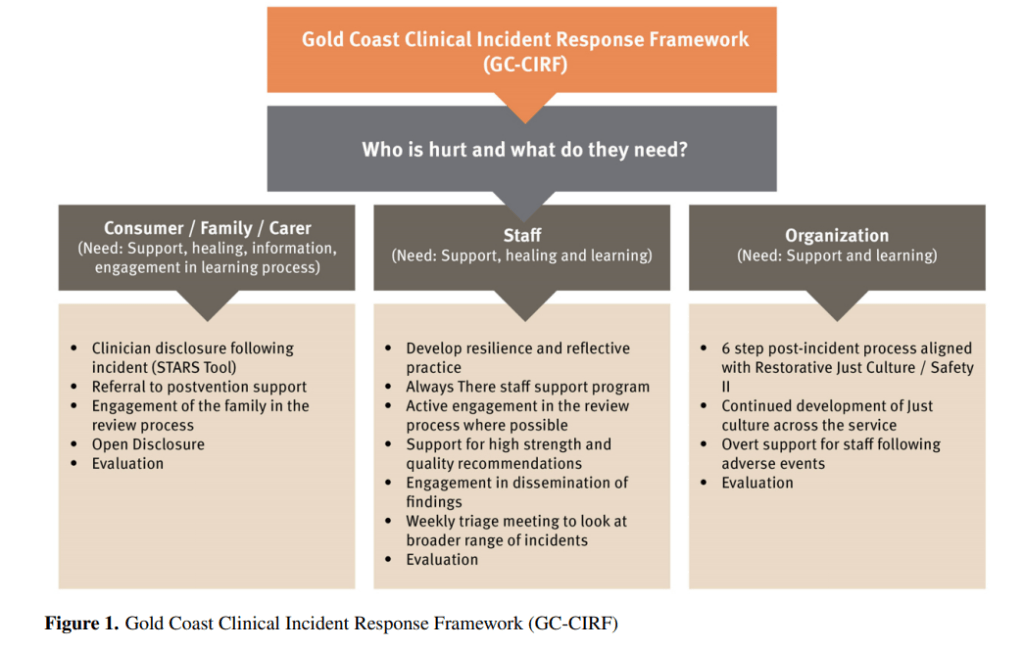
Impact pre and post implementation of the framework was assessed via surveys of just culture and second victim experiences and evaluation of the quality of learning recommendations and processes pre and post.
Providing background the authors argue that:
- Event investigation processes and learning and quality improvements in healthcare don’t adequately reflect the complexity in healthcare, but rather “Seeing complex systems as componential and linear” (p8)
- For mental health, linear perspectives that lead to concrete “causes” and “broken parts that can be fixed with a policy, rule or poster” may “drive restrictive practices, risk secrecy and underreporting because of the backward-looking accountability of traditional, retributive just cultures that are organized around individual actions, transgressions and consequences” (p9)
- In contrast, perspectives more embracing RJC and S-II lenses may assist “to respond to challenges … even if these fall outside the scope of design, training or quality initiatives” (p9)
- Further, forward-looking accountability explores the needs following an incident, and the obligations from all stakeholders to improve
- Thus, RJC “promotes healing, learning and quality improvement by asking what needs to be done to set people up for success, including consumers, families, clinicians and organizational stakeholders” (p9)
I can’t provide all study context or results, so I recommend checking out the full paper.
Results
Overall, it’s noted that these results “demonstrated improved just culture and second victim experiences, performance of reviews of a much larger range of incidents and near misses, a deeper understanding of what is going well (in line with Safety II), improved stakeholder engagement (in line with RJC), and an increase in number, strength and quality of recommendations” (p14).
The above occurred while moving away from root cause analysis techniques and “greater involvement of the treating team” (p13).
To their knowledge there were no other policy changes, adoptions or cultural shifts that may have occurred or could have accounted for the observed effects.
Some specific findings included:
- Significantly fewer staff post-intervention reported being afraid of disciplinary actions or being blamed when involved in an event (16.5% vs 20.3% pre and post)
- More staff related higher trust in the hospital to handle such events fairly (40.3% vs 25.3% pre and post)
- Statistically significant associations noted between staff ability to actively participate in the incident review process and more positive perception on all domains of just culture, less distress and negative impacts on their professional self-efficacy + more associations
- A large number of non-event data was incorporated into the learning cycle
- A statistically significant change was found with a higher average number of recommendations per event post initiative compared to pre
- The percentage of cases where auditors believed the assigned action made a change to the identified issue increased pre and post (64.8% vs 81%)
- GC-CIRF contributed to more specific recommendations with clear aims and more measurable recommendations including “substantive measure of performance improvement” (p14)
- However notably, even with these improvements “the majority of recommendations made after November 2018 (61.3%) continues to be rated as weak by the auditors, with a very low percentages considered to be strong (8.0%)” (p14)
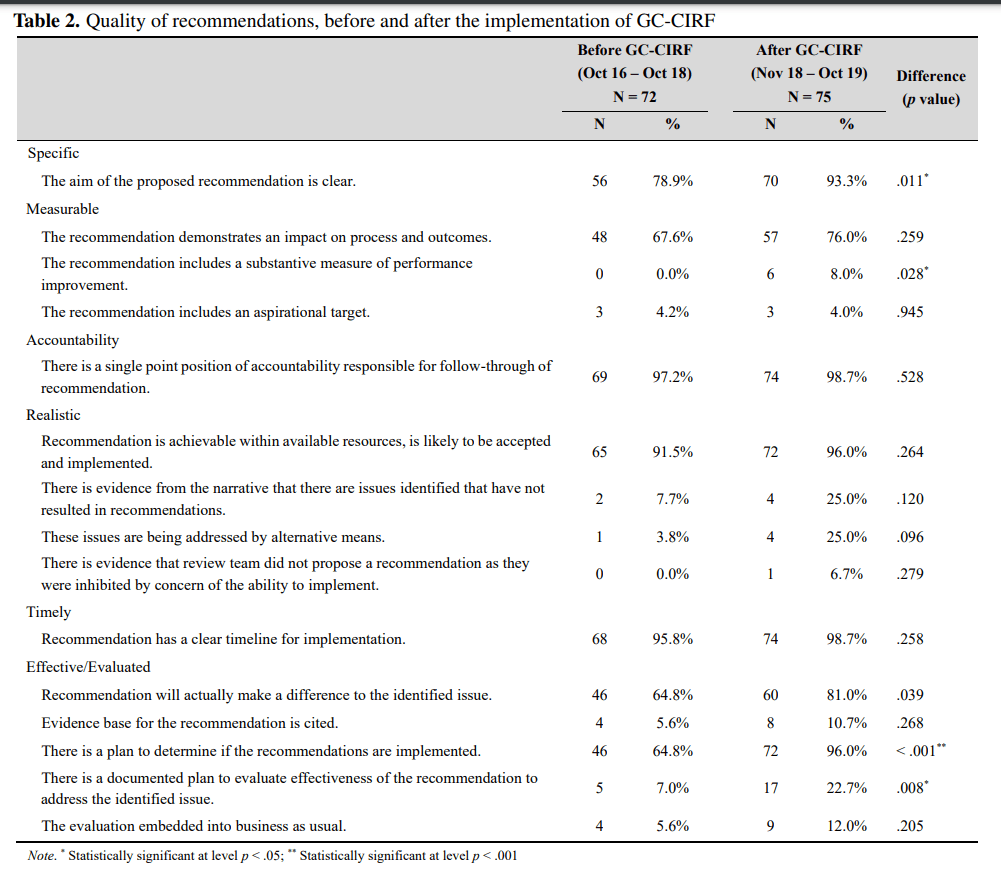
While significant improvements in the quality and strength of recommendations following the implementation of GC-CIRF, as noted above few of these were classified as a “strong” action.
Nevertheless, there were still “substantial changes away from modifying procedures and rolling out education, and towards more resilient responses such as enhancing team coordination, engaging with families, and simulation exercises to understand work as done” (p14).
They argue that while these types of actions aren’t deemed strong under a hierarchy of controls framework, they can be more desirable within complex social systems.
The “learn anything” principle within this framework, aimed to increase the capacities and opportunities to learning away from discrete events to anything that could be useful.
They note additional modifications to the GC-CIRF should be undertaken, as with more research.
Suggestions on modifications include:
- Increasing staff awareness of the concepts of S-II and RJC
- Remaining open to a range of possible learnings and actions
- Improving understanding of the misalignments between demand and capacity, WAI/WAD, trade-offs and adaptations, supporting actions to enhance team work, coordination and diversity of opinions
Several study limitations were noted.
Authors: Turner, K., Sveticic, J., Grice, D., Welch, M., King, C., Panther, J., … & Dekker, S. (2022). Journal of Hospital Administration, 11(2).

Study link: https://doi.org/10.5430/jha.v11n2p8
Link to the LinkedIn article: https://www.linkedin.com/pulse/restorative-just-culture-significantly-improves-ben-hutchinson

 SafetyInsights.org
2 thoughts on “Restorative just culture significantly improves stakeholder inclusion, second victim experiences and quality of recommendations in incident responses”