This study mapped similarities between the concepts of work engagement and Safety-II (S-II) – and in particular, the antecedents for each.
I’ve skipped large portions of this paper and particularly the research behind the engagement constructs (which I’ve mainly skipped to the S-II comparison discussion in each section), so recommend you check out the full paper.
Providing background, it’s noted that:
- Practitioners in organisations draw on a mixture of S-I and S-II approaches
- They cite previous research which looked at S-II on intervention design and that most studies focused on assessing the procedural landscape and just two offered recommendations on how to improve at the coalface
- That is, “to date, the focus on Safety-II interventions appears to be process- and system-related, rather than focussed on empowering and supporting the humans in the system by way of creating resilience” (p2)
- And that “Safety-II fails to explore the mindset needed amongst the managers and workers of an organisation to make a success of these empowering and collaborative approaches to safety” (p2)
- This is problematic, since S-II “requires managers to collaborate actively with workers to create mutually-beneficial working environments and this is contingent on them viewing workers as experts and ceding some of the managers’ own authority to workers” (p2)
- Nevertheless, the combination of S-II approaches and engagement strategies may work in unison, but evidence comprehensively linking the two is absent
Again, note that I’ve skipped most parts of the findings discussing the engagement constructs (psychological availability, psychological safety and psychological meaningfulness, which they show via an engagement wheel graphic).
Results
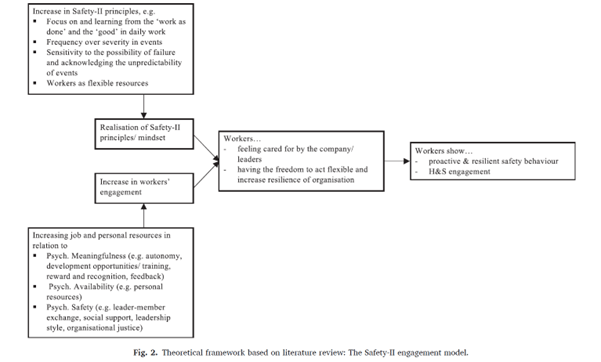
Overall, this paper highlighted how “engaged workers can be seen as antecedents for Safety-II behaviour” (p10) and that “the antecedents of Safety-II and work engagement are very similar” (p10).
The authors propose that “by companies investing in [worker engagement], they may also support a movement towards Safety-II, and similarly, while implementing Safety-II principles, [worker engagement] will be promoted” (p10).
Engaged workers go the extra mile and this is fostered via greater autonomy, job redesign, balanced feedback, and positive relationships between leaders and workers. Here, “Safety-II shares these antecedents with [worker engagement]” (p10).
In alignment with the work of Provan et al. on the role of safety professionals, the authors concur that professionals should “adopt a coaching role instead of a policing and monitoring role” (p10); the arguments from Provan et al. are supported by the research in worker engagement fields.
A model of the interactions is shown below:
Some specific findings will now be covered.
Engagement antecedents: psychological meaningfulness
Alignment with S-II was found here via organisations needing to facilitate workers taking responsibility through their own autonomy, mastery and purpose; all factors in line with meaningfulness on the work engagement wheel in the paper.
They note that research suggested that safety performance quality could be enhanced through a S-II approach when considering employee training that enhanced their reflective learning to improve work/role adaptation.
Research highlighted that higher autonomy and higher decision latitude positively improved relationships with work engagement. This aligns with the S-II perspective where “autonomy coupled with recognition of their skills to build confidence in their ability is necessary, when expecting them to draw on their experience, cognitive skills and intuition in adjusting to unpredictable and dynamic working environments to create safety” (p5).
One limitation of published S-II interventions thus far is the focus on learning between WAI/WAD and less so on “empowering and supporting the workers to independently adjust their own behaviour and practices successfully” (p5).
Engagement antecedents: psychological safety
Overlaps with S-II include calls for organisations to enhance just and/restorative cultures in order to facilitate accountability through learning.
These were also antecedents for worker engagement via reducing blame, and demoralising psychological availability factors, which go on to reduce an individual’s personal resources; thereby leading to heightened stress and anxiety.
They argue that in practice this means that an organisation “must pay attention to their employees’ personal resources through two-fold support; on the one hand, by increasing personal resources using social mechanisms such as feedback, training, and coaching; and on the other, through organisational factors such as creating a fear- and stress-free climate” (p8).
Summary
In discussing the findings, the authors highlight that in order to improve worker engagement, general practices need to be shifted that show workers that the organisation/leaders really care, and their H&S efforts are actually valued by the company.
Moreover, factors involving the organisational context, job context and individual psychological and motivational factors are also considered; in line with factors described under the various S-II movements.
For workers to apply S-II principles, a necessary level of autonomy and job design without fear of punishment needs to be in place. This could include reducing “unnecessary bureaucratic procedures”, which might enhance the flexibility of workers.
They quote Dekker around asking workers “what documents or procedures they perceive as least helpful/most hindering in order to do their work efficiently” (p11).
For organisations to establish such just cultures of trust and autonomy, organisations “need to establish a system of social (e.g. coaching, recognition, trust, etc.) and organisational support (e.g. autonomy, training, equipment, etc.) to equip workers with the requisite personal and work resources to perform well and remain engaged” (p11).
As they noted, worker engagement and S-II principles seem to have a lot of synergies and overlap and hence, improving one may enhance (rely) on the other. You will need to refer to the full-paper to see how S-II principles specifically interact and have similarities with the engagement antecedents (usefully, the authors present several tables comparing the antecedents).
Nevertheless, the authors note that while the narrative and theoretical links between S-II and worker engagement are “sound”, the direct link between S-II behaviour and worker engagement needs to be tested empirically. Other limitations were also noted.
Authors: Homann, F., Limbert, C., Bell, N., & Sykes, P. (2022). Safety science, 146, 105521.
Study link: https://doi.org/10.1016/j.ssci.2021.105521
Link to the LinkedIn article: https://www.linkedin.com/pulse/safety-through-engaged-workers-link-between-safety-ii-ben-hutchinson

 SafetyInsights.org
One thought on “Safety through engaged workers: The link between Safety-II and work engagement”