This explored the relationship between a psychosocial risk indicator (obtained via survey data) with hydrocarbon leaks on Norwegian oil & gas producing platforms and whether the indicator can be used as a proactive indicator for preventing such leaks.
The study also factored in the some technical issues of offshore installations, including installation age, weight and number of leakage sources.
Hydrocarbon leaks at offshore installations over 2010-2011 were considered.
Providing background on the topic, it’s said:
- ~40% of hydrocarbon leaks occur in connection with normal operations, with the remaining related to maintenance work
- Human error/failures of front-line operators in many cases represent only a superficial representation of the accident and “human error often derives from underlying factors that have developed in the system over a period of time” (p825)
- Within O&G, a traditional focus has been placed on technical factors. While technical factors are critical, also important are human and organisational factors (HOF)
- On the above, psychosocial hazards fall under such HOFs. Defined as “those aspects of work design and the organisation and management of work, and their social and environmental context, that have the potential for causing psychological, social or physical harm” (p825).
Exposure to psychosocial hazards can result in:
- Increased work-related stress and negative impacts in psychological, cognitive, social and physiological facets
- Stress, which can then result in poor sleep, fatigue, excessive drinking, depression, anxiety, anger and inattentiveness, among others.
- People experiencing higher cognitive or physical symptoms of work-related stress they’re more likely to become momentarily distracted, have impaired judgements and/or have wider variability in performance
- Higher stress may impact interpersonal relationships, impair communication between employees and “Stress has been also shown to be associated with lower levels of work situation awareness for drilling personnel on oil and gas installation” (p826)
A psychosocial risk index (PRI) was calculated based on a yearly survey that also measured perceived exposure to psychosocial hazards (see the full paper for more info on the index).
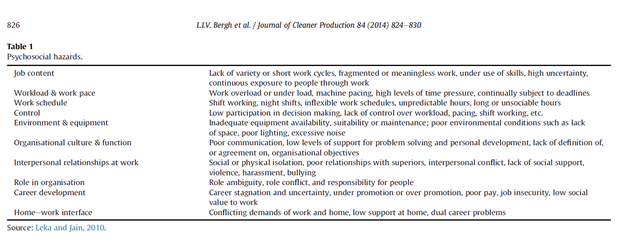
Some psychosocial hazards are listed below.
Results
Based on regression analysis it was found that “only a poorer psychosocial risk score (higher psychosocial risk) reported for installations was associated with a greater number of hydrocarbon leaks for two consecutive years” (p828).
They note that the findings of a significant link between higher reported psychosocial risk and a greater number of hydrocarbon leaks is consistent with investigation reports of accidents that have occurred in the industry.
Only partial support was found for the relationship between the selected technical factors (e.g. installation age, weight, number of leakage sources) and hydrocarbon leaks.
That is, although the PRI was the only factor that accounted for significant variation in hydrocarbon leaks, leading them to conclude that “psychosocial risks may be more important than the technical indicators included in this study”, the technical factors (technical complexity and condition of the installation) did seem to influence hydrocarbon leaks to some extent. However, these effects were weakened by the inclusion of psychosocial risks.
Interventions addressing psychosocial hazards could include:
- Better work redesign
- Better work organisation
- Improving the social work environment and work climate
The use of the PRI is a simple and easy tool that may help organisations when used as a proactive measure. These tools should help organisations to identify conditions where employees are, for example, exposed to conditions of high job demands in combination with low control and low support.
Nevertheless, further research is needed to study both the PRI and technical factors. Moreover, the PRI and other indicators should be used as part of a comprehensive system. Combining different indicators “provides managers with a navigation path to corrective actions, by highlighting the business areas that need the most attention”.
For example, if installations observe a combination of high psychosocial risk and frequent hydrocarbon leaks then attention should be paid to “how work is designed, managed and organised” [although that should probably happen in all instances, especially for high-risk work or work at risk of high exposure to psychosocial hazards] (p829).
In concluding the findings, it can be said that “only the psychosocial risk indicator significantly accounted for variation in hydrocarbon leaks. Only partial support was found for the relationship between technical factors and hydrocarbon leaks on the basis of correlation analysis” (p824).
These findings are related to other studies which explored the connection between safety climate and hydrocarbon leaks, see link below.
Note: As with any study, this had its own limitations which have to be factored in to the analysis and application. First – it’s a worker survey and based on a relatively infrequent sample of hydrocarbon leaks. Second, there’s real statistical challenges in connecting infrequent outcomes with upstream factors. Third, there’s likely a host of other factors that are relevant but weren’t incorporated into the analysis.
Authors: Bergh, L. I. V., Ringstad, A. J., Leka, S., & Zwetsloot, G. I. (2014). Journal of Cleaner Production, 84, 824-830.
1. Study link: https://doi.org/10.1016/j.jclepro.2013.09.040
2. Summary of safety climate and hydrocarbon leaks #1: https://www.linkedin.com/pulse/safety-climate-hydrocarbon-leaks-empirical-ben-hutchinson
3. Summary of safety climate and hydrocarbon leaks #2: https://www.linkedin.com/pulse/safety-climate-indicator-major-accident-risk-can-we-use-hutchinson
4. Link to the LinkedIn article: https://www.linkedin.com/pulse/psychosocial-risks-hydrocarbon-leaks-exploration-oil-ben-hutchinson

 SafetyInsights.org
2 thoughts on “Psychosocial risks and hydrocarbon leaks – an exploration of their relationship in the Norwegian oil and gas industry”