When investigating adverse events, “has the pendulum swing too far” towards remote and abstract organisational factors and away from local conditions.
Among helping to popularise organisational & system approaches to understanding safety and unsafety, James Reason also questioned the extent of chasing latent and upstream factors versus downstream worksite factors.
[Note. I present this more from the modern historical perspective rather than as something I necessarily agree or disagree with.]
In the context of nuclear safety, but he notes in virtually all high hazard contexts, there are “diminishing returns for risk management, in particular, as one moves away from the local contributing factors”.
Reason doesn’t argue to abandon upstream factors, nor exclusively proximal behavioural factors, but instead a “middle-ground be identified and that the limited resources available be focused upon tackling these problems”.
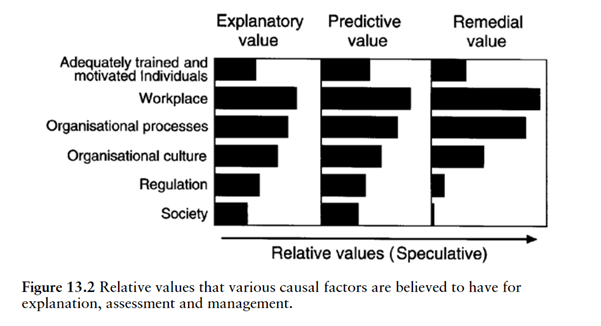
In image 1, Reason provides his views on the value different hierarchical levels have in explaining, predicting and fixing safety in an organisation can have. Namely:
- Individual factors alone only have a small to moderate value for all three goals
- Workplace & organisational factors contribute the most added value across goals
- Rapidly diminishing returns come when pursuing the more remote influences, particularly for countermeasures and risk management
While there’s no limits how far one can pursue upstream factors, for practical reasons safety & operational staff aren’t historians, so have stop rules on investigations. Reason suggests three stop rules:
- Focus on manageable issues., since risk management s about managing the manageable
- Stay within the influence range of the system’s managers and regulators
- Concentrate on identifying and reducing the tractable problems.
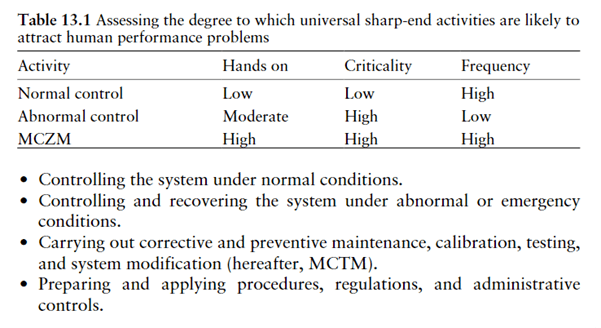
He further suggests re: human performance, focus can be directed in advance to areas known to be most susceptible to variability.
He provides his thoughts in image 2, with performance under normal conditions, abnormal conditions and under maintenance work. In his view, and supported by some data, maintenance work carries the greatest potential for a priori improvement since it scores high on all three problem-attracting criteria: hands on, criticality, frequency.
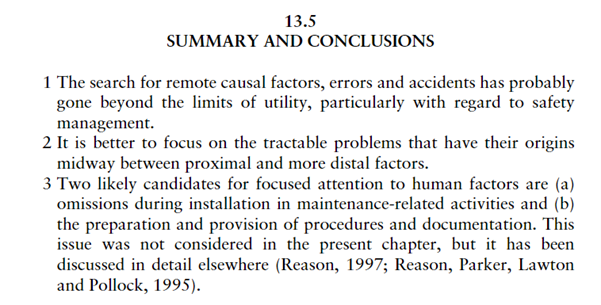
Lastly, he summarises his key contentions below.
Source: Reason, J. (2003). Are we casting the net too widely in our search for the factors contributing to errors and accidents. Nuclear Safety: A Human Factors Perspective, 212.

Link to the LinkedIn post: https://www.linkedin.com/posts/benhutchinson2_when-investigating-adverse-events-has-the-activity-7001677201741934592-m3WG?utm_source=share&utm_medium=member_desktop

 SafetyInsights.org
3 thoughts on “Has the pendulum swung too far in investigations and safety?”