I found this an interesting little study. They studied how people employ resilient behaviours to varying degrees of variability.
Via use of a fire fighting simulator, 21 uni students [** note the limitation of the sample] responded to a range of building fire extinguishing scenarios that introduced degrees of variability (e.g. removing fire trucks from the response, changing available resources, suddenly changing wind direction).
This occurred after being tasked to memorise and apply a fire extinguishing manual, which provided standard guidelines for efficient firefighting work.
A key premise in this study was that while both S-I and S-II are mutually beneficial, each may have different strengths to be emphasised in different contexts, such as when things suddenly and unexpectedly change more focus may be placed on S-II capabilities in order to adapt.
Here they wanted to clarify just how much variability in tasks/situations was necessary before people needed to adopt resilient/adaptive behaviours outside of standard operating manuals. Or as they said, “The purpose of this study was to clarify whether a human being responds flexibly without using a manual when the situation fluctuation is large (resilient behavior) and whether some factors could prevent that resilient behavior from failing” (p509).
[Just a note: while this was an empirical study, it was published in a rather brief conference paper style, so didn’t have a lot of technical details or explanatory notes which would have been useful.]
Results
Key findings which explored resilient behaviours as a situation fluctuated moment to moment was that:
- People changed from following standardised procedures to adaptive resilient behaviour when the variability in a task was “somewhat large” [** their data breaks this down but I haven’t covered it in the summary]
- The probability of a successful response was higher when people adopted resilient behaviours (that is, there was a higher chance of failure when people strictly followed procedures when the situation suddenly changed)
- However on the above, success with resilient behaviours was tied more to when the fluctuations were not too large or too small [which, expectedly, emphasises the need for adaptive responses AND valid and tested responses and procedures]
- People with high openness scores on personality were more successful adopting resilient behaviours under changing situations
The authors also evaluated cerebral blood volume of participants during the simulator tasks. They expected higher activation & blood flow in the dorsolateral prefrontal cortex during adaptive responses, which is responsible for executing functions like judgement and planning.
As predicted, higher activation was found when people responded to situations compared to following the manuals. Moreover, the change in activation wasn’t related to the difficulty of novel tasks (e.g. blood flow increased more or less similarly for low variability tasks as with high variability tasks).
They propose that “training to activate the [dorsolateral prefrontal cortex] to enhance resilience may be effective” (p512); that is, use of training, simulations and the like that increase use of the dorsolateral prefrontal cortex in decision making.
Predictably, there was a tendency for greater use of resilient behaviours as the situation fluctuation (variability) increased. As the authors state “when the situation fluctuated, people could not deal with it by following the manual alone, so they had to resort to resilient behavior” (p514).
Below highlights some of the adaptive responses in scenarios
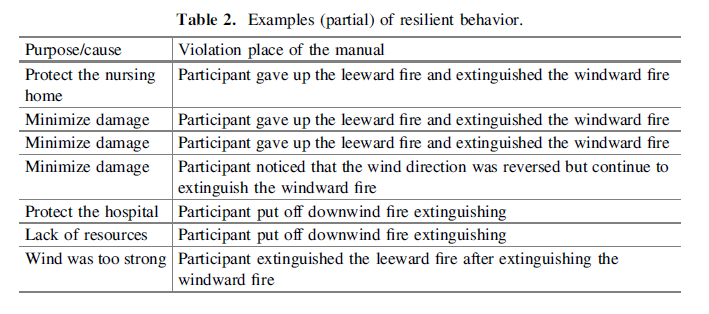
Failure of a task was regarded as when the fire spreads to more than 70% of the building/city. As noted above, successful responses were higher when people adaptively responded to the situation rather than rotely following the manual such that “there are few failures in cases with resilient behavior when the situation fluctuation is large” (p514).
Finally, the Big Five personality characteristics were assessed with participants. Openness scores were found to be statistically correlated with successful use of adaptive behaviour. Openness is “a characteristic that reflects the richness of imagination and curiosity” (p515).
These results suggest that people with higher openness personalities have more ease in adopting resilient behaviours and this is likely because “it was necessary to enrich imagination and curiosity in order to adopt those behaviors according to the situation and without relying on the manual” (p515).
As with any study, lots of expected limitations to consider.
Authors: Kubo, N., & Nakanishi, M. (2018, August). In What Conditions Do People Adopt “Resilient” Behavior for Safety?. In Congress of the International Ergonomics Association (pp. 509-516). Springer, Cham.
Study link: http://doi.org/10.1007/978-3-319-96089-0_54
Link to the LinkedIn article: https://www.linkedin.com/pulse/what-conditions-do-people-adopt-resilient-behavior-ben-hutchinson

 SafetyInsights.org
One thought on “In What Conditions Do People Adopt “Resilient” Behavior for Safety?”