In the world of decision making, thinking, intuition and risk, it’s safe to say that the somewhat negative view of bias and heuristics has become the modus operandi (e.g. the body of work by or inspired by Kahneman and Tversky…but important in its own right) compared to alternative & complementary perspectives.
Naturalistic Decision Making (NDM) and Recognition Primed Decision Making (RPD) provide different perspectives, as does the use of Fast and Frugal Heuristics (FFH).
This post aims to briefly highlight one complimentary perspective – FFH.
Heuristics are mental shortcuts, allowing people to make rapid decisions based on limited cues and FFH are one type of heuristics which use a structured framework to reach a goal.
Image 1 highlights several heuristics from sport and medicine:
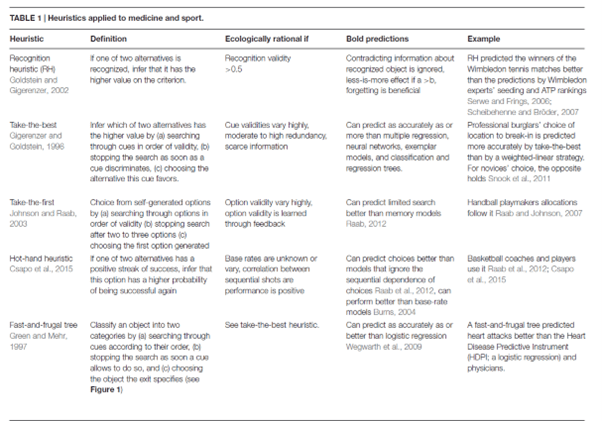
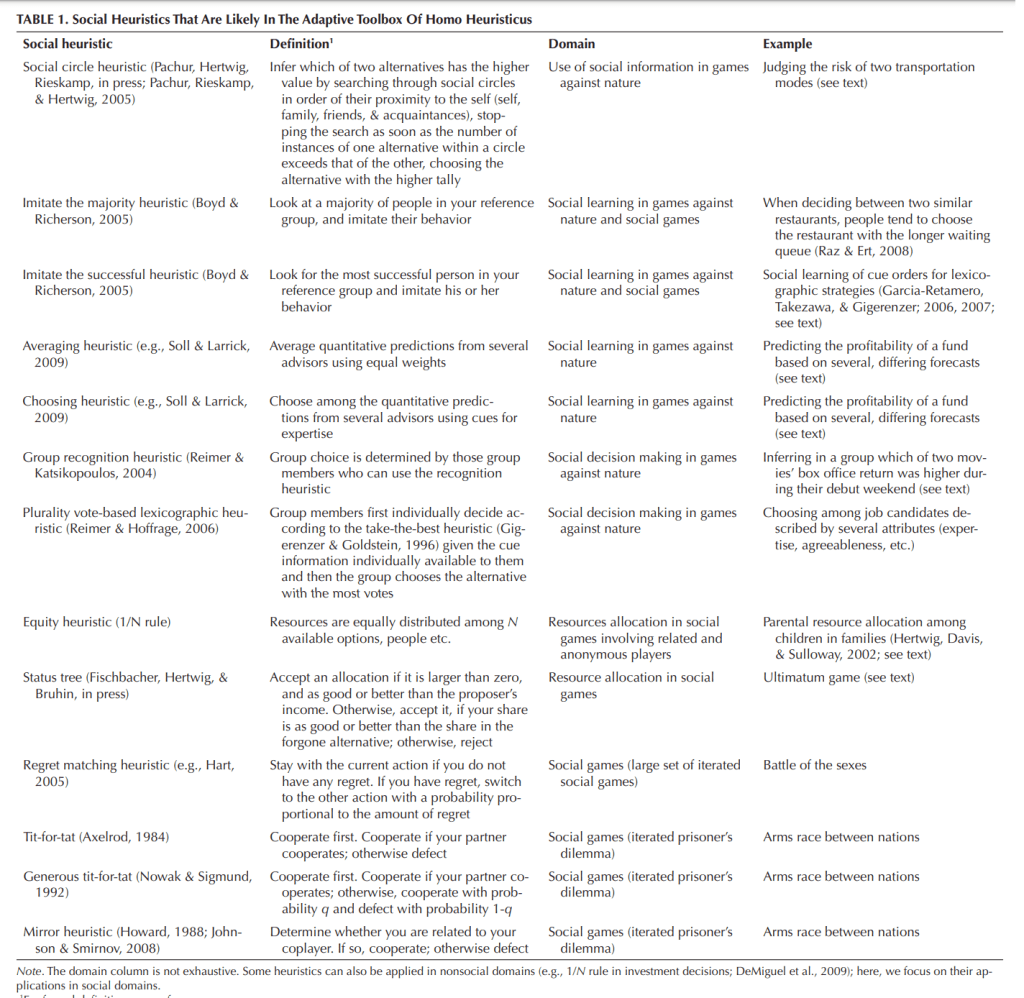
Image 2 highlights a bunch for guiding social interactions (there’s hundreds of FFHs, including in maintenance work, industrial plant operation, aviation, and everything in between).
An important use of structured FFH is in the domains of uncertainty.
A distinction is made between risk and uncertainty – risk describes situations where possible alternatives are known and consequences and probabilities can be calculated. Uncertainty describes situations where all possibilities and their probabilities aren’t known or are unknowable.
Classical decision making has a focus on known situations – risk. Calculating probabilities in gambles and lotteries for instance. This level of certainty is said to be rare in complex environments, like medicine, and likely many other organisational and social contexts.
FFH have three components:
1) search rules (where to look for info),
2) stopping rules (when to end the search) and
3) decision rules (how to make a decision).
Interestingly, FFH can outperform more rigorous calculative methods, like with predicting Wimbledon winners (e.g. using the ATP rankings is less predictive compared to simply choosing how well-known a person is by name).
In medicine, a simple heuristic which asks just 3 yes/no questions can outperform a chart with 50 probabilities (image 3).
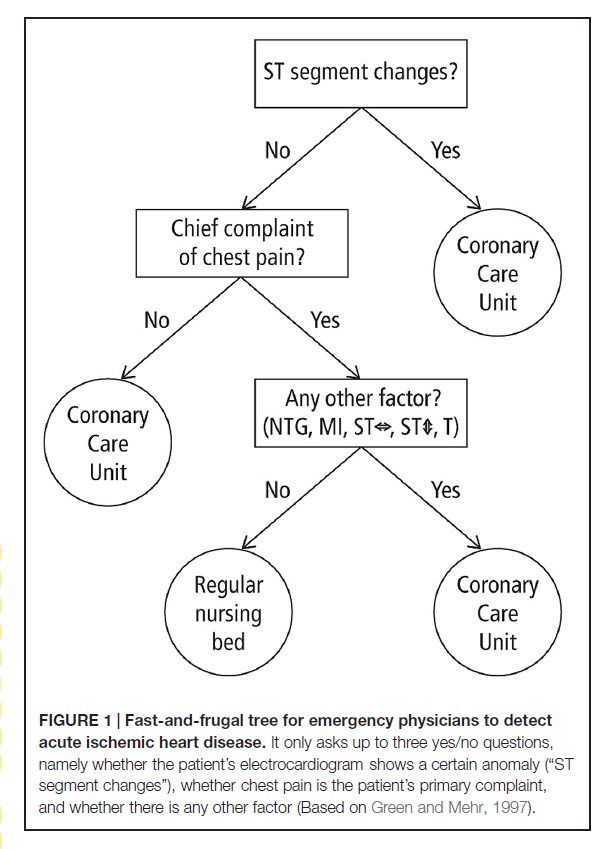
Image 4 provides a “Second revolution” on rationality. It posits that most human reasoning can be modelled by fast and frugal heuristics made with limited time and knowledge. They are “models of bounded rationality”.
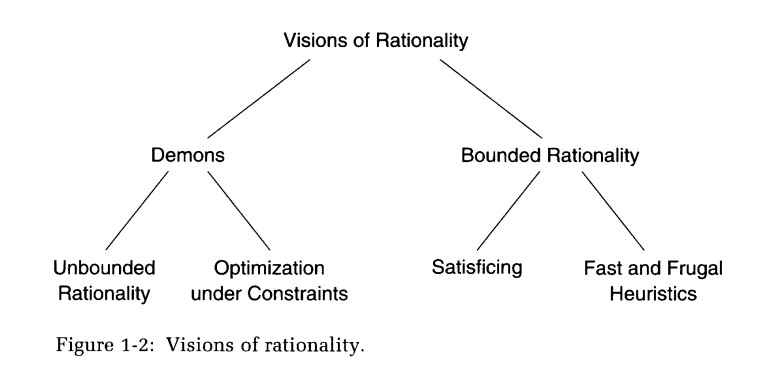
The ‘demons’ branch of unbounded rationality highlights the domain of deities – those without limits of cognitive capacity, time, finite knowledge. For the rest of us, mortals, our rationality is bounded by context and environment.
Regrettably, some popular models of decision making are better suited for our deities and not reflective of how people make sense of the world.
Sources below:
1. Raab, M., & Gigerenzer, G. (2015). The power of simplicity: a fast-and-frugal heuristics approach to performance science. Frontiers in psychology, 6, 1672.
2. Hertwig, R., & Herzog, S. M. (2009). Fast and frugal heuristics: Tools of social rationality. Social Cognition, 27(5), 661-698.
3. Gigerenzer, G., & Todd, P. M. (1999). Simple heuristics that make us smart. Oxford University Press, USA.
Link to the LinkedIn post: https://www.linkedin.com/posts/benhutchinson2_in-the-world-of-decision-making-thinking-activity-7006751954563461120-ylCY?utm_source=share&utm_medium=member_desktop

 SafetyInsights.org