The following data highlights the frequency and types of cognitive biases prevalent under two domains:
1) a range of accidents from nuclear, aviation, fire, transport and more, and
2) medical decision errors.
Note: Bias in this sense isn’t meant to indicate some human weakness or unreliability, but more simply, systematic deviations away from an “expected” judgement or outcome.
The following data highlights biases but I’ll dig up data in the future on the use of heuristics and their role in success.
Further, according to Gerd Gigerenzer, while “Homo heuristicus [i.e. humans] has a biased mind and ignores part of the available information”, a biased mind “can handle uncertainty more efficiently and robustly than an unbiased mind relying on more resource-intensive and general-purpose processing strategies” (Gigerenzer & Brighton, 2009).
Anyways, onto the data.
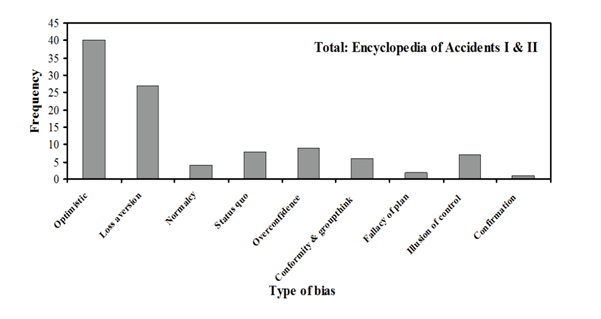
The first image shows a frequency distribution of cognitive biases or heuristics across 190 accidents. Optimistic bias (overconfidence leading to underestimating exposure to failures) and loss aversion topped the list.
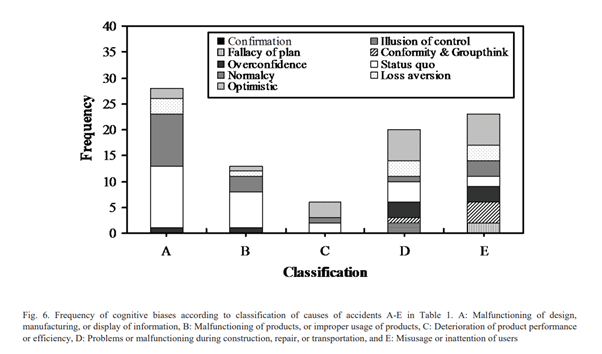
In the second image, the authors categorised the biases according to the classification of causes of accidents, e.g. malfunctioning of design, display of info etc.
Overall, they argue that humans are, of course, susceptible to cognitive misdirects and biases and as such “never behave rationally”.
However, not behaving “rationally” isn’t a slur, but rather people behave “arationally” (as notes Dr Rob Long).
Importantly, the authors conclude that their data supports the notion that “how we actually behave [arationality] is more important than how we should behave (rationality)”.
Finally, another study undertook a systematic review categorised observed medical diagnosis error types, image 3.
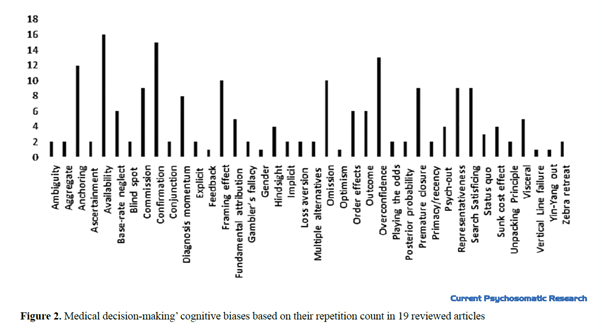
Another important insight from this data is that while cognitive biases are often framed as an individual problem, the study from image 3 suggests that at least half of these biases have their origins in system & organisational factors, e.g. workload, stress, workplace design, distractions, non-standardised processes and more.
Source:
1. Images 1 & 2: Murata, A., & Yoshimura, H. (2015). Statistics of a variety of cognitive biases in decision making in crucial accident analyses. Procedia Manufacturing, 3, 3898-3905.
2. Image 3: Farhadi, N., Ezati, M., Shojaie, A. A., Hatami, J., & Salehi, K. Cognitive Errors Associated With Medical Decision-Making: A Systematic.
Link to the LinkedIn post: https://www.linkedin.com/posts/benhutchinson2_the-following-data-may-interest-you-on-the-activity-7009300532280389632-ByuI?utm_source=share&utm_medium=member_desktop

 SafetyInsights.org