This data may be of interest on the links between daily sleep, weekly working hours and the risk of work-related injury based on US interview data.
[** Yes, interview data has limitations worth noting, for instance recall & memory issues]
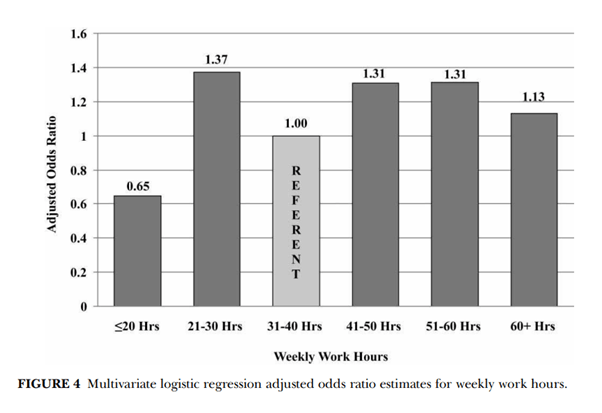
An odds ratio (OR) of 1 equals no difference in risk, whereas >1 is greater odds of an injury and <1 lower. An OR of 1.5 indicates 1.5 times the odds of an injury versus the referent value (the referent value is a baseline duration of sleep of 7 – 7.9 hrs per night).
In the first image the odds ratio of workplace injuries relative to usual sleep duration was quantified.
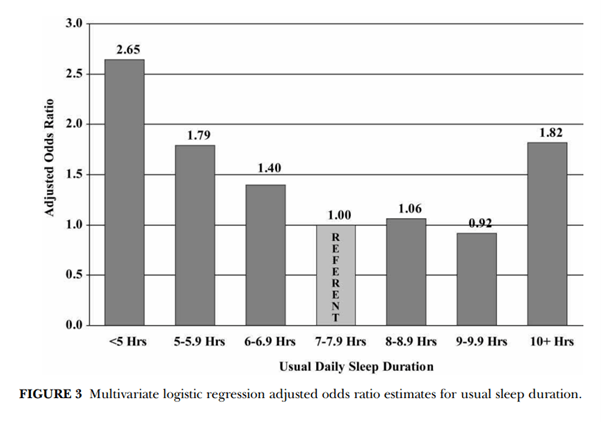
Predictably, the highest odds of a work-related injury was correlated with lower durations of nightly sleep. >10 hrs was also correlated with higher odds.
In the second image, injury was studied against weekly work hours, with 31-40 hrs the referent value. Compared to 31-40 hrs, again predictably, longer weekly hours was connected with higher odds of an injury.
Generally speaking, there is a 2-fold increased risk of a workplace injury in all categories more than 20 hours per week
For potential confounders, age had a significant negative association with injury risk, being female reduced injury risk, race/ethnicity and industry were marginally associated with injury risk, and education level wasn’t statistically significant.
BMI (body mass index) had a strong significant positive association with work injury risk.
Thus, decreases in usual sleep duration and increases in weekly working hours bot increased injury risk uniquely and independently.
They give an example of considering the risk factors simultaneously. For instance, “the independent additive risk of a work-related injury could be substantial. For example, comparing a person working >60 h/wk and a usual daily sleep duration of <5 h relative to a person working 31-40 h and sleeping 7-7.9 h, our model would yield an estimated adjusted OR = 3.12, or a 3-fold increase in work-related injury risk” (p1026).
Source: Lombardi, D. A., Folkard, S., Willetts, J. L., & Smith, G. S. (2010). Daily sleep, weekly working hours, and risk of work-related injury: US National Health Interview Survey (2004–2008). Chronobiology international, 27(5), 1013-1030.
Link to the LinkedIn post: https://www.linkedin.com/posts/benhutchinson2_this-data-may-interest-you-on-the-links-between-activity-7011116208578068480-z1O6?utm_source=share&utm_medium=member_desktop

 SafetyInsights.org
One thought on “Links between daily sleep, weekly work hours and injury risk”