This well-known and debated paper that explored major/fatal accidents in companies with and without a zero harm philosophy.
Fatal/major accident data was obtained from the UK HSE under a FOI request for 2011-12 to 1014-15. This was then correlated to the top 20 construction contractors in the UK by turnover.
Of the top 20 that adopted zero, 9 had an explicit zero policy in place. Six companies operated a safety program referencing zero, while the other three included clear statements around zero.
Providing background, the author notes:
· “Zero has become the biggest number in safety” (p1)
· Despite the prevalence of zero in industry, “the lack of an evidenced-based evaluation of Zero is surprising” (p1)
· Zero has been mobilised in many ways, zero harm, beyond zero, vision zero etc. Some position it as a ‘visionary journey’, adopted as a principle for organisational management and leadership rather than a specific goal. For others, zero is a specific target, with zero injuries, fatalities etc
· Some research found zero programs often position it as a tangible goal – something which can be counted and measured through a “plethora of targets”
· However, this “utopia was challenged and even derided by the construction workers themselves, for whom the lived realities of their working lives tells them Zero is, and is likely to remain, a utopian fantasy, totally incompatible with the current challenges of production that they face on a daily basis” (p3)
· Critics believe zero may stymie open dialogue and learning in organisations. Proponents argue that many construction organisations have zero ‘wrong’, and focus on the numbers instead of the vision to inspire real change and innovation in practice
· Despite the calls for a focus on the vision over numbers, it’s argued that “such innovative change cannot readily be identified in UK construction safety management; there has been a lack of identifiable development in work practices beyond the simple application of ‘Brand Zero’” (p3)
· Others argue that zero, in any form, can act as a distraction because of its “allure of … measurement” (p4). Thus, zero, in their view, creates a “misdirection in efforts to cease all harm rather than the harm that really matters … and stifling both learning and reporting in an industry which already struggles to report its accidents and incidents in an honest and timely fashion” (p4)
Results
Overall, this dataset suggests that “working on a project subject to a zero safety policy or programme actually appears to slightly increase the likelihood of having a serious life-changing accident or fatality” (p1), what they’ve called a “zero paradox”.
*** Note, the authors were careful to highlight both the limitations of the study dataset and that they make no claims about causality. We know of the statistical issues of incident data validity and also the possibility of other explanations (e.g. more hazardous companies may be more likely to adopt zero as a response).
Specific data was:
· Four fatal accidents occurred in zero companies
· No fatal accidents occurred in non-zero companies
· There were 214 major injuries for companies with zero
· There were 135 major injuries for companies without zero safety
· When correlated to the volume of work, there were 7 major/specified accidents per billion turnover for those with zero, and 6 accidents per billion turnover for those without zero.
Taken together they argue that a zero paradox could be in play, where you are marginally more likely to be involved in a major accident while working on a zero project compared to non-zero or as they aptly state, being involved in a zero affiliated UK construction project could “actually [mean] a greater risk of injury (or death) in practice” (p6).
[**Note: With such a small difference between adopters and non-adopters, it’s difficult to know whether this is actually a real statistical effect.]
It’s said that based on this data, zero approaches would struggle to be labelled a success, with more accidents rather than fewer under a “zero safety banner” (p6).
Next they provide a time plot of fatal/major accidents within companies following the introduction of zero. This data highlighted mixed results.
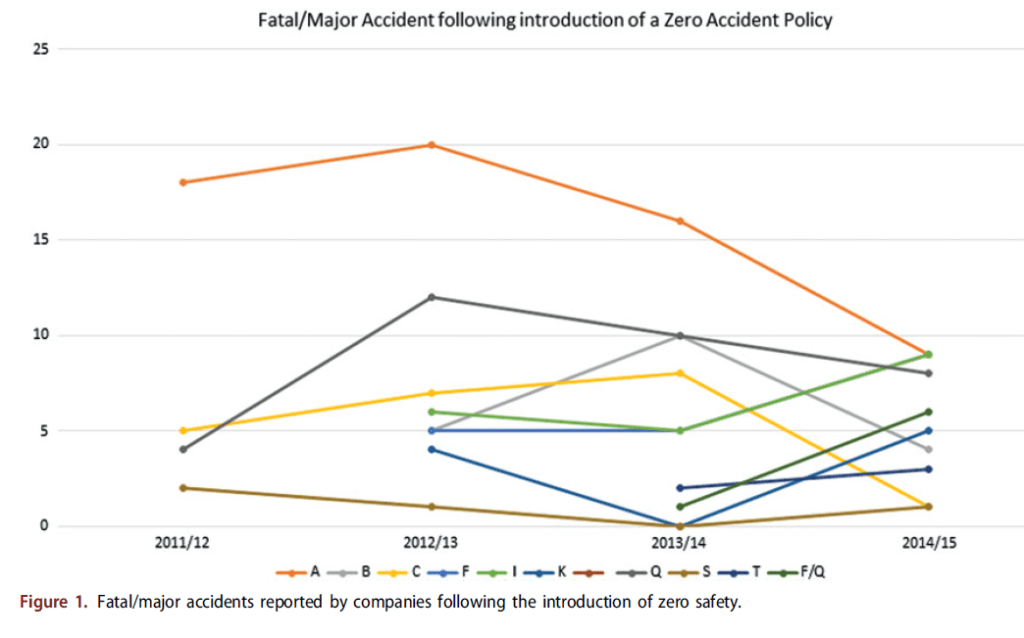
More importantly, to suggest that a zero approach may negatively impact safety is probably overemphasising the impact of zero in practice. Rather, one could argue that zero doesn’t appear to have made a significant contribution to “any improvement or decline of the industry’s safety performance” (p7); good or bad.
That zero possibly hasn’t made positive or negative contributions to practice “suggests that the rhetoric of Zero is masking the reality of construction site safety programmes which are neither innovating nor developing in their thinking or practice, beyond the application of this new branding” (p7).
[** On the above, some may possibly argue that this is no different to many other approaches or philosophies in safety, such as the new views. There’s also the statistical issues of using incident data.]
The author suggests that, perhaps, the UK construction industry simply isn’t mature enough for zero as either a target or vision. However, considering the findings of this study, it’s possible that “the dis-benefits outweigh the benefits” and again perhaps, “Zero is causing more harm than it is able to prevent” (p7, emphasis added).
Author: Sherratt, F., & Dainty, A. R. (2017). Policy and practice in health and safety, 15(2), 108-116.
Study link: https://doi.org/10.1080/14773996.2017.1305040
Link to the LinkedIn article: https://www.linkedin.com/pulse/uk-construction-safety-zero-paradox-ben-hutchinson

 SafetyInsights.org
One thought on “UK construction safety: a zero paradox?”