Another couple of apparent myths from Besnard and Hollnagel’s 2012 paper.
This time they argue that two assumptions are:
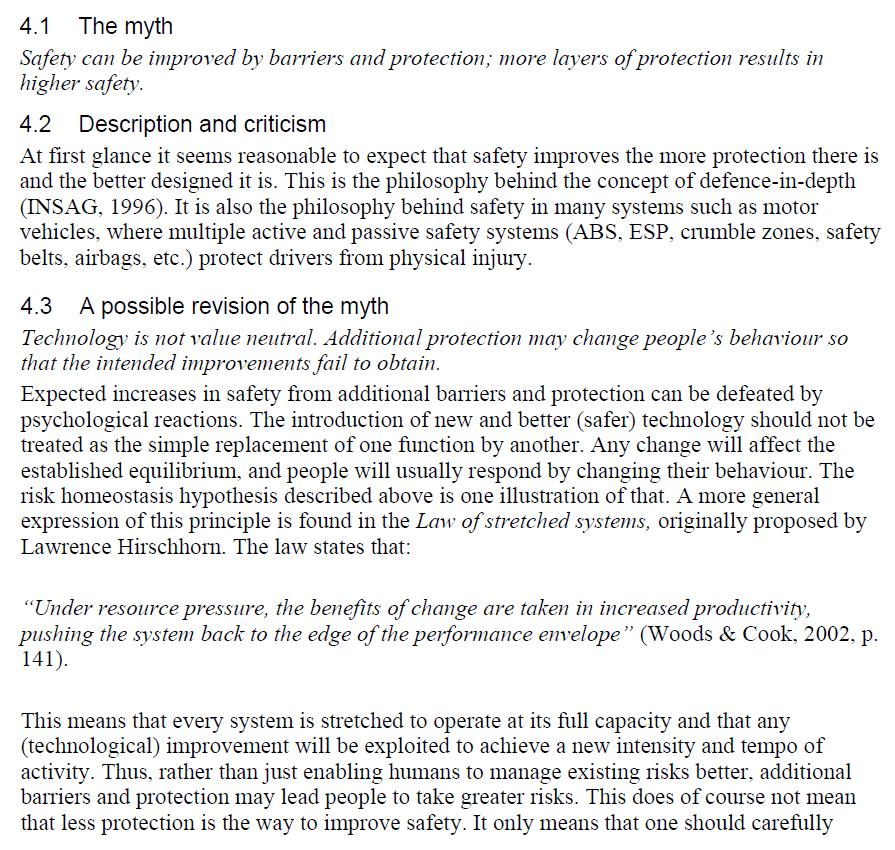
1) Safety can be improved by barriers and protection; more layers of protection results in higher safety
· In this example, the argument draws on risk homeostasis from Wilde, which hasn’t stood the empirical test of time. However, if you look past homeostasis, there is demonstrable behavioural adaptation across a range of studies.]
· Also note that they’re not arguing that we shouldn’t add layers of protection, controls or interventions but rather ensure we carefully consider its use and by-products (something I think systems engineering has been good at but not so much health and safety).
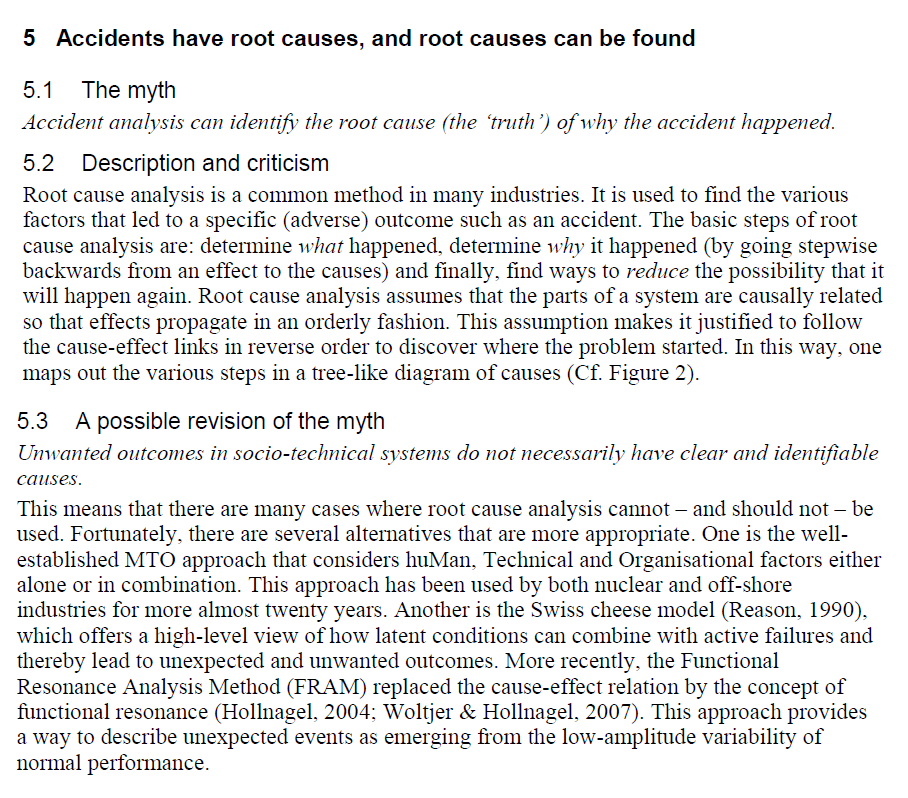
2) Accident analysis can identify the root cause (the ‘truth’) of why the accident happened
· Although they’re talking about particular relationships that are non-linear and/or non-deterministic (for practical purposes), this isn’t to argue that all relationships or issues we face will be non-linear.
· In this sense I really like how Cynefin explicitly clarifies different domains: clear, complicated, complex, chaotic.
Source: Denis Besnard, Erik Hollnagel. Some myths about industrial safety. 2012. <hal-00724098v1>
Study link: https://hal-mines-paristech.archives-ouvertes.fr/hal-00724098v1
Link to the LinkedIn article: https://www.linkedin.com/posts/benhutchinson2_another-couple-of-apparent-myths-from-besnard-activity-7024137013280854016-3ipv?utm_source=share&utm_medium=member_desktop

 SafetyInsights.org
One thought on “Myths of risk control & accident causality: Besnard & Hollnagel 2012”